





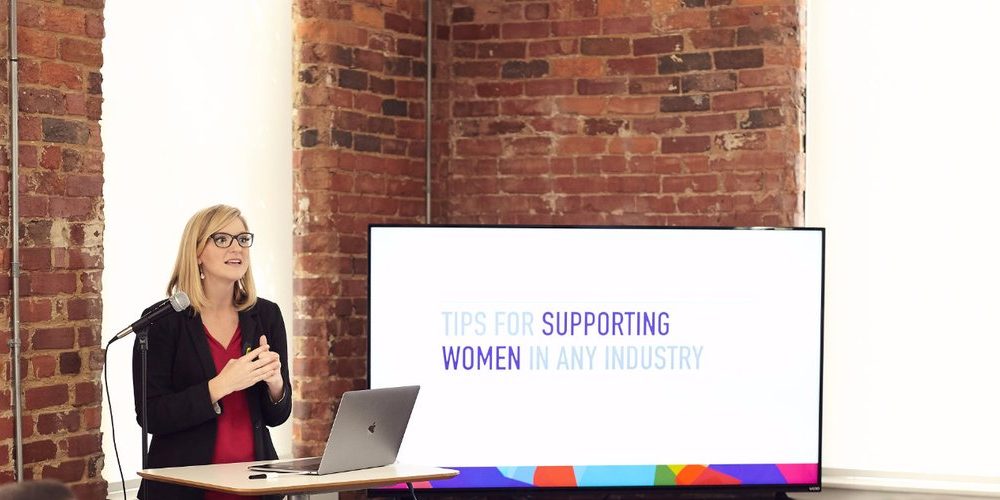
Today we’d like to introduce you to Emily Maxie.
Emily, can you briefly walk us through your story – how you started and how you got to where you are today.
When I was growing up, I had a lot of different answers for the question, “What do you want to be when you grow up?” When I was young, I wanted to be a teacher or a swim instructor. Later on, I wanted to be a nurse or a magazine editor. But there was always one thing I knew for certain — I wanted to work.
When I was five years old, I begged my mom to let me get business cards for my pretend business that sold cat toys. When I was ten, I hosted yard sales, handling everything from the promotion (making signs and advertising in the paper) and sourcing items (going through our junk drawers and playroom to find items that wouldn’t be missed) to pricing strategies. When I was 12, I called listings in the classified ads and was outraged that no one would hire someone my age.
In college, I pursued a journalism degree and absolutely loved it. Journalism (I had learned from the movies) was an appropriate place for women to be unapologetically driven. I quickly rose up the ranks at my school newspaper from reporter to managing editor to editor-in-chief. I took each role seriously as if each piece I wrote could be nominated for a Pulitzer.
And then, the spring I was set to graduate, the newspaper industry was hit by the biggest disruptor it has ever seen — the introduction of the first iPad. Suddenly, news was available at readers’ fingertips instantly for free. Newspapers across the country suffered massive layoffs. And I was applying to work for these newspapers. I distinctly remember the response to an internship application I sent to a newspaper in Virginia:
“The newspaper industry is in a death spiral that does not hope to abate soon, if ever,” the letter said. The paper’s editor went on to say that if I were willing to work for free for the summer, they’d welcome my help. Unfortunately, that wasn’t an option for me because I needed a job where I could support myself. I applied to more than 200 jobs during my last semester in college. I got one interview. One job offer. And suddenly, I was moving to Hickory, NC to be a page designer and copy editor at a centralized editing center. Not exactly my dream job, but beggars can’t be choosers.
I still wasn’t ready to give up on my dream of being the next Woodward or Bernstein, so I asked my boss if it’d be ok if I freelanced for the local paper on my days off. He said yes, and I started freelancing (emphasis on the “free”) on the days I wasn’t working at the editing center. I was given the stories any cub reporter would get — a new data center was opening in the area, veterans get discounts for Veterans’ Day, etc.
Ultimately, after a year and a half of working two jobs and barely making enough money to feed myself and pay my rent, I’d had enough. I decided that journalism — while a worthy profession — just wasn’t for me. I couldn’t see myself working strange hours (most days I worked 12 pm to 10 pm) and weekends for the rest of my life.
I decided to move home to Chattanooga and landed a job as a magazine designer at a publishing house. While there, I started designing an iPad version of the magazine I worked on. And when a colleague of mine went to work at another job, she brought me along with her. I got a significant pay raise and a lot more freedom.
But what seemed like an ideal situation quickly turned sour. The CEO was at best indecisive and at worst manic. He berated me publicly about work he had already approved. It was the most toxic work environment I’ve ever been in. I needed to get out, and I was much less picky about where I went than I’d ever been before. And that’s when I first entered marketing. I saw a role for a marketing specialist at a technology company, and I noticed that a lot of the job responsibilities were firmly in my wheelhouse — writing and design. I applied, and to my amazement, I got an interview and landed the job.
I found that I loved tech marketing. It has just the right blend of the “just the facts” nature of journalism along with a need for big-picture strategic thinking. It also offered me a greater variety than I’d ever experienced before. I thought to myself, “This is a good job. I’ll probably be a marketing specialist for the rest of my career, and I’m good with that.” Then, my company hired a female executive (before that, I was the only woman at the company). And she said six simple words that changed my career path: “I see leadership potential in you.”
Leadership? Me? But leadership is for men. Strong, gruff men who treat me like one of their daughters. But those words stayed in my head, and ever since then, I’ve been striving to increase my influence by taking on more and more leadership roles. Now, as a VP of Marketing (working hard to become a CMO someday and maybe a CEO after that), I can’t imagine what my life would be like if I hadn’t gotten that piece of feedback — if I hadn’t realized that leadership was an option for me. It’s such a core part of who I am (and who I’ve always been, I can see now).
Overall, has it been relatively smooth? If not, what were some of the struggles along the way?
No, the road hasn’t always been smooth. Early in my career, I had to fight hard to get my foot in the door. Later on, I had to learn how to manage up, advocating for myself and for marketing to leadership teams that didn’t see the value in my work. I got laid off from a job I’d put blood, sweat, and tears into. But all of those things have led me to where I am now — at a company that truly values me, invests in my professional development, and pushes me to be my best self.
My advice for women just starting their journey is to teach yourself grit. You’re going to be pushed around and sometimes knocked down. Get back up. Learn from it, and keep moving forward.
Please tell us about Very.
Very is a full-service IoT development agency that helps companies bring IoT products to market. We have a stellar team of senior designers and software engineers, plus mechanical and electrical engineers, who can handle the full spectrum of work needed to build smart products. Other firms offer software development services or services that focus on building hardware. We bring the two disciplines together seamlessly.
Contact Info:
- Website: www.verypossible.com
- Email: emily@verypossible.com
- Twitter: @emilymaxie


Suggest a story: VoyageATL is built on recommendations from the community; it’s how we uncover hidden gems, so if you or someone you know deserves recognition please let us know here.
Popular
-

Hidden Gems: Local Businesses & Creatives You Should Know
-

ATL’s Most Inspiring Stories
-

Portraits of Atlanta
-

Alexander Lewis on Betting on Himself, Building Momentum at Coco Studios, and Turning Opportunity into Ownership
-

Satoya Hayes on Turning Beauty 2 Extensions into a Platform for Affordable Confidence and Entrepreneurial Opportunity
-

Asha Ford on Building Krystal Klear Motion and Creating Purpose-Driven Design for Women