




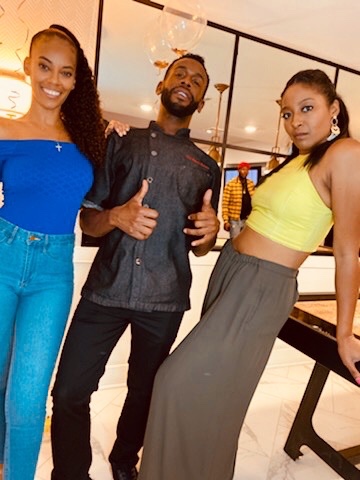
Today we’d like to introduce you to Roberto Small.
Hi Roberto, please kick things off for us with an introduction to yourself and your story.
My career in hospitality began in 2009 at the Chart House, where I started as a host at just 17 years old. I began in the front of the house, but I was constantly learning from and spending time with the servers. As soon as I turned 18, I was promoted to server, a role I held through my high school graduation.
Later that year, I enrolled at Johnson & Wales University in Miami to pursue culinary school. Because I was paying for school out of pocket, working was essential. During summer breaks, I returned home and worked as a server at The Cheesecake Factory in Tysons Corner. When classes resumed, I transferred to the Cheesecake Factory at Aventura Mall in Miami, continuing to support myself through school.
Culinary school exposed me to every side of the industry—cooking, bartending, and service. One of my instructors once told me, “Roberto, you’re a great chef, but I think you’ll ultimately end up in front of the house because of your personality.” She was right. Throughout my college years, I worked as a server in a variety of high-end restaurants and luxury hotels across Miami—not just to pay for school, but because I genuinely loved it.
During that time, I had the opportunity to work at prestigious properties including the Mandarin Oriental, the Fontainebleau Hotel, and the opening team of the Nobu Hotel and restaurant in Miami. These experiences gave me a deep understanding of luxury service, consistency, and guest experience at the highest level.
In 2017, I moved to Los Angeles to be part of the opening team for the Waldorf Astoria Beverly Hills, while also pursuing my career as a private chef. A few months after arriving in L.A., I cooked for Eric Bellinger, who is Megan Good’s brother-in-law. That opportunity led to me becoming the private chef for Megan Good and Devon Franklin. I worked closely with their family for nearly five years, building trusted relationships and refining my skills in personalized, high-level private dining.
While Megan was filming Harlem in New York, I relocated to New York City to continue working with her, while also serving at Zuma New York. Balancing private chef work with restaurant service further strengthened my adaptability and understanding of both personal and high-volume dining environments.
In late 2023, my brother and I partnered to launch our own business in Miami: Yakitori Yatai. This marked our transition into entrepreneurship. We specialized in yakitori—Japanese grilled chicken skewers—along with vegetables, sides and original dishes we developed ourselves. What began as a single pop-up at one bar in Coral Gables grew steadily. Within a year, we were operating regularly at eight different bars across the city.
We ran Yakitori Yatai through late 2023 and all of 2024 before deciding to pause operations temporarily. One of the biggest lessons I took from that experience was the importance of marketing. Being surrounded by other entrepreneurs made it clear how much intentional investment—both time and money—successful businesses put into marketing to sustain growth.
Today, I’m based in Washington, D.C., exploring the launch of my next business venture. My focus is on applying everything I’ve learned—from fine dining and private chef work to pop-ups and entrepreneurship—while placing a much stronger emphasis on branding, marketing, and long-term growth.
Can you talk to us a bit about the challenges and lessons you’ve learned along the way. Looking back would you say it’s been easy or smooth in retrospect?
It definitely has not been a smooth road. I mean, as grateful as I am, and as much as I look forward to the future and what I’m doing, this is definitely a rocky road.
Some of the struggles really are just doing everything on your own without having a corporation behind you, a big team behind you, investors behind you, or anything. So when I was doing Yakitori Yatai, and it was just me and my brother.
Cooking Japanese food is tough when you’re getting a lot of your ingredients shipped from Japan. We were getting binchotan charcoal shipped in at 80 bucks a box from Japan. We were getting Japanese citrus, Yuzu shipped in from Japan. at 70 bucks per liter.
And when you only have two people, it’s up to you to do 100% of the task. So even when you’re professional and you know how to cook, you just end up going through a rocky road of struggles doing everything on your own. And any excuse that you have ultimately falls on you. And so to not have corporate to call for certain things, to not have HR to call certain things, to not have health insurance because we no longer work for a corporate company had exstrealy hard. So all that was new to us and to myself, and it was just a big struggle because anything that we wanted to make happen, good or bad, we had to figure out ourselves. And so there was no calling out and knowing other employees were going to do X, Y, and Z. There was no blaming it on someone else if we were late for something or if something didn’t come in food and beverage-wise. Everything fell under us, and that is always and will always be a big struggle.
Thanks – so what else should our readers know about your work and what you’re currently focused on?
Chef Roberto Antonio is a Hollywood-based private chef known for his refined, seafood-forward cuisine and globally authentic cooking style. A pescatarian since relocating to Los Angeles in 2017, Chef Roberto has built a distinctive culinary identity rooted in his deep respect for seafood—while maintaining mastery across a wide range of international cuisines.
Raised around food and inspired from birth by his father, a professional chef, Roberto always knew the kitchen was his calling. He honed his skills at Johnson & Wales University, where he developed a strong foundation in classical technique and global culinary traditions. That formal training, paired with real-world experience, allows him to cook authentically across cultures—something not every chef can truly claim.
While many expected him to follow the traditional restaurant path, Chef Roberto realized early on that his passion lay in a more personal, elevated experience. His vision was clear: to become a private chef in Hollywood. After graduating, he moved to Los Angeles, secured work in Beverly Hills, and ultimately achieved his goal of cooking for high-profile clients in Hollywood—turning a long-held dream into reality.
Today, Chef Roberto is a trusted name in elite culinary circles. He has been requested to work for nearly every major award show in Los Angeles, including the Oscars, Grammys, Golden Globes, Emmys, and Critics’ Choice Awards. These opportunities reflect not only his technical skill, but also his professionalism, discretion, and ability to perform at the highest level under pressure.
Chef Roberto takes immense pride in the reputation he has built—one defined by passion, precision, and authenticity—and continues to elevate the private dining experience through thoughtful, world-class cuisine.
One thing that truly sets me apart is that I am just as trained, experienced, and passionate about front-of-house service as I am about back-of-house execution. My ability to step seamlessly between the kitchen and the dining room allows me to oversee a restaurant as a complete operation, not just a single department. I understand service, guest experience, communication, and hospitality at the same level that I understand technique, flavor, and execution. This dual perspective allows me to educate, lead, and elevate both front- and back-of-house teams—something not everyone is able to do at a high level, let alone with genuine joy and passion.
Do you have any advice for those just starting out?
One of the most important things I can stress is the need to save intentionally for your business and to develop it strategically. Early on, most—if not all—of the financial responsibility will fall on you if you do not have a loan or an investor, so being smart about where you allocate your money, particularly in marketing and long-term investments, is critical. Equally important is staying encouraged. There will be moments that feel like major setbacks or unexpected obstacles, but those experiences are valuable learning opportunities rather than reasons to become discouraged. When approached with the right mindset, they contribute to both personal growth and the development of a stronger, more resilient business. Passion is essential, but it must be paired with realism—there will be hurdles along the way. If you remain self-aware, adaptable, and committed to continuous evaluation and improvement, there is truly light at the end of the tunnel.
Contact Info:

Popular
-

Hidden Gems: Local Businesses & Creatives You Should Know
-

ATL’s Most Inspiring Stories
-

Portraits of Atlanta
-

Natasha Dillard on Redefining Beauty Standards and Empowering Women Through Unapologetic Self-Expression
-

Darren Paltrowitz on Blending Investigation, Media, and Culture to Uncover the Stories Behind the Stories
-

Naeemah Jade on Redefining Networking Through Trust, Proximity, and Intentional Community