




Today we’d like to introduce you to Ashlyn Pope.
Ashlyn, we appreciate you taking the time to share your story with us today. Where does your story begin?
I started drawing at two years old and as my mother tells it, she couldn’t pry the pencil from my hands. As I got older, I grew more interested in the art world, becoming intrigued by the ways in which art could communicate and connect people all across the world. As an undergraduate at Kennesaw State University, I began to discover my voice and it is where I discovered the artistic medium that would forever change the course of my life. While attending Kennesaw State, under the instruction of incredible professors, I fell in love with clay as a medium. After graduating, I took a job teaching art at the Art- Station: Big Shanty in Marietta, GA where I discovered my joy in teaching. I fell in love with teaching students of all ages, finding that their enthusiasm to learn the arts only inspired me and challenged me to be a better artist, educator and person. That journey propelled me to pursue a graduate degree in ceramics where I gladly attended The Pennsylvania State University, more lovingly referred to a Penn State. After graduating, I pursued other art opportunities that showed me that I loved collaborating with community just as much as I loved teaching. Today, I am an artist, Assistant Professor in Visual Arts at Coastal Carolina University as well as the Associate Director of the Charles Joyner Institute for Gullah and African Diaspora Studies.
Can you talk to us a bit about the challenges and lessons you’ve learned along the way. Looking back would you say it’s been easy or smooth in retrospect?
This journey has not always been smooth. There were many moments where life creeped in and threatened to permanently set me on a different course. I did not grow up in an economically stable world and as an artist, there were many moments where the lack of resources would keep me from pursuing the thing I loved most in this world. I remember distinctly, after graduating from Kennesaw State and before I started teaching at the Art- Station: Big Shanty, that I feared I wouldn’t be able to continue the pursuit of my happiness. I had no money, I didn’t have a job yet and I had lost access to all of the tools I needed to make ceramic work. I knew that getting a job outside of the arts could and likely would land me in a position that would divert my making of art over time. I also knew without resources, the joy I had in creating would fade into the world of adulting. I had to find ways to gain resources. Eventually, I did find resources by being willing to reach out to local ceramic businesses that would allow me to fire my work either through trade of time or small fees. Staying focused and being willing to veer from the path to find a new route to the same goal, no matter the goal, allowed me to stand where I am today.
As you know, we’re big fans of you and your work. For our readers who might not be as familiar what can you tell them about what you do?
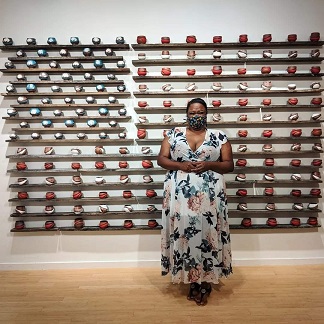
I am an artist that specializes in ceramic wares. My work blurs the boundaries between functional and sculptural ceramics while also existing as a tension between content and function. The content of my work can be socially and emotionally deep but its physicality is visually beautiful and useful. The content of the work focuses on connecting my personal experiences to the broader experiences of being a Black body in America. Drawing from Black history across the diaspora with a strong focus on American history, Art history and contemporary issues.
I am known for my pieces inspired by my Gullah/Geechee ancestry. My pieces utilize elements of sweetgrass baskets, an art form of my ancestors, recreated in clay. As a connection point to my own work, I look the evolution of the sweetgrass basket from a functional item to an artistic art form.
As an artist, I am most proud of finding my voice in the material. Being able to communicate experience through an inanimate object/objects. As a person, I am most proud of the growth that art has inspired within me to be a more empathetic individual who cares for others and their voices.
So, before we go, how can our readers or others connect or collaborate with you? How can they support you?
People can collaborate with me and support me by supporting the initiatives that are dear to my heart. The Charles Joyner Institute for Gullah and African Diaspora Studies is a place centered on elevating the voices of marginalized groups and specifically focused on those from the Gullah/Geechee communities. Financially, we could always use more help and socially we are always looking for those interested in collaborating/participating in events. Artisans of various media, researchers of the Gullah/Geechee people or the African Diaspora who want ways to share their research or people who wish to just lend a hand are all welcome.
As an artist, people can support me by being a collector of my artwork. I make work to end up in homes and therefore, my work is always looking to exist in your home.
Contact Info:
- Email: [email protected]
- Website: ashlynpope.com
- Instagram: https://www.instagram.com/ashlynpope_art
- Facebook: https://www.facebook.com/ashlyn.pope.773


Image Credits:
Image with me in front of the flag: Kyla Strid All other images: Ashlyn Pope
Popular
-

Satoya Hayes on Turning Beauty 2 Extensions into a Platform for Affordable Confidence and Entrepreneurial Opportunity
-

Hidden Gems: Local Businesses & Creatives You Should Know
-

ATL’s Most Inspiring Stories
-

Portraits of Atlanta
-

Asha Ford on Building Krystal Klear Motion and Creating Purpose-Driven Design for Women
-

Truth in Every Verse: Jay Erve on Identity, Experience, and Creating Art That Lasts