



Today we’d like to introduce you to Sarah Dolezal.
Hi Sarah, it’s an honor to have you on the platform. Thanks for taking the time to share your story with us – to start maybe you can share some of your backstory with our readers?
My secret passion developed in first or second grade when I was about 5 or 6. My family lived in New Orleans and regularly watched “Murder, She Wrote,” starring Angela Lansbury as Jessica Fletcher, a renowned murder-mystery author. Jessica seemingly fell into detective work, solving murders wherever she traveled away from her homes in Cabot Cove, Maine, or New York City.
I longed to use her typewriter; the sight and sound of Jessica’s fingers striking the keys during the opening credits sparked something inside me.
I also wanted to become as observant as she was, picking up on obscure details that connected the dots to the murderer’s identity. The murderer would reluctantly confess their guilt and motive after Jessica summarized the events and shared her observations in the show’s last few minutes. She pushed the culprits into a corner where they could no longer defend themselves or blame others for their wrongdoings.
Of course, Jessica always knew what to say and how to say it in every social and professional setting. She seemingly smoothed over rough scenarios, such as when anyone, including the bigwigs in her environment and law enforcement, downplayed her ability to bring justice to those who committed the murders. Every once in a while, folks did trust Jessica’s judgment and insights and relied on her to solve the murders.
Watching the closing moments of the opening credits, when a large, maroon leather-bound book with bold gold lettering embedded with the show’s title, “Murder, She Wrote,” closes, as if Jessica’s story is ready for publication, inspired me to dream of my writing accomplishments.
I just wanted to complete a writing project that meant something to me, perhaps to someone else, to anyone willing to listen.
Although I started journaling in my diary, hidden beneath my mattress, in third grade, I also immersed myself in ballet, violin, and choir, both in lessons and performances. My family moved to Athens, GA, the summer before I started the sixth grade, entering middle school for three years.
After graduating from middle school and completing a summer ballet workshop in New Orleans, I attended a private arts high school in Michigan on scholarship during my freshman and sophomore years. Eventually, I integrated jazz and modern dance into my studies. I returned to Athens, where I finished high school at the local public school.
My journey with playing the violin and singing gradually waned. I replaced my musical performances and lessons with consistent journaling throughout high school, after graduation, and beyond.
I developed my writing skills by reading poetry, starting in middle school. Oftentimes, before I fell asleep at night, I would read from a slim selection of poetry books, tucked in my nightstand, by dead women, such as Emily Dickinson and Elizabeth Barrett Browning. I’ve kept those books because I’m a level-three hoarder.
I tried my hand at poetry for decades, influenced by the women who came before me.
Yet, I rarely shared my writing unless I had to for school assignments. I took a poetry course during my first few years in college in Miami, where I studied and wrote poetry. I also first presented my poetry work in front of my classmates and instructor for a sociology class, around the same time.
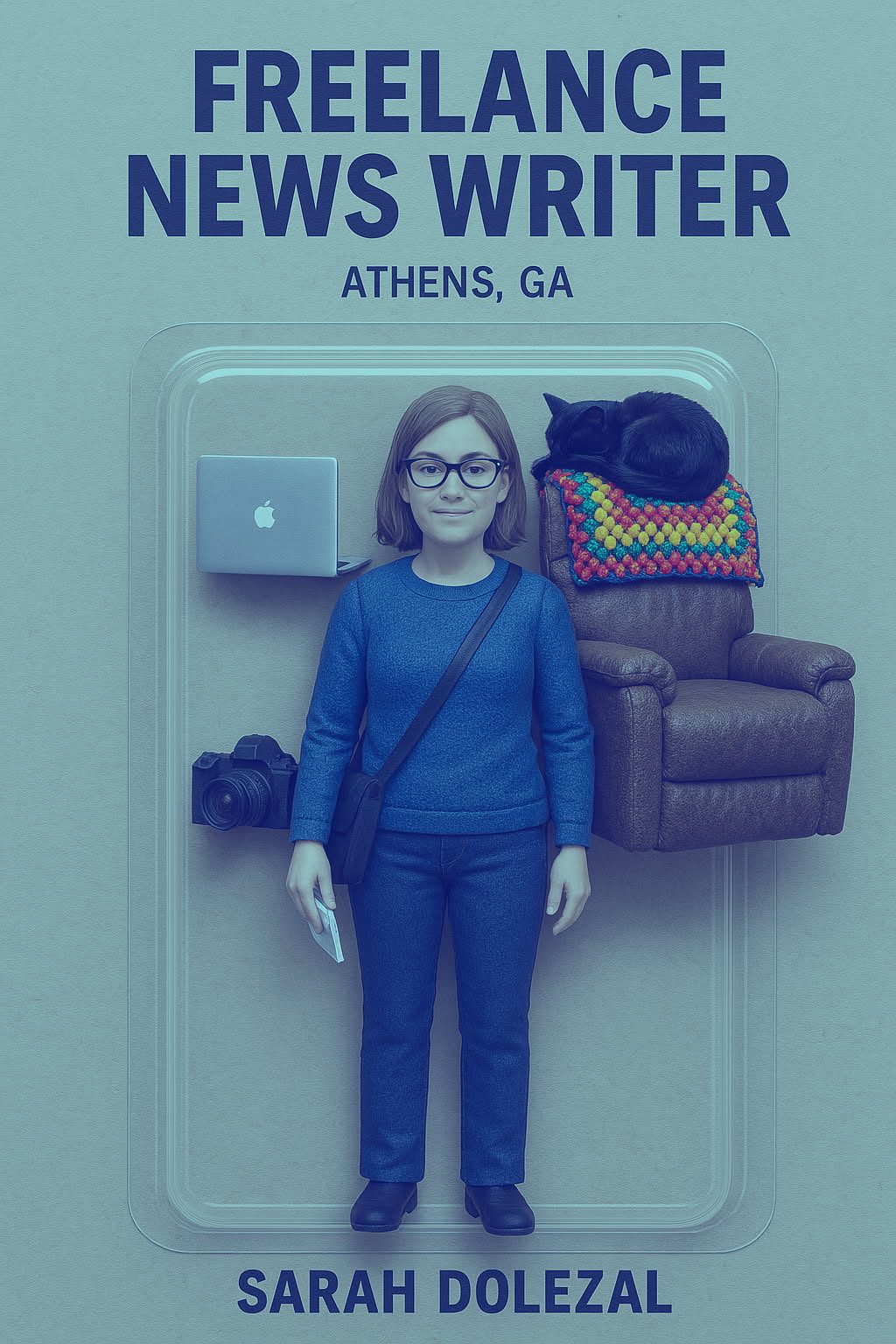
During my decades of writing escapades, I never thought I’d make a living writing. But here I am, today, sitting in my new armchair rocking recliner with my black cat lounging on my lap (we’ve negotiated on sharing our space), clicking away on my laptop on a Sunday afternoon.
I’m a writer.
We all face challenges, but looking back would you describe it as a relatively smooth road?
What got in the way of starting a writing career before March 2020?
From my perspective, the medical profession dropped the ball by overlooking girls and women for decades, failing to recognize that they, too, may also live with ADHD. (Yes, some of those born as females have been diagnosed and treated for ADHD, however, I assume that those females were outliers.) Academic and other expert research found that ADHD is not just a lived experience by young boys who can’t sit in their chairs at school, for example.
As an adult, and during my childhood and teenage years, I hit rock bottom mentally and emotionally at least five times before being diagnosed with ADHD in 2017. I burned out; over time, I descended into a maelstrom of painful anxiety and depression.
I kept going anyway, like an incessantly screeching stainless steel cog. I failed to set boundaries to manage my workload. My perseverance and stubbornness in pushing forward despite my unseen struggles only worsened my mental and physical health.
The relentless cog has kept spinning inside my chest and stomach for decades. The incessant screeching wheels cultivated layer upon layer of anxiety, low confidence, butterflies in my stomach, along with various emotions such as frustration, guilt, and mourning.
I first learned about the possibility of living with ADHD during a pre-screening psychological assessment as a non-traditional college student in 2014. I lived with horrible anxiety, mismanaged emotions, and mental anguish that got in the way of reaching my goals. I knew what success looked like; I knew I never got there.
Unfortunately, I quit the process because, first, the assessor interrupted me during my unofficial evaluation. I painstakingly voiced my thoughts, starting with my recent experiences, about my current failed state and my childhood struggles with school and personal relationships. He just interjected his opinion as I spoke and eventually said, “Wow, there’s so much going on with you.”
I felt angry. I felt trapped. Now I wonder why I remained obedient while I stayed, listened, and engaged with him instead of ending our session and leaving. I felt obligated to appease him and his process.
Then, I found out from the administrators at the disability office that to receive a full psychological assessment, I would have had to take tests for over four hours at a time across multiple sittings. I felt verklempt, or overwhelmed, by the idea of adding more tasks to my plate. I already continuously felt stressed about schoolwork and working throughout undergraduate school.
“How could I go through the testing process?” I silently asked myself. “I have to study and do school projects. I don’t have time for all this testing. Ugh.”
I finally sat down and finished the full psychological assessment in the summer of 2017 in Washington, D.C., as a graduate student for my second time around at the same school, when I was diagnosed with ADHD. I responded to an ad by a different university looking for folks to join a study who suspected that they were addicted to social media. They recommended a more robust treatment plan, but first, they needed medical evidence on how to pursue it.
In 2018, I started on the popular stimulant for treating ADHD, Adderall. I felt the cog working harder and faster, continuously screeching inside me, without the career or personal success I wanted. I quit taking the Adderall and other medications for ADHD until early 2022. I then started a new treatment program at a different facility in Georgia, where I relocated in late 2020, again, for the fourth time since high school. My provider diagnosed me with the combined ADHD type, which involves a mix of inattentive and hyperactive-impulsive symptoms.
Fast forward to 2025: I’ve maxed out my dosage of Atomoxetine, the generic version of Strattera, the nonstimulant medication to treat ADHD. I’ve just been prescribed a new nonstimulant ADHD medication without a generic counterpart, Qelbree, because I’m still losing concentration and the ability to start on important professional work throughout the day.
We’ll see how Qelbree goes.
As you know, we’re big fans of E-Vortex Creatives, LLC. For our readers who might not be as familiar what can you tell them about the brand?
My news writing and feature stories are published in Inc. Magazine, Business Insider, The Society of Human Resource Management (SHRM), The Texas Observer, JSTOR Daily, and more.
I specialize in a wide range of topics, from technology in the workplace and employment law to the intricacies of the restaurant industry and other timely workplace subjects. I’ve also written about the shifting funding for community colleges in Texas and the challenges current college graduates face in securing full-time employment.
I’m open to exploring new topics and approaches to publishing stories.
My passion intersects with data journalism and social science research, where I apply fresh perspectives to long-standing problems, especially when new laws meet old challenges. I’m also a sought-after ghostwriter for CEOs in the HR industry.
I excel at asking the right questions while interviewing sources, drawing overall lessons or conclusions for a story, crafting concise news pieces, conducting deep research, and more.
I interview experts and global celebrities.
I began my freelance writing career at the onset of the pandemic in early 2020. I was among the first to break stories on issues like unfair unemployment compensation within the restaurant industry, the confusion around tip-sharing among staff because managers and owners started to change the goal posts because of the new PPP loan rules, and the sector’s high quit rates during the pandemic.
With over 10 years of hands-on experience in the service industry, I bring a unique, first-person perspective to the restaurant and bar industry.
One of my major reports, published by SHRM, highlighted how HR professionals, or the lack thereof, directly impacted the unemployment benefits process for service workers.
I revealed, through the challenging task of compiling data from various U.S. Bureau of Labor Statistics sources, that 8% of U.S. eating and drinking establishments provide HR services to their employees. I included interviews with renowned sommelier Victoria James, two Boston bartenders, and HR experts.
My recent achievements include the following:
- Awarded two conference scholarships from the Online News Association: 1. As a successful early career professional in 2022, and 2. In 2023, as a member of the diversity and inclusion community;
- The first to report on the service industry’s unequal distribution of unemployment benefits, a confusing tip-sharing model based on the rules for PPP loans, and the reasons behind why the industry faced high quit rates;
- The first to report on diversity, equity, and inclusion topics throughout employee-led resource groups;
- The first to report on how the Trump administration’s tariff threats in early 2025 bled revenues from U.S. SMBs; and,
- The first to report on how AI tools may develop soft skills among SMB leaders and executives.
Any big plans?
I’m writing a book proposal focusing on women and the restaurant industry; I’m obviously aiming to publish a book.
I’m still a paid freelance news and ghost writer, publishing and pitching story ideas for publication.
Oh! And I’m the Founder, Creative Director, and Writer for E-Vortex Creatives, LLC, where I curate and offer handmade pottery by artists (not me!) connected to Georgia, operating under the business name The Georgia Pottery Collective.
So, I plan to keep going.
Contact Info:
- Website: https://www.canva.com/design/DAGeFjApz9A/V-UGofntVjx3TwGx-pd07Q/edit
- Instagram: https://www.instagram.com/evortex_creatives/
- Facebook: https://www.facebook.com/LowSodium/
- LinkedIn: https://www.linkedin.com/in/sarahkatherinedolezal/
- Other: https://www.instagram.com/the_georgia_pottery_collective/
Popular
-

Hidden Gems: Local Businesses & Creatives You Should Know
-

ATL’s Most Inspiring Stories
-

Portraits of Atlanta
-
Satoya Hayes on Turning Beauty 2 Extensions into a Platform for Affordable Confidence and Entrepreneurial Opportunity
-

Asha Ford on Building Krystal Klear Motion and Creating Purpose-Driven Design for Women
-

Truth in Every Verse: Jay Erve on Identity, Experience, and Creating Art That Lasts