







Today we’d like to introduce you to Forest Dearing.
Hi Forest, we’re thrilled to have a chance to learn your story today. So, before we get into specifics, maybe you can briefly walk us through how you got to where you are today?
I started my LSAT journey the way a lot of people do: excited about law school, but quickly humbled by how deceptively hard the LSAT is. My diagnostic wasn’t anything special, and at first I bought into a lot of the same myths that frustrate students today—like the idea that Reading Comprehension can’t really improve or that most people are basically capped at a 10–15 point increase. I also saw how easy it is to waste money and momentum in a test prep world that’s packed with overpriced “help” that doesn’t actually help.
But I kept going. I learned—through a lot of trial, error, and deliberate practice—that the LSAT is challenging, but it’s also incredibly learnable because it’s really testing a small set of core skills at a very high level. Once conditional reasoning clicked and my approach to timing became strategic instead of frantic, everything started to change. Over time, I worked my way up to a 173, and that score completely altered my path: it earned me a full-ride scholarship and made law school possible when it otherwise would’ve been out of reach.
I went on to graduate with my J.D. from the University of Missouri School of Law, and along the way I started tutoring. Over the last five-plus years, I’ve worked with hundreds of students, and tutoring has become one of the most meaningful parts of what I do—especially seeing those “aha” moments when a student finally gets conditional logic, stops overreading question stems, or learns how to manage time without sacrificing accuracy.
Today, I’m a part-time LSAT tutor and I write about the exam and the law school process as well. My goal is to give students the kind of clarity and direction I wish I’d had at the beginning: a practical, no-gimmicks approach that dispels persistent myths, respects people’s time and money, and helps them reach scores that can genuinely change their options—whether that means scholarships, better admissions outcomes, or just the confidence that they’re not stuck.
Can you talk to us a bit about the challenges and lessons you’ve learned along the way. Looking back would you say it’s been easy or smooth in retrospect?
It definitely hasn’t been a smooth road—and honestly, that’s a big reason I’m so invested in helping students now.
The first struggle was simply realizing how deceptively difficult the LSAT is. My diagnostic wasn’t strong, and early on it felt like I was putting in time without seeing results fast enough. That’s a discouraging place to be, because it’s easy to start thinking you’re “not cut out for it,” or that your score is basically fixed.
Another challenge was sorting through all the noise in the test prep landscape. There’s a lot of expensive, polished “help” out there that can make you feel like if you just pay more, everything will click. When it doesn’t, you’re left frustrated—and sometimes with less time, less money, and less confidence than when you started. That combination of emotional and financial pressure is real, especially when you know scholarships and admissions outcomes can hinge on a few points.
Then there were the plateaus. Even once I found a better system, I still hit stretches where my LR or RC scores would stall. Those periods can mess with your head because you start second-guessing everything—your study plan, your ability, even your decision to pursue law school. Reading Comprehension was especially tough because there’s this persistent myth that it can’t improve much, and it’s hard not to internalize that when you’re stuck.
What ultimately made the difference was treating the LSAT as a set of learnable skills—especially conditional reasoning—and getting serious about timing as a strategy, not a frantic race. Once those pieces started clicking, improvement became much more consistent.
So no, it wasn’t smooth. But the struggles were also the point: they’re what taught me how to navigate the process without gimmicks, and they’re what let me relate to students who feel stuck now—because I’ve been there, and I know there’s a way through it.
Great, so let’s talk business. Can you tell our readers more about what you do and what you think sets you apart from others?
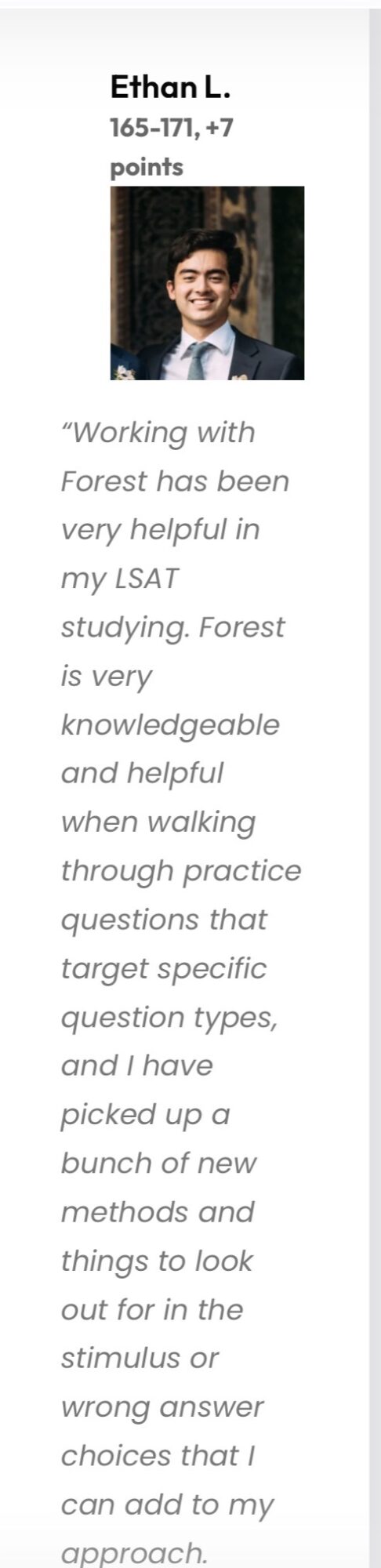
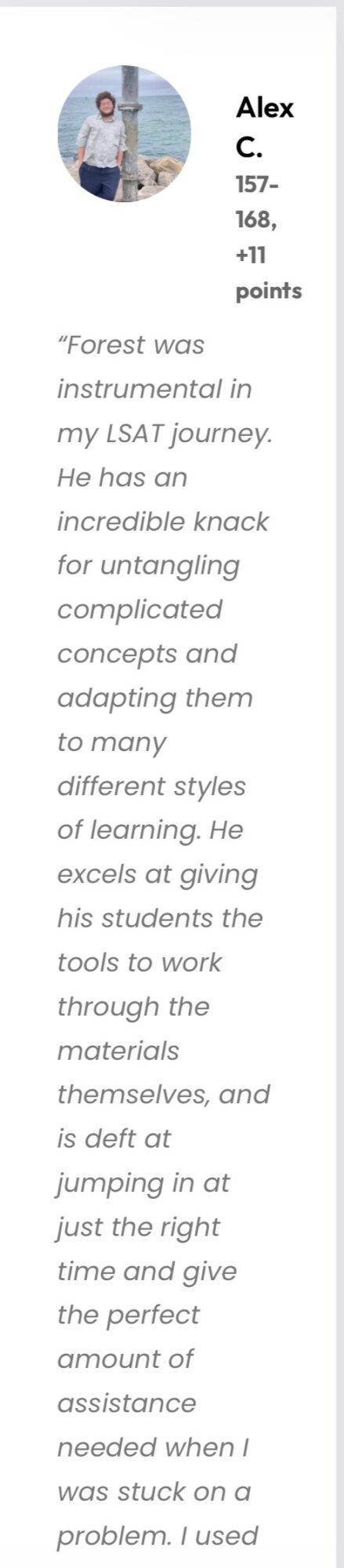
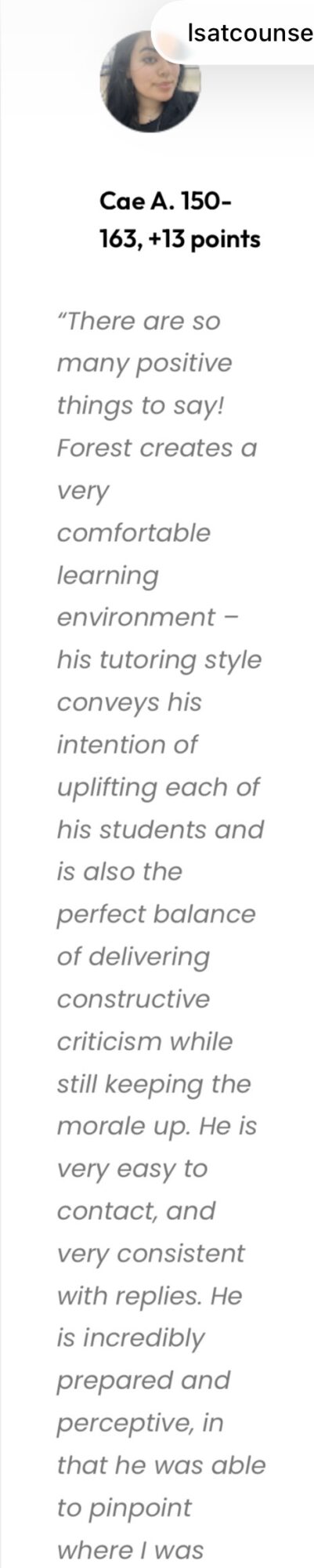
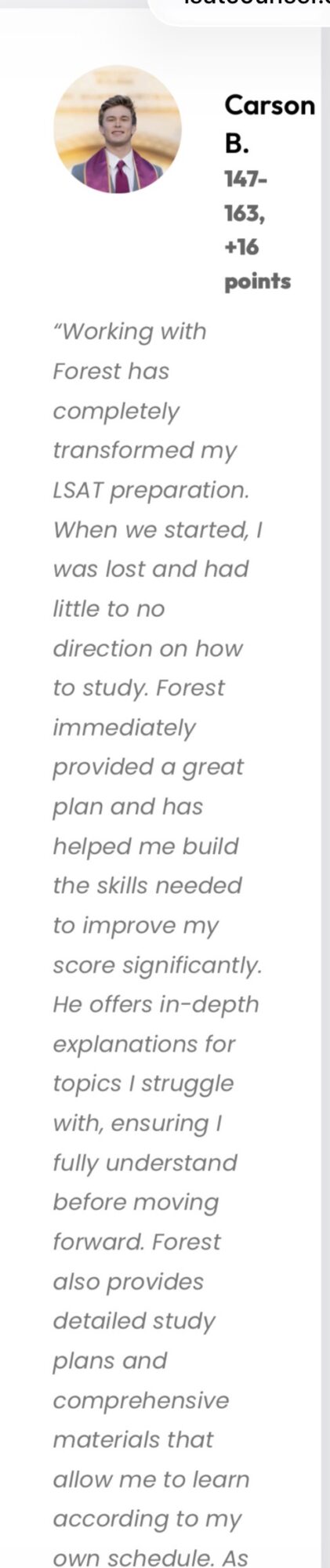
I’m an LSAT tutor and writer (via my Substack) focused on one mission: helping students earn major score gains without wasting time, money, or emotional energy on gimmicky, overpriced prep. I’m known for making the LSAT feel learnable by teaching the core skills the test actually rewards—especially conditional reasoning/formal logic, smart timing strategies, and targeted methods for breaking through Logic Reasoning and Reading Comprehension plateaus—while dispelling stubborn myths (like the idea that RC can’t improve dramatically or that you can’t gain more than 10–15 points). What sets me apart is that I didn’t start with a strong diagnostic, so I understand what it feels like to be stuck and I teach in a practical, patient, results-driven way that’s been refined over five-plus years tutoring hundreds of students. Beyond the LSAT, I also support law school admissions with unlimited revisions across the entire application—Personal Statements, Why X essays, Diversity Statements, GPA/LSAT addenda, résumés, transfer statements for 1Ls, and guidance on letters of recommendation—plus free brainstorming via email/text and example essays to guide the writing, with unlimited edits for grammar, structure, and content. And once students are admitted, I help them transition into law school with strategy advice on how to excel early, what time-inefficient approaches to avoid, and practical support for 1L coursework—including providing free outlines for core 1L classes. Brand-wise, I’m most proud that my work is built on access, honesty, and real outcomes: my own 173 helped me earn a full-ride scholarship, and I want readers to know that “a few points” can change everything—and that a low diagnostic isn’t a ceiling, it’s just a starting point.
Alright, so to wrap up, is there anything else you’d like to share with us?
The biggest thing I’d want readers to know is that the LSAT is far more learnable than it’s often made out to be. At its core, it tests a small set of skills at a very high level—and with the right approach, big score jumps are absolutely possible, even if your diagnostic is low or average. That said, real improvement usually comes from a longer-term commitment, especially when it comes to conditional reasoning. Mastering conditionals is a lot like learning a foreign language: at first it feels unnatural and slow, you “translate” in your head, and progress can seem invisible—but with consistent repetition, the patterns start to become automatic, and suddenly the test feels clearer and more predictable. If you’re feeling stuck, it doesn’t mean you’ve hit your ceiling; it usually means you’re early in the process or missing the right framework. Stay patient, focus on quality over quantity, and remember that a few points can translate into life-changing admissions outcomes and scholarship money—so the work is worth doing the right way.
Contact Info:
- Website: https://lsatcounsel.com/


Popular
-

Hidden Gems: Local Businesses & Creatives You Should Know
-

ATL’s Most Inspiring Stories
-

Seeing the Story Between the Moments
-

Portraits of Atlanta
-

Dr. Sinclair N. Grey III on Why Founders Stall—and How Discipline Breaks the Pattern
-

Meet Lee Patterson: Teaching Entrepreneurs How to Build Wealth the Right Way From Day One