






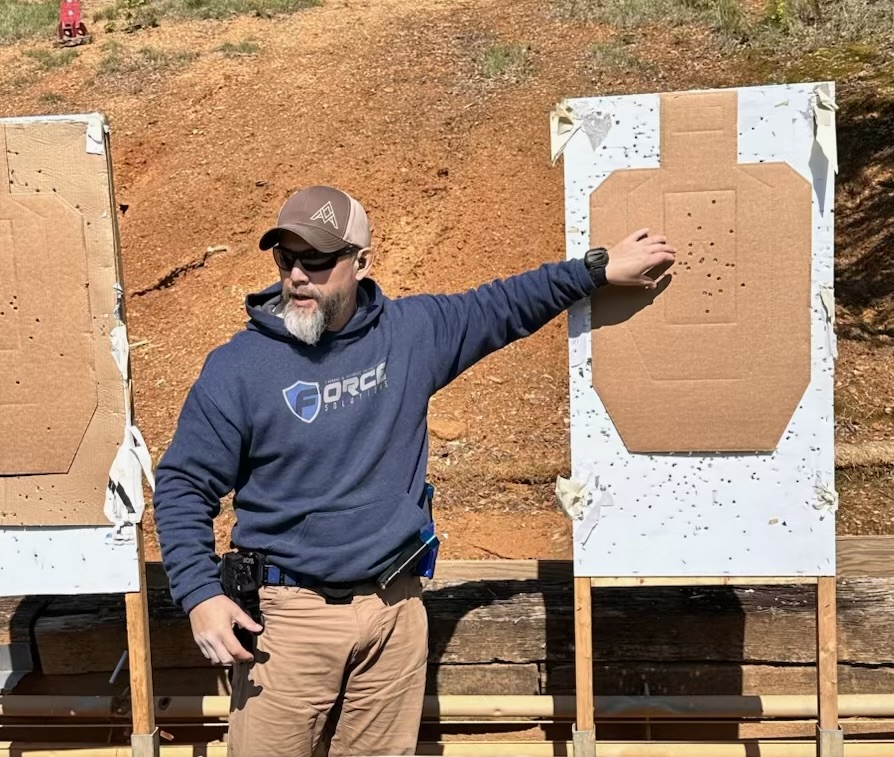
Dennis Rousseau shared their story and experiences with us recently and you can find our conversation below.
Dennis, really appreciate you sharing your stories and insights with us. The world would have so much more understanding and empathy if we all were a bit more open about our stories and how they have helped shaped our journey and worldview. Let’s jump in with a fun one: What are you chasing, and what would happen if you stopped?
I’m chasing unachievable perfection — not because I expect to reach it, but because the pursuit itself drives growth. Every day, I’m striving for a deeper understanding of firearms performance, defensive tactics, and how those two worlds integrate under pressure. My focus is on simplifying the complex — taking principles that are often overcomplicated and breaking them down so they’re easier to understand, retain, and apply when it counts. I’m chasing the constant refinement of both my own skills and how I teach them — finding better ways to communicate, demonstrate, and connect. If I stopped, complacency would set in. The moment I believe I’ve “arrived” is the moment I start to fall behind. For me, it’s about being a lifetime student — always evolving, questioning, and striving to make others more capable and confident in their own defense.
Can you briefly introduce yourself and share what makes you or your brand unique?
I’m Dennis Rousseau, founder and lead instructor at Force Solutions, established in 2019. We’re a firearms and defensive tactics training company built on the principle that skill and mindset must evolve together. My background spans decades in martial arts, law enforcement, and competitive shooting, and Force Solutions was born from the drive to bridge those disciplines into a cohesive, reality-based training philosophy. What makes our approach unique is how we integrate firearms, defensive tactics, and emergency trauma care (TECC) — giving students the tools to respond decisively in critical moments. We don’t just teach people to shoot; we teach them to think, move, and problem-solve under stress. Our mission is to create capable, confident, and adaptable individuals through training that’s pressure-tested, efficient, and constantly evolving to meet real-world demands.
Great, so let’s dive into your journey a bit more. Who taught you the most about work?
Three people — or influences — stand out when it comes to shaping how I view work. My father taught me the foundation: work ethic, pride in what you do, and the importance of never cutting corners. He believed your name and your integrity are attached to every job you do, no matter how small. My first martial arts instructor built on that by showing me that anything truly worthwhile comes with a price — effort, time, and perseverance. Nothing meaningful comes easy or free, and that mindset shaped how I train and how I teach today. Then came the Army. They talk about “an Army of One,” but what it really taught me was the power of brotherhood — that success is built on trust, teamwork, and being there for the person next to you. Each of those lessons combined to form the foundation of how I lead, train, and approach every challenge: with pride, discipline, and loyalty.
What did suffering teach you that success never could?
Suffering teaches you lessons success never will. To me, suffering teaches you that you don’t want to suffer — but it also shows you that you can endure it. The more you suffer early, the less you suffer later. If you stay consistent in facing hard things, the discomfort becomes familiar, and eventually, it’s manageable. In training and in life, that’s the key — embracing the grind so that pressure and adversity don’t break you when it matters most. In my line of work, whether it’s firearms, defensive tactics, or teaching others to perform under stress, controlled suffering builds composure. It sharpens focus and exposes weaknesses before they become failures. Suffering is the honest teacher — it strips away ego, reveals character, and forges the resilience you can’t fake. Success feels good, but suffering is what makes you capable.
I think our readers would appreciate hearing more about your values and what you think matters in life and career, etc. So our next question is along those lines. What are the biggest lies your industry tells itself?
The first big lie is: “I own a gun, therefore I’m armed.” Ownership is only step one. Being truly armed means mindset, storage and safety practices, habit-based manipulations, medical readiness, and — above all — proficiency. A firearm sitting in a safe or in a drawer does not make someone capable of solving a sudden life-threatening problem. Real preparedness comes from repeated, realistic practice that builds reflexes and decision pathways under stress, plus the ability to apply emergency trauma care when the unthinkable happens.
“Qualification equals proficiency” is another myth. A range qualification is usually a controlled, predictable check-box — static drills, known distances, scripted scenarios, often performed at a pace that won’t replicate real life. Proficiency is layered: accuracy under time and stress, speed with safety, problem solving when things go wrong, and the ability to integrate shooting with movement, cover, communication, and casualty care. Passing a minimum standard doesn’t mean you’ll perform when the stakes are high — it only means you met that particular test.
Finally: “Competition or martial arts will get you killed in the streets.” That’s misleading. Competition and martial arts are not street templates, but they are invaluable laboratories. They teach stress inoculation, efficient motor patterns, real-time decision making, and controlled exposure to failure — all things you need in a crisis. The danger comes when people translate sport rules directly into tactics without considering context, threat dynamics, or legality. The best training borrows the stress and speed of competition and the discipline of martial arts while deliberately adapting those lessons to messy, uncontrolled reality — and adding trauma care, verbal de-escalation, and sound tactics.
Other industry falsehoods worth calling out: “More gadgets fix poor fundamentals” — they don’t; fundamentals always trump toys. “One course fixes everything” — ongoing habit maintenance and layered training do. At Force Solutions we build toward integrated competence: fundamentals first, stress-tested skills second, and medical/tactical integration last — because real capability is more than a certificate or a flashy chrono number.
Okay, we’ve made it essentially to the end. One last question before you go. How do you know when you’re out of your depth?
I know I’m out of my depth when I can’t confidently answer, demonstrate, or explain a concept — either right away or with minimal effort. In this line of work, credibility is built on both knowledge and the ability to translate that knowledge into action. If I can’t do that, I owe it to my students and to myself to recognize that gap. That doesn’t mean every answer has to align perfectly with someone else’s version of the truth — in this industry, there are often multiple ways to solve a problem, depending on the context, environment, and individual capability. My approach may not always match another instructor’s, but if it’s safe, functional, and repeatable under pressure, it has value. Still, if I don’t know, I’ll say I don’t know — and then I’ll find out. I’ll seek out those who do, study, train, and test until I understand it well enough to explain or perform it myself. Being out of your depth isn’t a failure — it’s an opportunity to grow and refine your craft. The danger is pretending you aren’t.
Contact Info:
- Website: https://forcesolutions.co/
- Instagram: https://www.instagram.com/force_solutions/
- Facebook: https://www.facebook.com/forcesolutionsllc

Popular
-

Hidden Gems: Local Businesses & Creatives You Should Know
-

ATL’s Most Inspiring Stories
-

Portraits of Atlanta
-

Dr. Hildiah Martin-Suggs Is Building Second Chances for Youth Who Were Almost Lost in the System
-

From Showing Up to Seeing His Face on a Billboard: Anthony Green Is Just Getting Started
-

Wayne Smith Jr on Survival, Psychological Thrillers, and the Cost of Staying Alive