


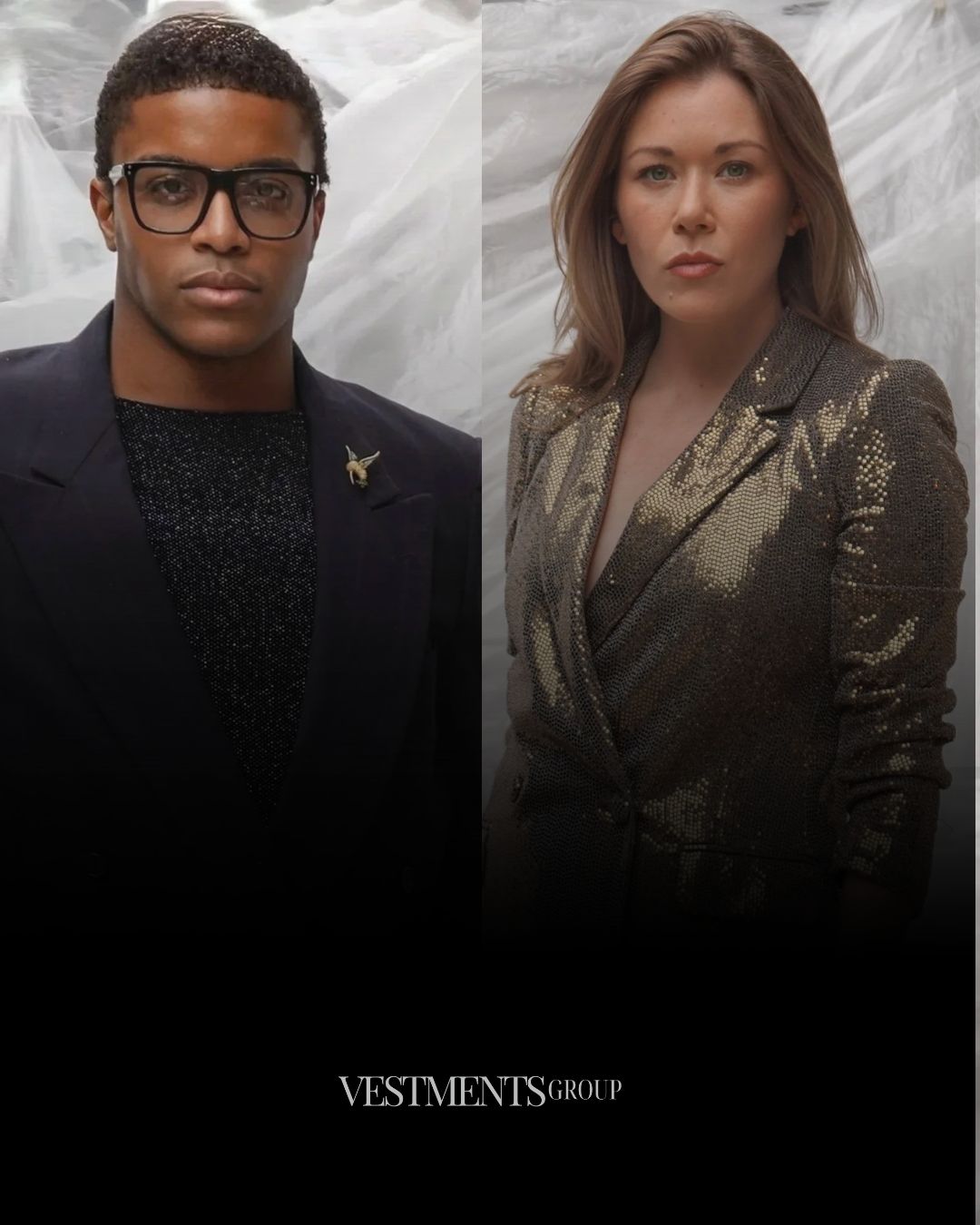
Today we’d like to introduce you to The Vestments Group.
Hi The Vestments, can you start by introducing yourself? We’d love to learn more about how you got to where you are today?
The Vestments Group was founded by Allison Behring and Marcus Allen as a wardrobe atelier working across film, television, red carpet, and private life. The practice applies production-level rigor to costume design on and beyond the screen, supporting clients across personal and leadership roles, weddings,international engagements, and long-term public visibility.
The work is supported by a trusted global network of tailors, seamstresses, designers, hair and makeup artists, alongside Emmy-nominated production professionals who are widely regarded as leaders in their fields. These are long-standing creative relationships, brought together as needed to ensure continuity, craftsmanship, and consistency across locations and timelines.
Structurally, the atelier functions as a single accountable department, coordinating costume design for narrative production alongside wardrobe for private, institutional, and public life within one integrated system of design logistics and long-term care.
1. Can you briefly walk us through your story – how you started and how you got to where you are today?
We met working in the costume department on the reboot of the primetime soap opera, Dynasty, for the CW network. Following that production, our paths moved into separate sectors in entertainment, but the throughline remained clear: the most successful outcomes were not driven by styling, but by the operational systems built to sustain visibility over time. Those same systems allow us to move beyond surface presentation, helping individuals align how they are seen with who they are as their lives and roles evolve.
The Vestments Group was founded to bring production-level expertise into private wardrobe management. We treat wardrobe as an integrated system rather than a sequence of isolated moments, formalizing a discipline we practice across film, editorial, and red-carpet environments.
Across contexts, the same core competencies govern success: precision under pressure, long-range planning, and coherence across visibility and time. Outside of production, The Vestments Group exists to bridge that gap, introducing our systems, continuity and understanding of cultural congruence with how people live, move, and are seen in their clothing.
Can you talk to us a bit about the challenges and lessons you’ve learned along the way. Looking back would you say it’s been easy or smooth in retrospect?
2. Has it been a smooth road? If not, what were some of the struggles along the way?
It hasn’t been a traditional road, largely because we were building a discipline that lacked a formal name. Our path through film sets, red carpets, and private estates gave us a profound respect for the isolated moment, while also revealing a gap that was largely unaddressed.
Early on, breadth was a challenge. The market was accustomed to hiring for narrow highlights rather than long-term coherence. Rather than narrowing the work, we leaned into its complexity. We recognized that while the moment is vital, our clients needed their wardrobes to remain coherent as their lives, roles, and careers scaled. Our fashion psychology studies have evolved from this realization. By combining what we learned from narrative production; how characters are read, understood, and perceived with real-world behavior, we moved beyond solving for a single event. The focus shifted to continuity between moments: who the person is now, who they are becoming, and whether the wardrobe supports that transition.
The refusal to follow the designated road shaped the practice into what it is now, a wardrobe infrastructure firm rather than an event-based service. That same decision continues to clarify who the work is truly for.
We’ve been impressed with The Vestments Group , but for folks who might not be as familiar, what can you share with them about what you do and what sets you apart from others?
Founders
Allison Behring
Allison Behring (Yatto) is a costume designer and wardrobe professional with extensive experience across television and film. Her work spans major studio features and long-running series, including Dynasty, The Runarounds, Passengers, Outer Banks, and A Bad Moms Christmas. Formally trained in fashion design and shaped by years within production environments, her practice centers on character continuity, narrative structure, and wardrobe systems built to function cohesively across long-form productions and real-world application.
Marcus Allen Creative
Founded in 2009, Marcus Allen of Marcus Allen Creative is a multidisciplinary studio specializing in creative direction, event production, styling, and costume design. With over two decades of experience across fashion, film, and the arts, the studio delivers large-scale projects defined by editorial precision, narrative clarity, and controlled execution.
Marcus Allen’s work includes collaborations and credits with institutions and platforms such as The Knot, Adidas, Vogue, and Lifetime Networks, including serving as Creative Director and Planner for the wedding of actress Kat Graham and Bryant Wood, featured in The Knot’s Winter 2025–2026 six-month issue, released in October 2025 and on newsstands through March 2026.
How do you think about luck?
3. What role has luck played in your life and business?
In film and television, there’s a saying: If you don’t have a backup, you’ll be getting a call for one. When you do have a backup, you almost never need it. We’ve always understood luck as access meeting an elite level of preparation. Being in the right rooms is incidental; being ready once there is the work. We’ve been fortunate to work across high-visibility productions and deeply personal milestones, and each time, a new perspective surfaces in unexpected places.
One of the more unexpected places this surfaced was in conversations with architects and interior designers. As estates and residences scale or contract, they are often designed without accounting for the actual volume, archival preservation, or long-term behavior of a wardrobe. It’s rarely a design failure; it’s simply an overlooked dimension of how fashion actually lives within a space. By applying wardrobe usage data during the design phase, we’ve been able to help teams plan accurately from the start, saving time, cost, and rework by integrating these considerations early rather than correcting for them later.
Looking forward, our applications continue to expand, from maintaining continuity during cross-border relocations to supporting long arcs of public visibility including international press tours, weddings, or ongoing leadership roles. In each case, the pattern has remained consistent: production-level thinking applies wherever fashion moves beyond a single moment, and becomes a regular part of how life functions.
Contact Info:
- Website: https://www.thevestmentsgroup.com
- Instagram: vestmentsgroup

Popular
-

Opening Up to Move Forward: Diane Martinez on Vulnerability, Small Steps, and Getting Unstuck
-

Hidden Gems: Local Businesses & Creatives You Should Know
-

ATL’s Most Inspiring Stories
-

Portraits of Atlanta
-

Storytelling, Wellness, and Community: Dayana Preval on Finding Alignment Through Creative Expression
-

Rewriting the Rules of Publishing: How Jalisa Rose Ray Is Building an Author‑First Legacy with JRose Publishing