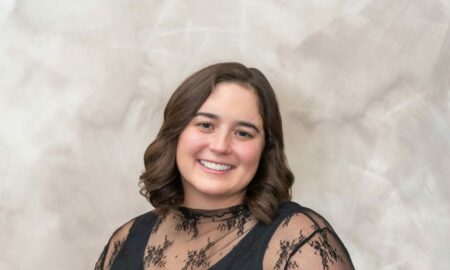





Today we’d like to introduce you to Abi Lambert.
Thanks for sharing your story with us Abi. So, let’s start at the beginning and we can move on from there.
I sort of stumbled into a graphic design career but I’ve always been a visual person so it was a question of what visual medium I would end up in. I was obsessed with comic books, video games, and horror movies when I was a kid. My dream job was to be a prosthetics makeup artist for horror movies. I wanted to make elaborate monsters like the ones in Hellraiser and pour fake blood on everything. I probably watched every horror movie that existed whether it was Halloween five or The Shining. I did not care how good it was. I lived and breathed horror movies for quite some time, so when I went to college, I majored in a film production-related major. I explored majoring in sculpture but eventually, I faced the fact that I am not good at painting, drawing, or sculpture! I worked really hard in studio art in high school but no matter how hard I tried I could not execute my ideas the way I had come up with them in my head. I worked on a couple of films sets doing grip and electric-type work. It is relentless, grueling work that sometimes requires you to work eighteen hour days. Grip and electric people get to be creative in their own way but not in the way that I want to be.
Towards the end of my time in college, I joined the design team for the school magazine at University of Georgia. I told them that I already knew Adobe InDesign (which I didn’t.) I taught myself InDesign overnight. I found myself getting sucked into the work for hours at a time without even realizing it. I found that I could learn software quickly, so I taught myself Illustrator, Photoshop, Premiere, and Maya Autodesk. I applied for a grant to create my own magazine from the Ideas for Creative Exploration. The magazine I started was called Tom Boy Tom Cat which was my first real exploration into designing on my own.
During this same time period, I moved to Washington, D.C. for a paid internship while finishing my last credits of college. I worked from 9-5 Monday through Friday, went to class from 6:30-9, and then scrambled to complete my grant project every other waking hour. Washington, D.C. was not the town for me so after my last semester of college, I rented a car and moved all my things from D.C. to New York. I applied to hundreds of jobs when I got there and after two weeks found myself working five days a week as a creative personal assistant and two days a week as a graphic designer at an architecture firm. I did that for about nine months before I found a full-time job as a graphic designer at a magazine publishing company. That job didn’t work out, so I ended up working a number of different places part-time or freelance trying to figure out what I wanted to do. I was recruited for a graphic design position at Sotheby’s which has been my most career-defining job to date. Eventually, I’d had enough of New York and moved back down to Atlanta to be closer to my friends and family. I’ve been freelance designing in Atlanta ever since. In a way, I feel I ended up taking the graphic design career path because it’s something I can get paid to do. Money is certainly an incentive to stay in the design industry.
Has it been a smooth road?
It has and it hasn’t! It feels like some things I’ve had to fight tooth and nail for and other things have landed on my lap like getting a call from a recruiter to work at Sotheby’s. It’s hard being an innately creative person and working on projects you don’t care about. I also found it quite difficult to adapt to corporate office culture. I tried to maintain my eccentricity and personality in a work environment. I learned the hard way to turn that off. Your co-workers in an office are the people you do business with. I learned to stop giving my opinion which in part came from not feeling respected at work. I’ve always been quite confident, bordering on arrogant. People do not like when a 21-year-old walks into the office and has opinions! On one hand, I’ve learned so much from older designers just by listening and asking questions.
On the other hand, a few put-downs wore down my confidence over time. I was working on a project with the creative director at Sotheby’s and he was going over everything he thought we should do. After he was done talking, I just said, “Okay! Sounds good.” And he goes, “So… what do YOU think?” I was completely surprised that someone above me in the design chain valued my opinion. It made me realize how I was treated as an Adobe software operator was wrong, and I knew it was wrong even when it was happening.
Most of the struggles I’ve experienced in my career have actually come from my personal life. I lost three people very close to me soon after I moved to New York. I chose to continue working like there was nothing wrong but I buried a lot of pain and guilt. Ignoring the problem and trekking on has always been a coping mechanism of mine. Aside from grieving for loved ones, I broke nineteen bones in a car accident when I was eighteen which was very traumatic for me. The memories of the accident tend to resurface when I’m going through a hard time, especially if I’m not giving myself time to reflect or relax. You would never know by looking at me. I made a full recovery. Many new people in my life have no idea that I’ve had a near death experience. I think I’ve focused a lot on career goals so that I could live a normal life after a car accident shook me to my core. I did not want my accident to have long-term effects on my options in life.
It took me until this past year to realize that my health and my happiness should be the most important things in my life which seem quite obvious. Health is a literally a matter of life and death. And isn’t the pursuit of happiness the entire reason to be alive? I met someone who once told me, “You can’t work, work, work and then be happy. You have to be happy first and then work comes easily.” That was a major wake-up call. I thought being miserable and feeling overworked were just “being an adult.” It’s not. If something feels bad, there’s a reason. I was walking home from work once and had this epiphany where I thought, “All you need in life is good food, good people, and good music. Everything else is extra.” I didn’t have any of those things! All I had was a good job. I’ve been rebelling my whole life and here I was doing things that made me unhappy because I thought that’s what I’m supposed to be doing.
I think periods of growth can be very painful. That’s not to imply that good times aren’t also periods of growth. You have to grow and accept loss from hard times and it will evolve you into a different person. You can never be the person you were when you were a teenager, or twenty-one, or even yesterday. That can be difficult to accept. I have to believe that I’m a better version of myself after surviving a car accident and losing loved ones. How else can we go on if we don’t believe hard times help us grow?
So let’s switch gears a bit and go into the Abi Lambert Design story. Tell us more about the business.
I’m a graphic designer that works in print, experiential/exhibition, and digital design. I specialize in luxury markets. At least this is what I tell people. “Graphic designer” is really just a label to help navigate the job market. I am also a digital artist, an art director, and an avid gardener. I hope to one day combine my love of plants and my love for art together. As a designer, I’m proud of the fact that I’ve worked on diverse projects from exhibits to websites. I value thoughtful, intentional design. I am constantly educating myself by attending design lectures, reading, and looking at other designer’s work. I know design is something I can increasingly become an expert in through education and experience. This is why when you’re working with a designer that’s been at it for decades, they can glance at a project and say, “That’s one-pixel off-center.” And they’re right! As a digital artist, I’m still finding my way and I’m beginning to treat that path similar to my design path: continued learning and experience.
How do you think the industry will change over the next decade?
Designers talk about this A LOT. Design trends and design industry trends are a hot topic. Design seems to be going simultaneously more and more interactive and high tech while also becoming more hand-made and low tech. The design is looking sleeker ever year while also adding on animation, augmented reality, virtual reality, 3D modeling, and probably holograms one day. At the same time, mass production has led people to look back to how things used to be made. Nice restaurants often use letterpressing for their menus. Slow design goes with the slow food movement. There was this huge fear about the death of the print industry but clearly, it didn’t die. It just evolved. The industry, of course, has an increasing demand for web UX or UI designers, interactive designers, and motion designers. Some people are afraid that the good ol’ graphic designer will become obsolete. I doubt that but I do think younger designers will have a more diverse skill set technologically speaking. Graphic design as a whole ties all of these new mediums together because “design thinking” is still required to design a website or an app. You can understand the software but that doesn’t make you a good designer.
Contact Info:
- Website: www.abilambert.com
- Email: abi@abilambert.com
- Instagram: www.instagram.com/abi_lab


Image Credit:
Taylor Kyles and Abi Lambert
Getting in touch: VoyageATL is built on recommendations from the community; it’s how we uncover hidden gems, so if you know someone who deserves recognition please let us know here.