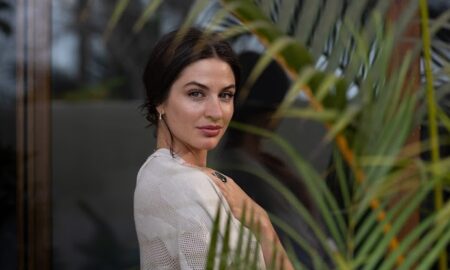
After years rooted in poetry, Kimberly Butin is turning back to long‑form fiction with a renewed sense of patience and precision, embracing the novel as a space to examine identity, memory, and inherited patterns over time. Rather than chasing explosive moments, her current work focuses on emotional architecture — the quiet decisions, subtle shifts, and accumulated tensions that shape a life — drawing on poetry’s restraint while allowing prose to stretch, layer, and breathe. The result is a deeply intentional return to narrative, one built not on urgency, but on craft, control, and trust in the slow unfolding of truth.
Hi Kimberly, thank you so much for taking the time to share what you’ve been working on. It’s exciting to hear about your return to longer-form fiction alongside your ongoing poetry practice — let’s jump right in.
Your creative journey began with storytelling and short fiction, then evolved deeply into poetry, and now you’re circling back to a novel-length project. What inspired you to return to long-form narrative at this point in your life and career?
I’ve always loved the scope of a novel. There’s something about the way long-form narrative allows you to sit inside a character’s evolution over time that poetry just can’t replicate. Poetry captures the moment — the fracture, the pulse, the flash of realization. A novel lets you trace the pattern.
For a long time, poetry felt like the right container for what I was working through. It’s immediate and instinctive. But as I’ve grown — both as a writer and as a person — I’ve become more interested in the architecture behind experience. Not just what happened, but how it unfolded over years. How one decision leads quietly into another. How identity shifts without you noticing.
At this point in my life, I don’t want to write something that feels explosive. I want to write something that feels constructed. I want to build a narrative that holds tension over time — that shows how instability, love, conditioning, and survival intertwine slowly rather than all at once.
Returning to long-form now feels intentional instead of urgent. I understand structure differently. I think more about pacing, about what to withhold, about how present-day scenes move forward while the past explains why everything feels inevitable. That kind of layered storytelling requires space. A novel gives me that space.
This new work explores identity, inherited patterns, and the quiet ways early instability shapes who we become. What first sparked your desire to examine these themes through fiction rather than memoir or personal essay?
Fiction gave me freedom — but it also gave me control.
Some of the details in the book are rooted in lived experience. Certain scenes are emotionally true in a very literal way. But others are softened, condensed, or intensified. Timelines shift. Moments are layered together. Some elements are entirely imagined. That blending was intentional.
I wasn’t interested in documenting events with forensic accuracy. I was interested in capturing emotional truth. Memory itself is nonlinear. Trauma distorts scale — some moments feel louder than they were, others feel muted even if they were seismic. Fiction allowed me to mirror that reality without being bound to exact chronology.
There’s also protection in it — for myself and for others. Not as a way of hiding, but as a way of honoring complexity. When you move into fiction, you’re allowed to ask harder questions. You can explore patterns instead of defending positions. You can examine identity without turning the book into a verdict.
The result is something that lives between memoir and invention. Certain details happened. Others are shaped to serve the larger architecture of the story. What matters most to me is that the emotional core is true — even when the scaffolding around it is imagined.
You mentioned focusing on voice, structure, and the “emotional architecture” of the book instead of rushing the plot. What does that slower, more intentional process look like day-to-day for you as a writer?
Slower, for me, means I’m not chasing the most dramatic scene anymore.
When I was younger, I would write the explosion first — the confession, the rupture, the moment everything falls apart. Now I’m more interested in the scaffolding around those moments. I’ll spend days rearranging scenes so that the emotional logic lands before the dramatic one does. If a present-day chapter is trying to move the story forward and unpack the past at the same time, I’ll split it. I want the tension to feel inevitable, not rushed.
On a practical level, that means outlining and re-outlining. It means keeping structural notes about what each scene is actually doing. It means revising language before adding more pages. I’m constantly asking myself whether a line is necessary or whether I’m just trying to over-explain because I’m uncomfortable with silence.
There are days when I don’t draft anything new. I trim. I shift. I tighten. That used to feel like failure. I’m not naturally the most patient person — waiting for something to simmer instead of forcing it is a relatively new skill for me. But writing a novel has forced me to learn that discipline. You can’t brute-force emotional architecture.
The slower process has made the work stronger. It’s less reactive. Less impulsive. I’m building something designed to hold weight over time, and that requires restraint. Patience might not be my default setting, but in this case, it’s become part of the craft.
Poetry remains a consistent part of your life, especially through sharing work on Instagram. How does your poetry practice influence or inform the way you approach prose and storytelling?
Poetry is my calibration tool.
It’s where I test emotional honesty in its most concentrated form. When you write poetry — especially in a public space like Instagram — you don’t have the luxury of excess. A poem either lands or it doesn’t. There’s no hiding behind exposition. That constant practice has made me much more intentional in prose.
Poetry sharpened my ear for rhythm. Even in a novel, I’m listening for cadence — how sentences breathe, where a paragraph needs space, where silence carries more weight than description. It also trained me to trust restraint. If a line feels too explanatory, I cut it. If a moment can be implied instead of declared, I let it sit.
At the same time, prose allows me to expand what poetry compresses. A poem might capture the fracture. The novel lets me examine how the fracture formed — slowly, subtly, over years. I think the two forms balance each other. Poetry keeps me precise. Long-form narrative lets me build.
Sharing poetry publicly has also made me braver about vulnerability. When you post something personal and watch it resonate with strangers, you realize emotional specificity is universal. That understanding carries into the novel. I’m less afraid of quiet moments now. Less afraid of subtlety.
Poetry taught me how to hold a single spark. The novel is teaching me how to sustain the fire.
For other writers who feel called to explore deeply personal themes but aren’t sure how to begin, what advice would you give about finding their voice and trusting the process as a story takes shape?
Start smaller than you think you need to.
When you’re writing about something deeply personal, the instinct is to tackle the entire story at once — to explain everything, justify everything, make it airtight. That pressure will paralyze you. Instead, focus on one moment. One exchange. One image that won’t leave you alone. Write that clearly. Don’t worry about the thesis yet.
Voice isn’t something you “find” all at once. It’s something that stabilizes through repetition. The more you write — even imperfectly — the more you start to recognize your natural cadence. What you emphasize. What you avoid. What you return to. That pattern is your voice.
I’d also say: give yourself permission to use fiction as distance. You don’t owe anyone full exposure. Sometimes the truest way to tell something is to shift it slightly — change the names, alter the timeline, combine events — so you can see it without being swallowed by it. Emotional truth matters more than documentary precision.
And trust that the story will reveal its shape gradually. The first draft might feel messy or fragmented. That’s normal. Structure is often something you understand in revision, not in the initial outpouring. Be patient with that stage — even if patience isn’t your strongest trait.
Most importantly, don’t wait until you feel “ready.” Clarity comes through writing, not before it. Start somewhere honest, and let the architecture emerge as you go.
Links: