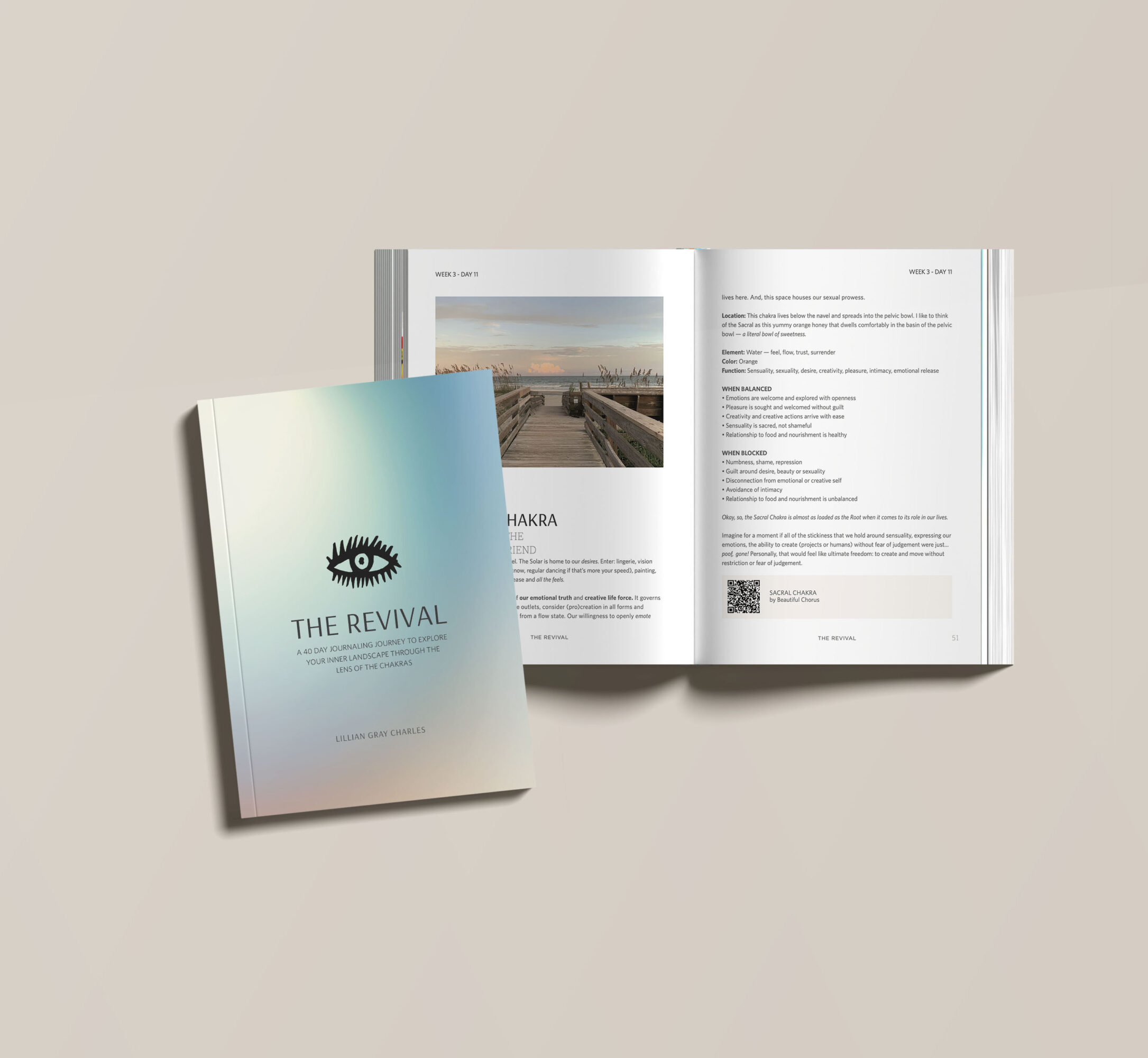
Lillian, you’ve just released The Revival, a 40‑day guided journaling experience—what inspired you to create this now, after more than a decade of working 1:1 with women?
After years of 1:1 and group work with women of all creeds, I saw the same core pattern again and again: women weren’t “missing information,” they were disconnected from their own truth. I wanted to put the most transformational part of my 1:1 + group sessions into a format that women could do privately, at their own pace. So many women are quietly living in a threshold season — ending something, starting something, questioning lots of things! In these seasons, we need a grounded structure that helps us come back to ourselves.
I’ve watched how fast the world has gotten. Plenty of books sit on shelves and collect dust. With an honest, 40 day pace to commit to, The Revival gives us a roadmap to follow without noise or pressure.
The book is structured around the chakra framework, with one week per chakra—how did this structure help you create both depth and practicality for readers?
The chakra framework gave me a clear “pathway” through the parts of life women actually struggle with: safety, desire, personal power, love, self-trust, intuition + connection to the Divine. One week per chakra creates enough time to go deeper into each topic — but it’s contained. Readers aren’t overwhelmed, and they can track what’s shifting week by week.
Practically speaking, it becomes a diagnostic: you start noticing where you’re strong, where you’ve been compensating and where your heart is asking for a reset. It also keeps the experience embodied, not just mental. The point isn’t to “think your way through” your life — it’s to feel what’s true and make decisions from that place.
You’ve said women don’t need more advice, but better questions—what kinds of shifts have you already seen when women are given space to hear their own inner knowing?
The biggest shift is ownership. When a woman finds her own answer, especially repeated back to her on paper over and over again, she can build trust in her responses.
I see women stop outsourcing their decision-making: less polling friends, less spiraling, less second-guessing and more clean, calm action. They also get more honest — about relationships, work, their bodies, their patterns — not in a dramatic way, but in a “I can’t unsee this now” way. And surprisingly, women get kinder with themselves.
Better questions don’t just reveal truth — they reveal self-compassion.
The Revival is designed for women in “in‑between” seasons—why do you think these transitional moments are so powerful for reflection and growth?
Because the old identity isn’t fully working anymore — and the new one hasn’t fully formed yet. That’s uncomfortable, but it’s also incredibly honest. That “in-between seasons” time usually means we grip to the old or are super anxious to get to the new and the next. This work, this book, loosens the grip of autopilot so you can see what you might be tolerating or where you are performing or repeating. These moments can feel destabilizing, but they’re also full of signal — your values get clearer, your needs get louder and your intuition gets harder to ignore. The Revival gives women something steady to hold onto while things are shifting: a daily practice that turns confusion into clarity.
What do you hope readers feel or understand about themselves after completing the full 40‑day journey?
I want them to feel reconnected — like they can hear themselves again. I want them to understand their patterns without shame.
My absolute favorite prompt from the entire book is “What would Love say to this part of me?” I want readers to leave with a clearer internal compass: “This is what’s true for me. This is what I’m no longer available for. This is what I’m building now. This is how I love myself well.” More than anything, I want the experience to restore self-trust — so we (myself included) are not just inspired for a day but actually living from a deeper alignment long after the 40 days are done.