




Today we’d like to introduce you to Sam Lockwood.
So, before we jump into specific questions about the business, why don’t you give us some details about you and your story.
It began in 1993, as a hobby that quickly got out of control.
My brother & I were racing for fun and we started providing services for ourselves because we weren’t satisfied with the services that were available in the area – particularly the availability of parts and graphic design for race cars. So we started selling safety equipment, parts, & decals & signs as a way of supporting our own racing habit.
We participated in a variety of racing series & provided a lot of different types of services & goods over the years. I could probably break it up into some distinct “phases.”
1993 to 1998 was what I like to call the “early production car years.” We got involved first in oval track racing, in what were called “Front Wheel Drive Mini Stock” cars. Basically, old VW & Honda 4-cylinder cars stripped down & with a minimum of safety equipment. By 1996 we were into the road-racing version of those cars. Our main business areas were metal fabrication (primarily roll cages), parts & safety equipment sales, & decals / graphics.
Starting in 1997, but not really full-time until 1998 to 2002 we got involved in professional production car racing. These were cars similar to the old VW’s: 4 cylinder economy & performance cars but newer & with more modifications allowed. Business wise we moved away from heavy duty fabrication and into “street tuner” work. Think “The Fast & The Furious” without the criminal activity and way better taste. We also began doing “prep” work on customer race cars – usually suspension setups.
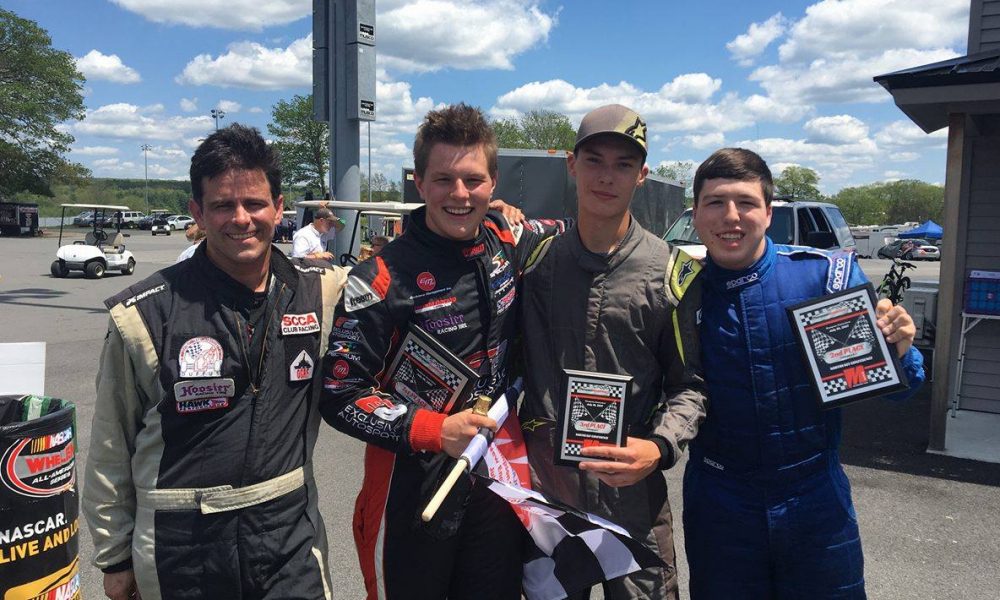
In 2003 we got into open wheel racing with Formula Mazda. By 2004 my brother Grant left the business and I started slowly shifting over to open wheel & doing arrive & drive programs. We won a regional championship in 2005 and back-to-back national championships in 2006 & 2007. By 2008 I dropped the street tuner business entirely for a variety of reasons. The graphic design business branched out quite a bit: we now do everything from race cars to commercial fleet graphics to weird little decal & printing jobs for hobbyists (such as scaled down stickers for a scale model).
By 2010 I was completely out of production car racing. Grant came back in 2011 by buying our first Formula F car, that particular program fell apart by the end of the year but involvement with that type of car continued. By 2014 I’d acquired two FF cars of our own & by 2015 we were out of Formula Mazda.
A list of the racing series we’ve been involved in: IMSA (in a variety of forms), Grand-Am, NASCAR, INEX (legends cars), USAC, SCCA (club & pro), NASA (the racing club, not the space agency), SVRA, & HSR.
Great, so let’s dig a little deeper into the story – has it been an easy path overall and if not, what were the challenges you’ve had to overcome?
The biggest problem is that essentially this is the entertainment industry, and a rather expensive sort of niche entertainment at that. The client pool is relatively tiny and, for want of a better term “fickle.” By that I’m not implying any character flaw, it’s just that you’ve got essentially two types of customers; people that want to do this as a hobby and people that want to do it as a career. The hobbyists are always in danger of getting bored or having life events get in their way (few people are narcissistic enough to bail on their kid’s graduation for a race), and while the pros are more focused and dedicated they’re also much more likely to drop you after a bad weekend.
The second biggest problem is dealing with the inherent instability of the business. Racing is one of those endeavors where you can work really hard, do everything right, and fate will still reward you with a kick to the face with some freak mechanical failure, another driver’s mistake, or some sort of weirdness on the road. You’ve got to have a very high tolerance for uncertainty and develop a very thick skin.
Raceworks – what should we know? What do you guys do best? What sets you apart from the competition?
I make people’s dreams come true, provided those dreams have something to do with driving a race car.
The main thing we do (as far as what takes up my time the most) is what we call “arrive & drive” events in entry-level open wheel race cars. My clients are either people that want to race for fun, or people looking to make a go at a racing career and we provide some of the first rungs on the “ladder” to a ride in a series like Indy Cars or Formula One. I provide the infrastructure & crew (and often times the race car as well), and thus all the customer has to worry about is showing up and driving.
Related to that, I also sell parts & safety gear and do graphic design work (I’ve done all the design work on our cars since the beginning). These areas were our primary focus back in the mid 1990’s when we started out, and they’re still significant parts of what we do.
I’m most proud of the fact that we’ve been able to provide very good value for the dollar. There may be outfits where you can do the same thing for less money, but there are few outfits that put together a better car than I do (and they are all way more expensive). I’ve been able to do this by paring things down to the bare minimum: essentially if it doesn’t make the race car go faster, make it safer, or make it more reliable I’m not interested in it. I’m perfectly happy to add “frills” such as personal trainers or catered meals, but most racers are more concerned about having a fast car that can go the distance than what sort of cheese selection there is at lunch.
I’m also the one of the more honest prep shops in the business. By that I mean that if you tell me what your goals are and what your budget is, I’ll give you the most realistic assessment of how we can meet those goals. If you tell me you have hardly any money & no driving experience but you want to end up being a paid Indy Car driver within three years I’m most likely going to tell you you’re nuts. Then I’ll lay out some more feasible options if you still want to scratch your racing itch. That sort of candor has lost me potential clients, but the ones that I do get tend to stick with me a lot longer because of it.
What moment in your career do you look back most fondly on?
It’s a toss-up. My proudest moment would be winning a national championship on our first try in 2006.
The most rewarding moment was when I had a driver tell me that the car I gave him was the first of its type that he felt he could stay on top of. He followed this statement by beating his best lap time ever at the track. This was on a chassis setup I had just put together based on combining my personal impressions driving the “sister” car and going over three years’ worth of notes and doing some math. I felt like I’d just performed a magic trick: not the kind where you learn a sleight of hand trick and make it look like you pulled a rabbit out of a hat, but the kind where you reach into a wormhole you created in the hat & pull said rodent from a parallel dimension.
Pricing:
- Club racing weekends from $2,425
- Pro racing season from $34,790
Contact Info:
- Address: 8490 Fields Ford Rd
Gainesville, GA 30506 - Website: http://lockraceworks.com/
- Phone: 770 886-1380
- Email: info@lockraceworks.com
- Facebook: https://www.facebook.com/Raceworks-Inc-323374175129/


Image Credit:
Rob Bodle
Sam Lockwood
Anne Marie Lockwood
Getting in touch: VoyageATL is built on recommendations from the community; it’s how we uncover hidden gems, so if you know someone who deserves recognition please let us know here.
Popular
-

Hidden Gems: Local Businesses & Creatives You Should Know
-

ATL’s Most Inspiring Stories
-

Portraits of Atlanta
-

Satoya Hayes on Turning Beauty 2 Extensions into a Platform for Affordable Confidence and Entrepreneurial Opportunity
-

Asha Ford on Building Krystal Klear Motion and Creating Purpose-Driven Design for Women
-

Truth in Every Verse: Jay Erve on Identity, Experience, and Creating Art That Lasts