







Today we’d like to introduce you to Paige Gray.
Hi Paige, it’s an honor to have you on the platform. Thanks for taking the time to share your story with us – to start maybe you can share some of your backstory with our readers?
I could tell you many stories from my childhood that may give insight into how I became a professor who researches youth culture and texts BUT ALSO has a background in journalism AND ALSO also loves fashion and film. At the end of the day, I like telling and sharing stories in ALL the ways we can tell and share stories.
When I was a kid—I’m guessing it was second or third grade—I desperately wanted Peter Pan to fly through my
bedroom window and take me to Neverland. I could not grow up. I had to stay a child—I refused to abandon
imagination and play and whimsy for what I discerned to be the doldrums of adulthood. I convinced myself so
absolutely in this possibility of Peter Pan showing up at my window that I wore only fancy pajamas to bed for a
time. No grubby old t-shirts for me—if I were to relocate from Indiana to Neverland and remain a child for
perpetuity, I wanted to do so in fashionable sleepwear.
Another memory from my childhood that makes much more sense now:
In elementary school, one of my favorite activities was show-and-tell. I don’t even know if teachers still do this. As an adult, particularly as an academic in the humanities, I see how problematic show-and-tell is—if not facilitated in a productive way, it could essentially function as a sanctioned space for kids to brag about their stuff, dividing the haves from the have-nots.
Of course, when I was in second grade, I didn’t think about this. I saw it as a time for wonder, a time to wonder—to ooooh and ahhhh over fascinating things. And anything could be a thing.
Really. A thing was something that you could bring to life through the magic of your interest, attention, and imagination. Though, some things were already alive. Namely, Spencer, my brother. I decided to bring in my baby brother—who, if I recall correctly, was barely walking—as my thing for show-and-tell.
Our babysitter came to school at the appointed time one Friday afternoon, and I proudly went to the main office to pick-up Spencer for his star-turn. Holding his hand as he took his unsteady steps, I proudly paraded Spencer through the rows of little desks explaining that this was my little brother.
Certainly, I didn’t understand this then, but now I see the ways in which I saw little discernment between Spencer and any other object from my room—a doll or stuffed animal or a favorite book, for example. What interested me was play—how things could come alive or take on new meanings through this power of the imagination.
Given my brother’s willingness to wear whatever costumes I dressed him in (and his inability to voice too much protest, aside from crying), he became a plaything for me. And as such, I thought he was perfect for show-and-tell.
For many, childhood enables and encourages the imagination. This unrestricted freedom grants us limited agency within the wider world of adults because with the imagination, we have creative power—a power that can give life to things through the magic of play.
The notion of play bringing something to life, while at the same time defining human life reminds us that to be human is to create, to be creative, which I see as a form of play. In essence, we are playthings affirmed and defined by our play things. In play, we work through our individual and cultural anxieties through the things we create—those things become agents of our inner realities.
I try, as much as I can, to see my life, my work as play. That doesn’t mean it’s easy. It’s the very opposite. For me, play is defined through creativity.
So I started as a kid in Indiana, making DIY newspapers and reading Peter Pan and The Wizard of Oz. I worked in journalism in high school and college, eventually majoring in English. I went off to graduate school (round one) in Chicago to study journalism further before working for newspapers in Colorado and New Mexico. I then decided I wasn’t done with school and headed off to Mississippi where I could get my PhD in English and specialize in children’s literature (which has expanded to the study of youth cultures). While finishing my dissertation, I was hired for a visiting assistant professorship at the United States Military Academy at West Point. I then moved back to colorful Colorado to take a position at Fort Lewis College. In 2018, I took my current position at the Atlanta campus of the Savannah College of Art and Design, where I teach courses in literature, writing, journalism, and cinema studies.
Can you talk to us a bit about the challenges and lessons you’ve learned along the way. Looking back would you say it’s been easy or smooth in retrospect?
Anyone who has a smooth road isn’t living!
It definitely has not been smooth, and there have been plenty of struggles—particularly during young adulthood. I’ve lived several lives, but I think that what life should be. It’s an adventures full of struggle and strife and delight and challenge and laughter. That’s what makes a good story, right?
Without indulging in one of my sob stories, I’ll just say broadly that my biggest struggle was discerning and believing in my own self-worth. It’s something probably all of us struggle with at some point. And for me, my inability to see that worth could trigger acts of self-destruction.
Alright, so let’s switch gears a bit and talk business. What should we know about your work?
I wasn’t sure what category to choose here, Technically, I’m an English professor—many would not see that as creative or artistic. But I view all my work as creative, and I try to put creativity into all my daily choices. Picking out what to wear in the morning is so much fun! Anyway, whether I’m thinking about how to design a course or lecture or thinking about a research project, it IS art to me.
My work as a scholar and a professor has been focused on unpacking these perspectives and possibilities of play and creativity, and how they define childhood—AND adulthood.
More than anything, I’m interested in helping facilitate larger cultural conversations with children and adults that engender intellectual investigation, individual and social agency, community building, and basic empathy around ideas of play, creativity, and age.
I’m proud of the work on my second book, Children of the Black Press: How Young People Helped Create an African American Youth Literature (The Ohio State University Press). It looks at the writing of Black children and young adults that was published in 20th-century periodicals. There’s a chapter on a high-school page printed in Spelman’s newspaper in the 1920s by its boarding students! Part of my broader argument is that I want youth literature to also consider work by actual youth, by young people.
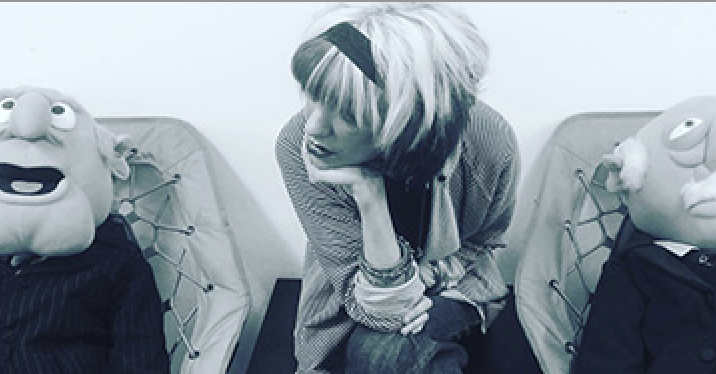
I also have been researching puppets and dolls since moving to Atlanta—SCAD Atlanta is right next to the Center for Puppetry Arts! So I had to take advantage of that archive. I did a chapter in an essay collection about “The Dark Crystal” and have page upon pages of research on puppets and Muppets and dolls and play things. I just need to figure out what I want to do with it! One thing I’d love to do is an essay collection on the Jim Henson film Labyrinth, among many other ideas!
Before we go, is there anything else you can share with us?
Curiosity! Curiosity! Curiosity! The joy and pain and beauty of life exists in the discoveries to which our curiosity leads us. That’s really the secret of youth. If you keep learning, you’ll always be young and life will always be interesting.
Contact Info:
- Website: https://linktr.ee/blankpaige1110
- Instagram: @blankpaige
- Facebook: @blankpaige
- LinkedIn: https://www.linkedin.com/in/paige-gray-237a9815/
- Twitter: @blankpaige
- Other: https://www.paigemariegray.com/




Popular
-

Hidden Gems: Local Businesses & Creatives You Should Know
-

ATL’s Most Inspiring Stories
-

Portraits of Atlanta
-

Natasha Dillard on Redefining Beauty Standards and Empowering Women Through Unapologetic Self-Expression
-

Darren Paltrowitz on Blending Investigation, Media, and Culture to Uncover the Stories Behind the Stories
-

Naeemah Jade on Redefining Networking Through Trust, Proximity, and Intentional Community