





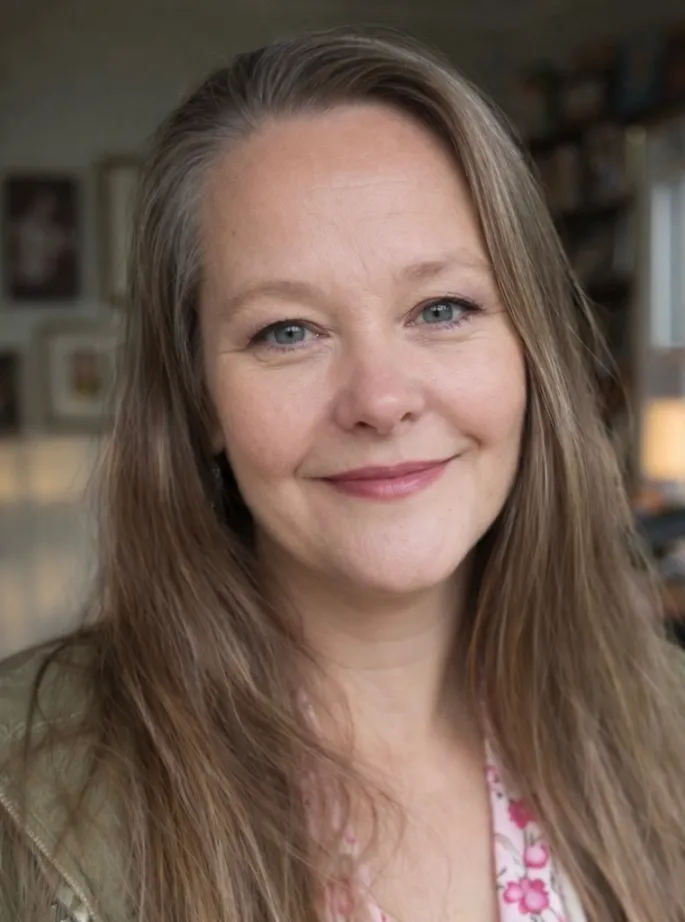
Today we’d like to introduce you to Jessica Traylor.
Hi Jessica, thanks for sharing your story with us. To start, maybe you can tell our readers some of your backstory.
Wherever my husband and I travel, I find myself doing the same thing. Looking for my people. A courthouse, a cemetery, a church archive. My ancestors are documented across centuries. I can trace them to colonial Massachusetts, to counties in Georgia where they farmed and fought and left paper trails. Ryran doesn’t get to do that. His line goes back three or four generations and then it just stops. Not because the story isn’t there. Because someone decided it didn’t need to be kept.
That gap is not just about names. When you can’t trace your people, you lose access to something much harder to replace than dates and places. You lose the stories of how they survived. What they built from nothing. How they held community together under conditions designed to break it. What strategies they used, what they leaned on, what they passed forward to the next generation. That knowledge doesn’t just belong to family. It belongs to whole communities trying to understand where their strength comes from and whether they can call on it again.
I grew up in Barnesville, Georgia, a small town in Lamar County where everybody knows the shape of everybody else’s story, or thinks they do. I became a school psychologist and have spent more than two decades walking into schools still quietly divided by race and income, watching neighborhoods carry the weight of choices made long before the people living there were born, and seeing new lines being drawn that looked a lot like the old ones. I also taught psychology and human services, first as an adjunct and eventually full-time, and later earned my doctorate in adult learning. Somewhere in all of that, I became a community oral historian, though I wouldn’t have used that word at the time. I just kept noticing whose stories were being held carefully and whose were being lost, and I couldn’t stop asking why.
When I returned to teach full-time at Gordon State College, the institution just down the road from where I grew up, a class project took an unexpected turn. My students started interviewing alumni about the college’s history, and what came back was something none of us were prepared for. Two people could have been in the same room, in the same year, and walk away with completely different versions of what happened there. One remembered belonging. Another remembered survival. The same place, the same years, and almost no overlap in what it had meant to be inside it.
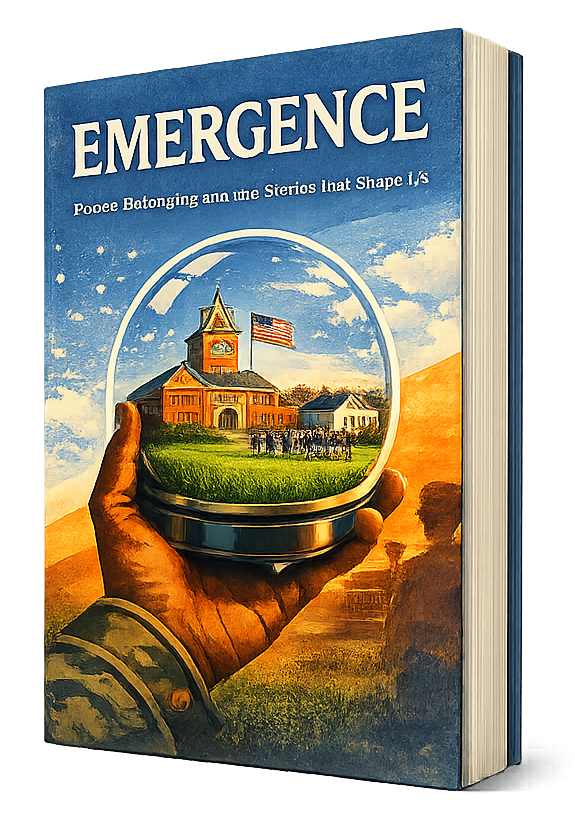
That became Emergence: Power, Belonging, and the Stories that Shape Us, an oral history of Gordon College from the height of its military culture through desegregation and its absorption into the University System of Georgia. For two years, my students sat across from alumni and listened. Thirty-seven people. Four decades of transition. One institution that meant completely different things depending on who you were inside it. The book publishes in June through Full Circle Press, and all author profits go back to the Lamar County community.
I kept circling the same question through all of it: whose stories get preserved, and whose disappear? And what do communities lose when the answer is the same people, generation after generation? I had no idea, when this project started, how far it would take me from where I thought I was standing. Or how much it would ask of me personally. But that is the nature of this work. You go in thinking you are documenting history. You come out understanding that history has been documenting you all along.
Alright, so let’s dig a little deeper into the story – has it been an easy path overall and if not, what were the challenges you’ve had to overcome?
There’s a particular kind of reckoning that comes with being a white woman doing community memory work in a place where your own lineage carries harm. Some of the families in this book, their ancestors did real damage to other people in this community. I grew up connected to some of those families. My children grew up with their grandchildren. There are things I didn’t know to protect my kids from, and I’m still making peace with that. The discipline of this work, the thing I have to practice constantly, is getting myself out of the way. These are not my stories to interpret. My job is to hold them as honestly as I can.
The other thread running through all of it is something I’ve watched repeat itself across every kind of institution I’ve worked in. K-12 schools, colleges, nonprofits. When a community’s true story threatens the institution’s preferred one, the institution protects itself. It protects its chosen people. It closes ranks. What that taught me is that the official record and the community’s memory are almost never the same document. Emergence exists in that gap.
The hardest parts haven’t been the politics. They’ve been the quieter things. Sitting across from someone whose family hurt people I care about and finding genuine warmth for them anyway. Going looking for narrators who weren’t in the alumni database because the institution had simply erased them. Starting with yearbook photos because that was the only proof some people had ever been there. Learning again and again that history isn’t in the records. It’s in the people. And sometimes you have to go looking before those people are gone.
Can you tell our readers more about what you do and what you think sets you apart from others?
I wear a lot of hats, and for a long time I thought that was a liability. School psychologist. Professor. Oral historian. Special education advocate. Community organizer. Author. Facilitator. What I’ve come to understand is that they all ask the same question from different angles: how do people find their way to authentic belonging, and what happens when the systems around them make that harder than it needs to be?
My clinical work as a school psychologist has always been rooted in that question. For my entire career, I’ve evaluated students, advocated for families, and sat in rooms where the official story about a child rarely matched the fuller truth of who that child was. My teaching, in psychology and human services, has centered on how people adapt, how they heal, and how institutions shape both of those processes, whether they mean to or not. My advocacy work in special education is about the same thing at a different scale: making sure the people most likely to be overlooked by a system are the ones the system is most accountable to.
The oral history work pulls all of it together. I founded the Barnesville-Lamar Community Memory Project because I believe that the stories communities tell about themselves determine what they think they’re capable of. When those stories are incomplete, or when whole groups of people have been written out of them, the loss isn’t just historical. It’s practical. Communities draw on their collective memory of resilience when hard things arrive. When that memory has been erased or suppressed, people don’t have access to the stories of what their people already survived and how they made it through. They don’t know what they’re made of.
What sets me apart is probably the combination of the clinical, the academic, and the community-based, held together by a genuine belief that the most important knowledge rarely lives in official records. It lives in people. And what I’m most proud of is not the book itself, though I am proud of it. I’m most proud of the narrators who trusted us with their stories, and of the students who did the listening. They learned something in that process that no textbook could have taught them.
What matters most to you?
Belonging. Not the performed kind, where everyone is technically invited but only certain parts of you can show up in that space. I’m talking about real belonging, the kind where a person can bring their whole history, their whole self, into a room and have it received with appreciation and curiosity instead of discomfort.
I have been thinking about this for a long time. In 2002, I was pregnant with my daughter and writing a master’s paper on triple consciousness. I was researching what it costs a person to manage multiple, competing identities just to move through the world. I didn’t know then that I was writing the question I would spend the next two decades trying to answer. But I was. And now I look at my kids, and I think about what I want the world to feel like for them. Not easier, necessarily. I want them to have to work for things. But I want them to be able to show up whole. I want them to inherit a world that has been moved, even a little, toward that.
What matters most to me is that people know their whole story is worth keeping. Not just the triumphant parts. The complicated parts, the survival parts, the parts where they made choices under conditions no one should have had to navigate. All of it. Because when people understand their own story in that fullness, something shifts. They stop asking whether they belong and start understanding what they’ve already endured to get here.
And that understanding is not just emotional. It is physiological. It is nervous system medicine. When you can locate yourself in a lineage, when you can say my people survived this, and here is how, and here is what it cost them, that’s when you recover access to something internal that chaos cannot touch. That internal safety is more than pretending the external world is fine. It is a stable place to stand while the external environment is unstable, which, for a lot of the people I work with and care about, it often is. Story is how we find that ground. Community memory is how we pass it forward.
I also care deeply about the people who do this work alongside me. The collaborative nature of community memory work is not incidental to it. It is the point. We remember together, or the memory diminishes. And honestly, I care about the ones we didn’t get to in time. The woman who walked through those doors first and never got to tell us what it cost her. She matters to me too.
But if I’m being honest about what gets me out of bed in the morning, it’s my kids. And their kids. And their kids after that. I am doing this work because the world I leave behind is a choice I am making right now, one story at a time. Belonging is not just something I want for the people I interview. It is something I am building, as deliberately as I can, for the ones who will come after me and never know my name. That is enough. That is everything.
Contact Info:
- Website: https://www.thedynamicbalance.com
- Facebook: jessica.traylor.94
- Other: TIkTok: @drjessicatraylor
Popular
-

Hidden Gems: Local Businesses & Creatives You Should Know
-

ATL’s Most Inspiring Stories
-

Portraits of Atlanta
-
Natasha Dillard on Redefining Beauty Standards and Empowering Women Through Unapologetic Self-Expression
-

Darren Paltrowitz on Blending Investigation, Media, and Culture to Uncover the Stories Behind the Stories
-

Naeemah Jade on Redefining Networking Through Trust, Proximity, and Intentional Community