




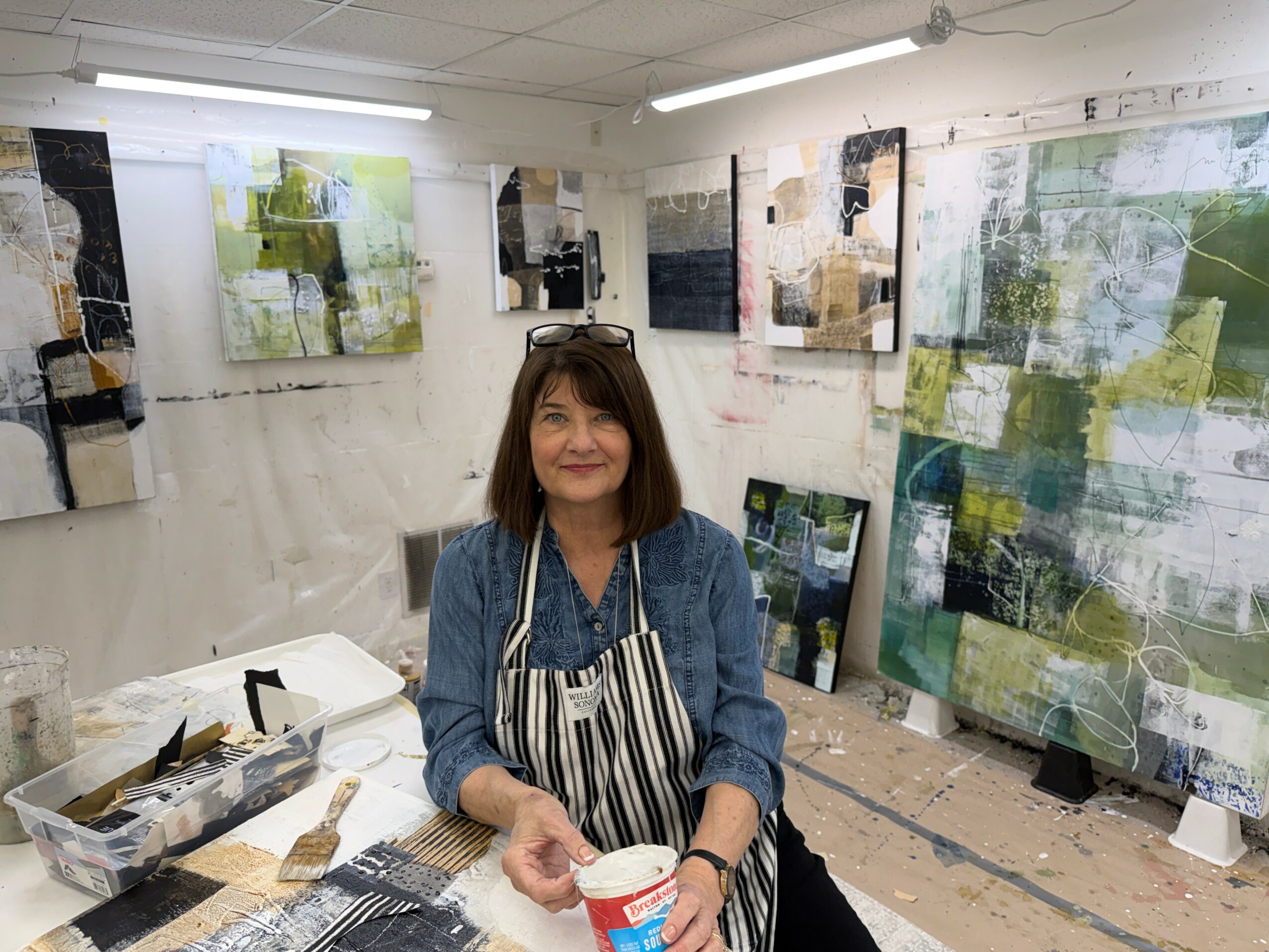
Today we’d like to introduce you to Susanne Carmack.
Hi Susanne, thanks for joining us today. We’d love for you to start by introducing yourself.
I loved art as a child, and there was always a tin of crayons in the back seat of our car in various stages of ruin, sometimes melted. My parents gave me art materials, mostly to keep me out of their hair, and one year, I remember getting a lovely, organized wooden box of art tools and a John Gnagy drawing book. I can’t believe I remember his name and his picture on the front. Fast forward to high school, and I began using watercolor to paint landscapes. I loved being outside.
I was accepted to the University of Virginia for college and was in the second class of women. There were five hundred of us, I believe. In my first semester, I took art history 101 from the magnificent scholar Frederick Hartt. I was hooked. I majored in art history while taking every studio art course I could. I was particularly fond of figure drawing and sculpting. Later on, my favorite course to teach would be beginning figure drawing.
I got married in my last semester of college to my college sweetheart, Jim. He had a four-year obligation to the U.S. Navy after attending as a ROTC scholar. We moved to Virginia Beach, and I got a real job as a fashion illustrator at Rice’s Nachman’s Department Store in Norfolk. I lasted a year there. I don’t think I was very good! Then I worked at Thalhimer’s Department Store as a fashion coordinator. I don’t think I did much art during that time, but it was a really fun job. Jim got out of the Navy, and we moved to Gaithersburg, Maryland. We had our first son soon after, then another son two years later. My daughter came six years later. Most of the time, I was a stay-at-home mother and did not have the time or the money to make art.
When the boys were finally both in school, I went to Rockville Community College in Rockville, MD, to learn printmaking. Barbara Kerne, whom I credit as my mentor, was head of the printmaking department, and I took every class I could for almost ten years. Etching, lithography, silkscreen, monotype, collagraph, and book-making were some of the processes I learned. Then my daughter arrived, and I continued taking courses while she was home with a babysitter. Barbara Kerne encouraged me to get my Master’s Degree at the University of Maryland. She said it would jump-start my career, and she was right. Not everyone gets to go to art school, and not everyone needs to, but for me, it put me inside a community setting. With help from the professors who were artists themselves, and by observing my colleagues showing their work and learning to talk about it, I gained more confidence and asked for what I wanted and needed. It was often a challenge. I had my share of rejection.
I started at UMD in the printmaking program, but quickly realized I needed to switch to the painting program because I wanted to work on my imagery, not printmaking processes. Back then, I worked in oils, large abstract paintings that I stretched on two-by-fours and gessoed myself. In my second semester, I received a teaching fellowship and was a teaching assistant to the esteemed Anne Truitt. That was a really lucky break. She mentored me as well, and I still hear her in my head when I am painting.
After graduation, I continued painting in my unfinished basement. I had started to use sand in my paint, and carborundum (from my lithography classes). I was very much intrigued by texture. I found I could dig into the sloppy mixture I made while it was drying to produce a kind of primitive looking alphabet. I started applying to every opportunity to show my work. Gomez Gallery in Baltimore took me on and started showing and selling my work. Everything was built on what I had done before. I was getting reviewed, and corporations were buying my work. Twice, I was a recipient of grants from the Maryland State Arts Council. I was a fellow at The Virginia Center for Creative Art eleven times, and twice at Ragdale in Lake Forest, Illinois. There I was surrounded by creatives of every discipline, and that really helped me grow my work. I built a beautiful studio in my yard and finally escaped from the basement. It was equipped with light and ventilation, and I had two areas, one for printmaking and one with large, well-lit walls for painting.
All was not perfect by any stretch of the imagination, though. I remember times I was despondent about my work, thinking I was a farce, wondering if I was on the right track, or going down yet another rabbit hole. I never met a medium I didn’t like, and sometimes I felt unfocused as I wanted to try everything. In 1996 and 1998, I had two public shows and gave a lecture about a very dark time in my life. I had never attempted such personal, serious work. Afterwards, it was hard to continue working for quite some time, as I felt I might never do important work again.
My husband retired, and we moved to Bluffton, South Carolina. There, I joined a cooperative gallery in Savannah. We had work responsibilities, and as luck would have it, (I have been lucky numerous times), a woman came into the gallery while I was there, walked right up to my wall, and said to her friend, “I could sell this work in my store!” That began an association that continues to this day. I have been showing my work at BDJeffries in Atlanta for twelve years.
I moved to Atlanta five years ago because in 2016, my house and studio burned down to the ground in Savannah while we were away visiting our son. (I am not always lucky). We decided not to rebuild, but eventually moved here, as two of our children and four grandchildren live in the Atlanta area. Plus, I get to do business easily without long trips and a van loaded with art.
My work has evolved over the years. I still occasionally make monoprints and collagraphs on my Takach press, but most of my home studio is filled with painting on canvas, paper, and panel. Since 1991, I have had twenty-five solo shows, and prizes and honors in local and national exhibitions. I have shown my work in commercial galleries all over the United States.
Alright, so let’s dig a little deeper into the story – has it been an easy path overall and if not, what were the challenges you’ve had to overcome?
On a practical level, there are logistics involved in making and moving large works. Fortunately, I have always had a van big enough to hold 48×72″ canvases. And I have always done my own transporting, loading, and unloading for shows. It takes health and strength.
On a psychological level, there is always the need to push yourself to discover a deeper, more personal way to make your art. Of course, there are always people who will not understand or like what you do. Sometimes that stings, and sometimes rejection can stop you in your tracks. That has happened to me from time to time, and one has to decide to forge ahead. I remember one group show I was part of in Rockville, curated by the famous Washington, DC artist Sam Gilliam. The exhibition was reviewed by The Washington Post. The reviewer was so dismissive about my work that I almost quit art for good. I got over it eventually.
Alright, so let’s switch gears a bit and talk business. What should we know about your work?
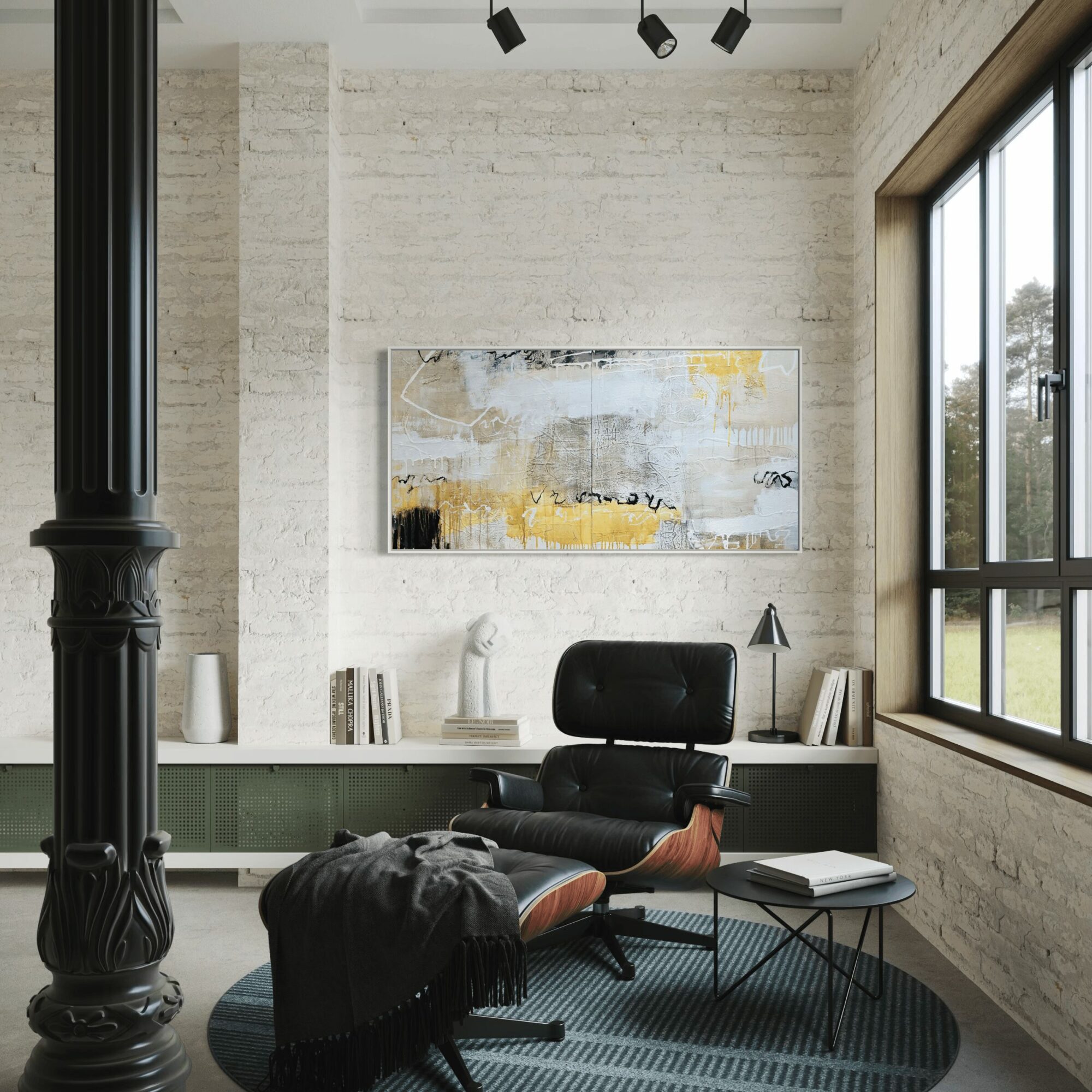
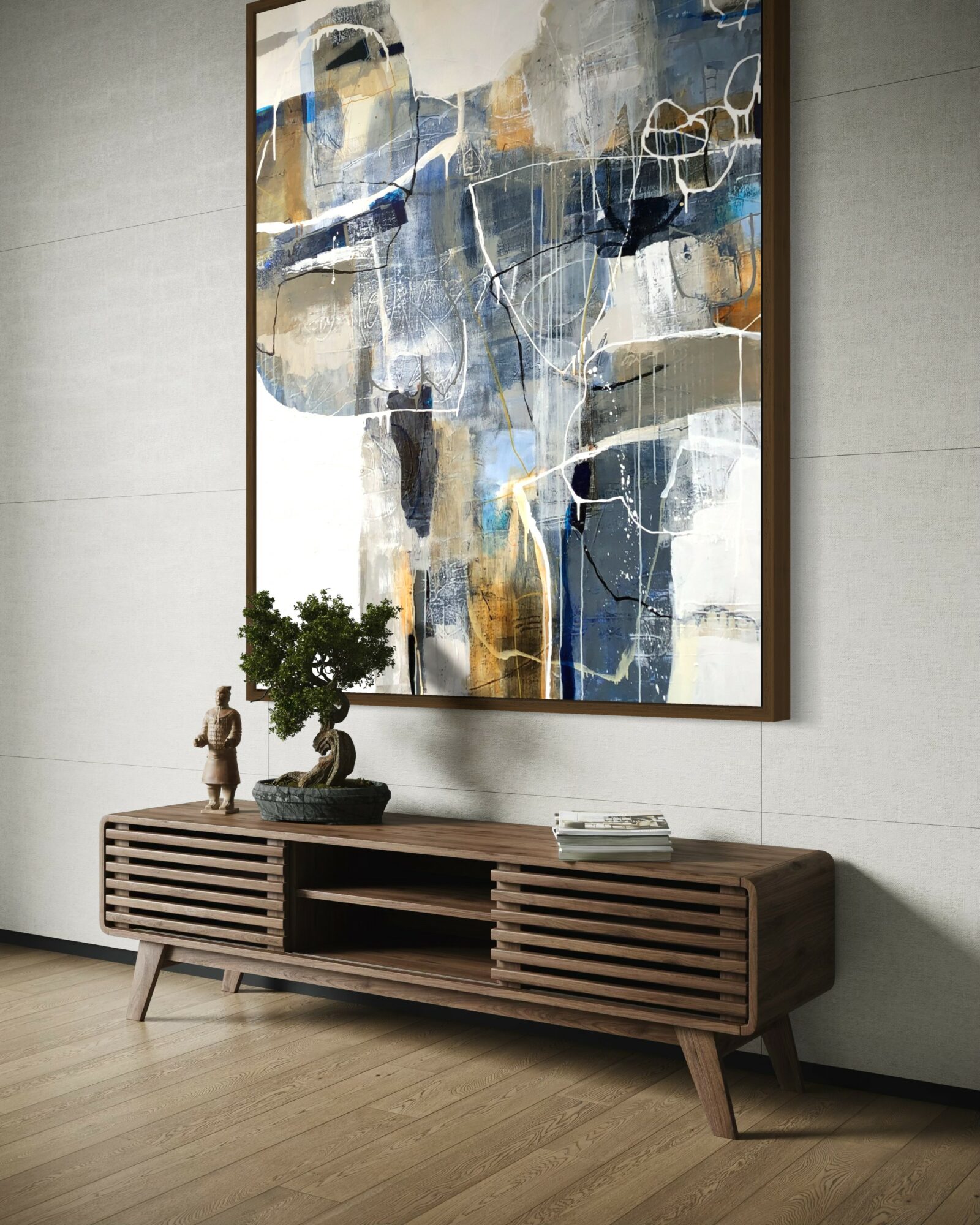
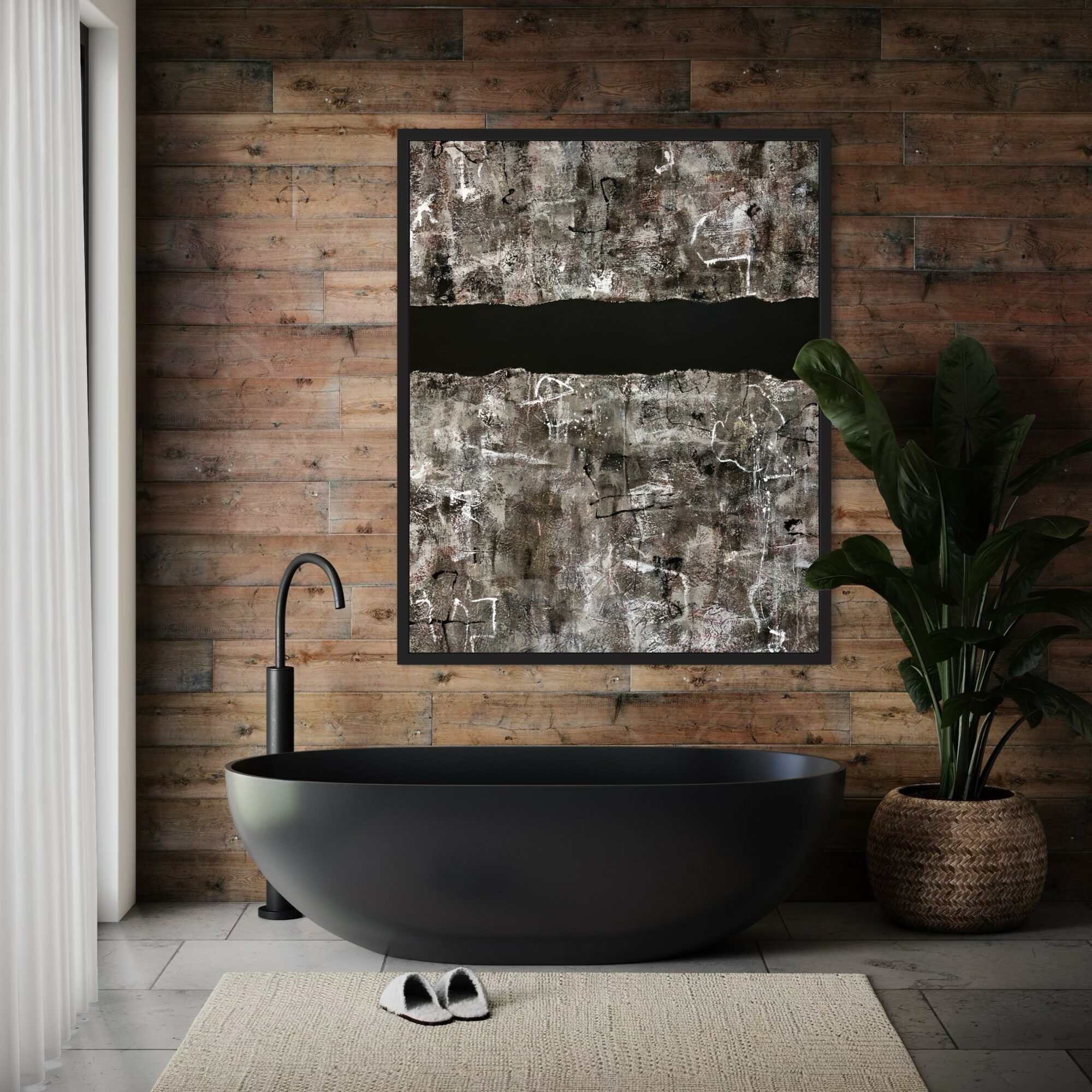
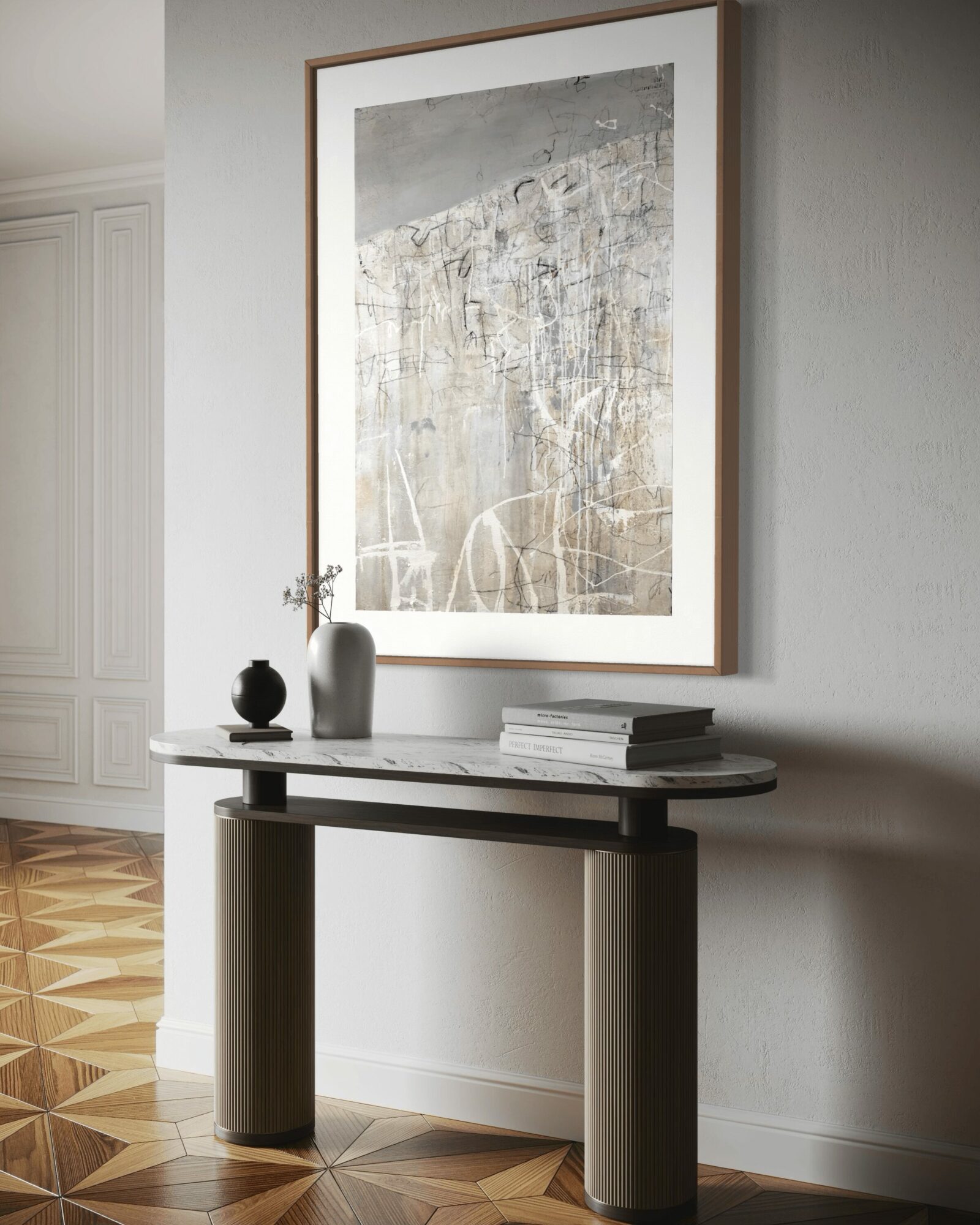
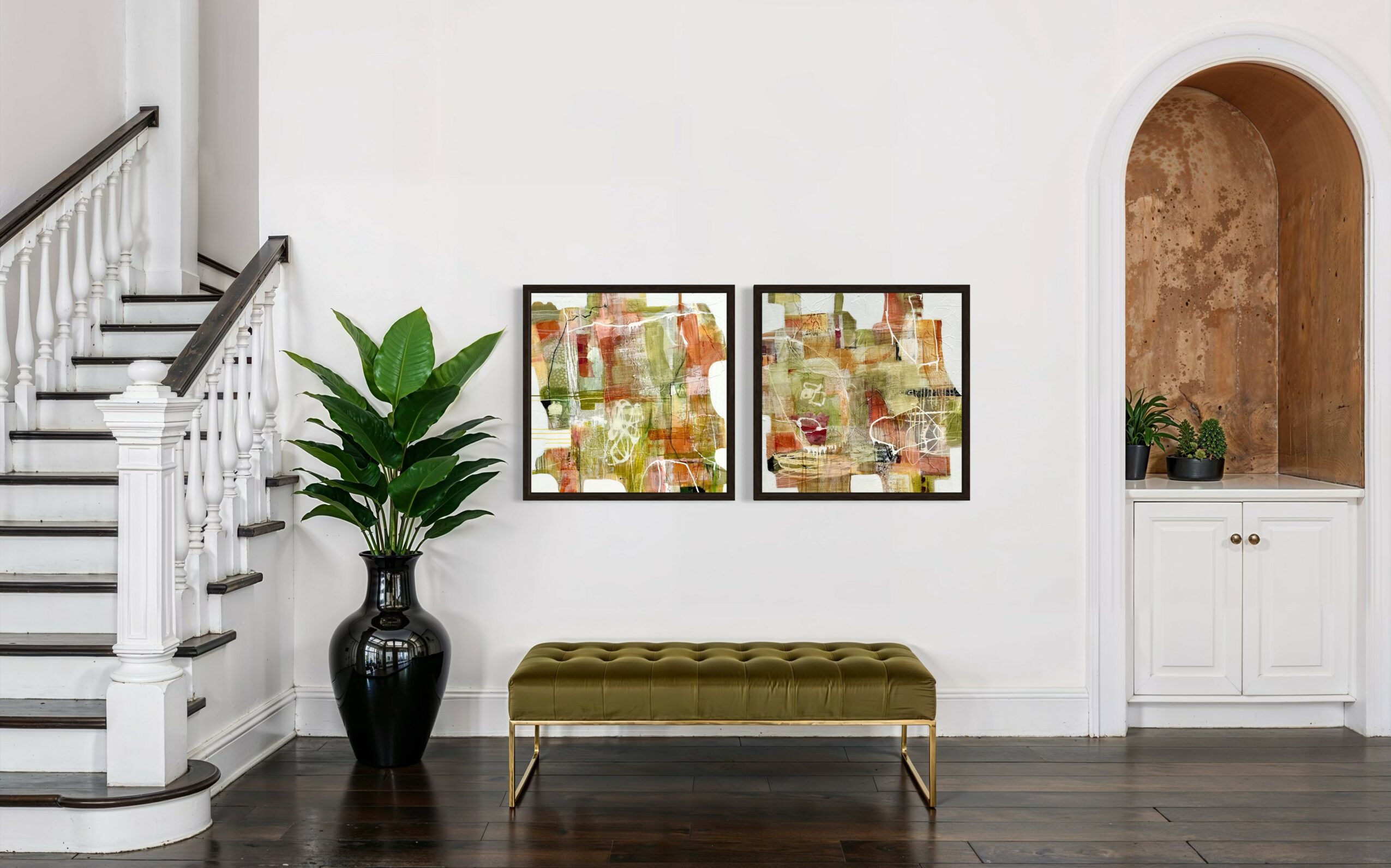
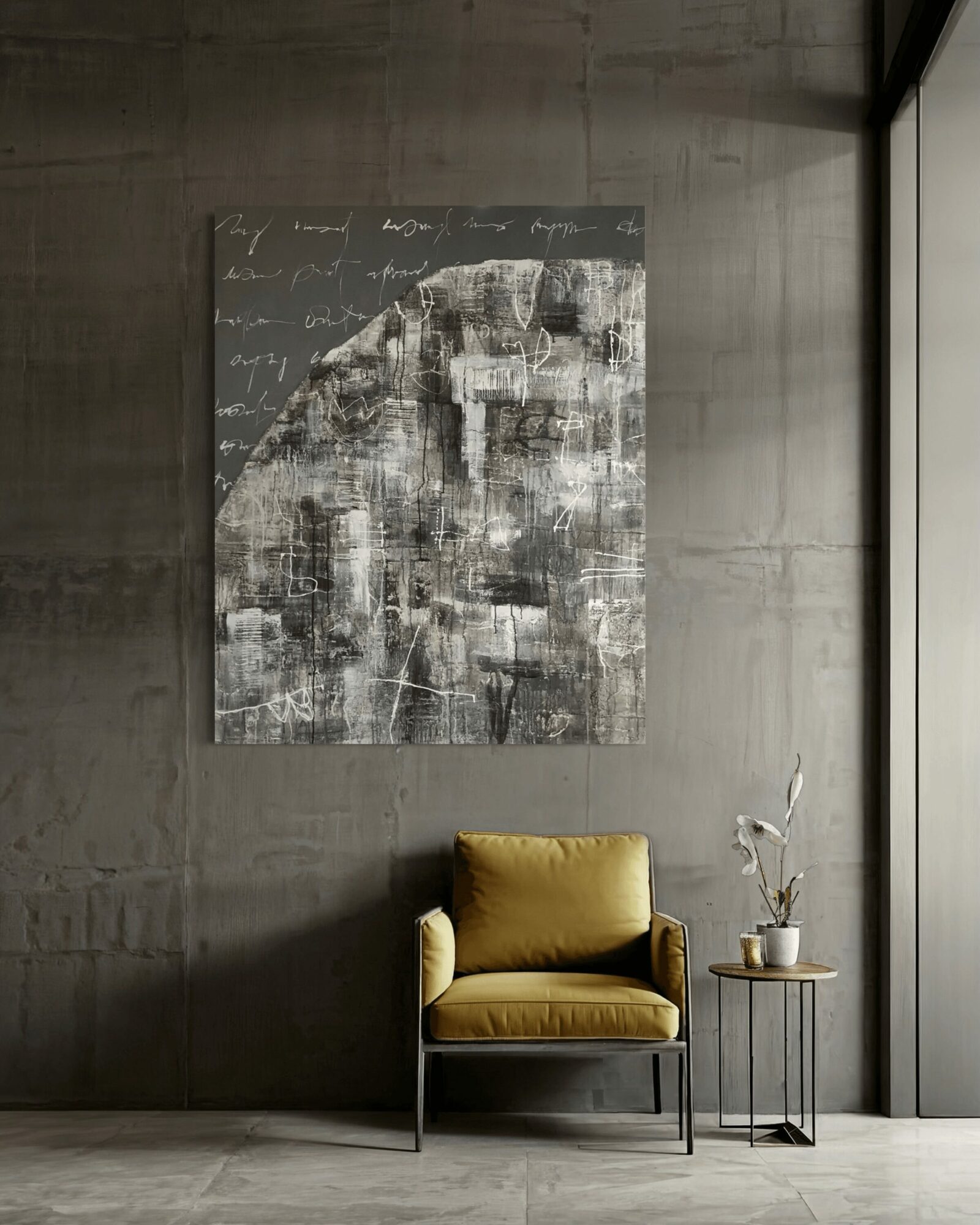
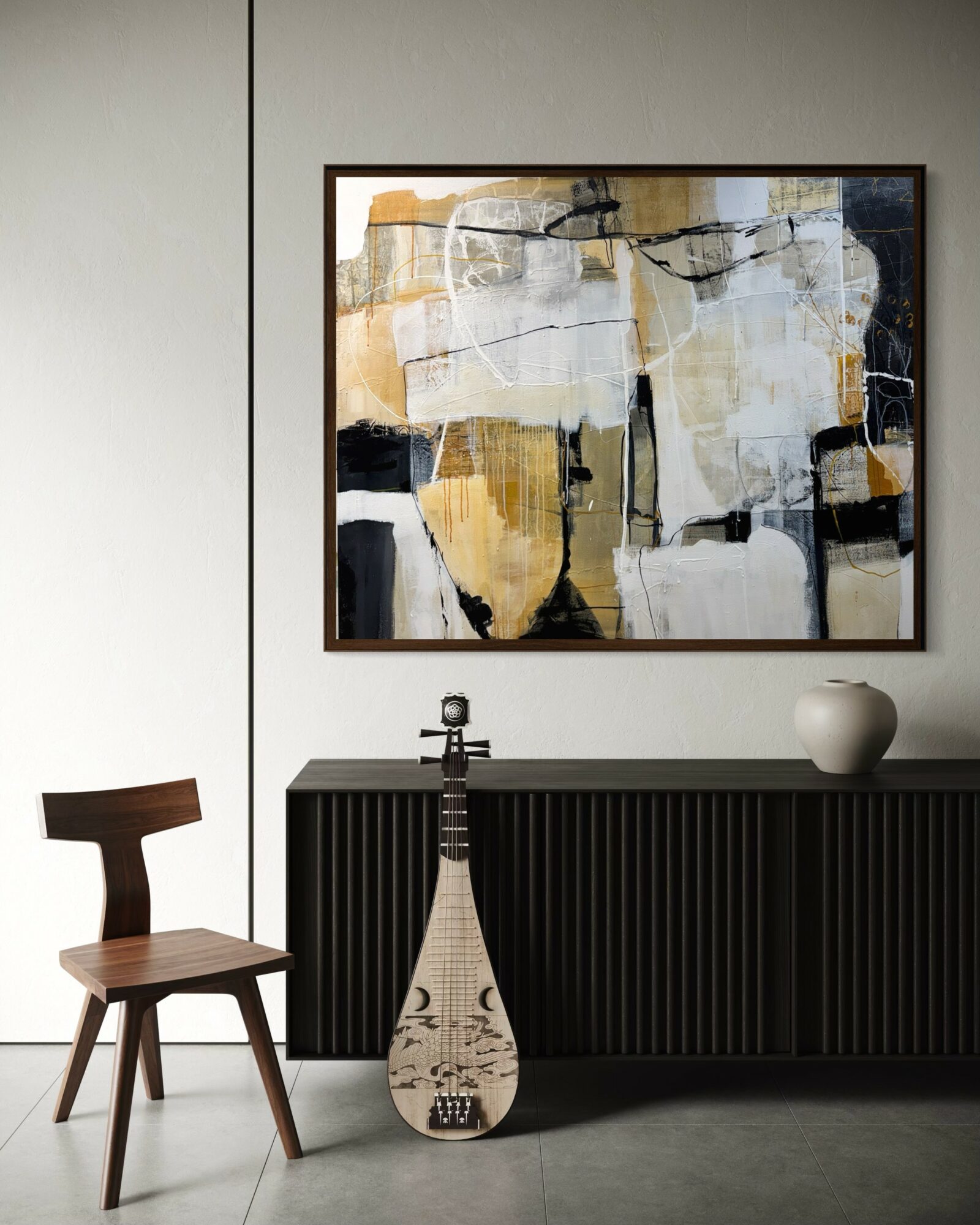
I work abstractly on paper, panel, and canvas with acrylic paint. They almost always end up with paper collage somewhere in the painting, and I still occasionally put sand in my paint. I use fluid acrylic paint, but lately I have been adding more medium body paint for texture. I would call myself an intuitive painter, beginning with no particular idea in mind and letting mark-making tell me where to go next! I like a monochromatic palette, though I have been venturing into more color lately. I believe I am known for the texture and asemic writing I include in my imagery.
Asemic writing is “writing” that looks readable but says nothing. I include it as a carrier of feeling. I have an elegant script, a primitive one, and one that resembles calligraphy. The writing can work as a compositional connector, leading the eye around the painting. It also gives a nod to the desire to communicate.
I am most proud of my resilience after my house and studio burned down. To say I felt spared by God is an understatement. I felt art would lead me back to myself. I lost a lot, but two weeks later, I set up a studio in a rental house garage and made my first painting from semi-burned remnants from the fire. I had been doing a lot of collage before we went away, and was throwing leftover pieces into the (dry) tray to file later. When they put out the fire, the tray filled up with water, and saved some of the pieces from burning. I have a collection of that saved paper, and I am still using it.
Are there any important lessons you’ve learned that you can share with us?
You have to have faith that there will be hiccups in your career and realize when you need to take a break. The most important thing I remember is a quote from Anne Truitt. She said “Put yourself at the hub of the wheel. Always say yes, I will think about it.”
Contact Info:
- Website: https://www.susannecarmack.com
- Instagram: www.instagram/susannecarmack
- Facebook: https://www.facebook.com/studiocarmack
Popular
-

Hidden Gems: Local Businesses & Creatives You Should Know
-

ATL’s Most Inspiring Stories
-

Seeing the Story Between the Moments
-

Portraits of Atlanta
-

Dr. Sinclair N. Grey III on Why Founders Stall—and How Discipline Breaks the Pattern
-

Meet Lee Patterson: Teaching Entrepreneurs How to Build Wealth the Right Way From Day One