

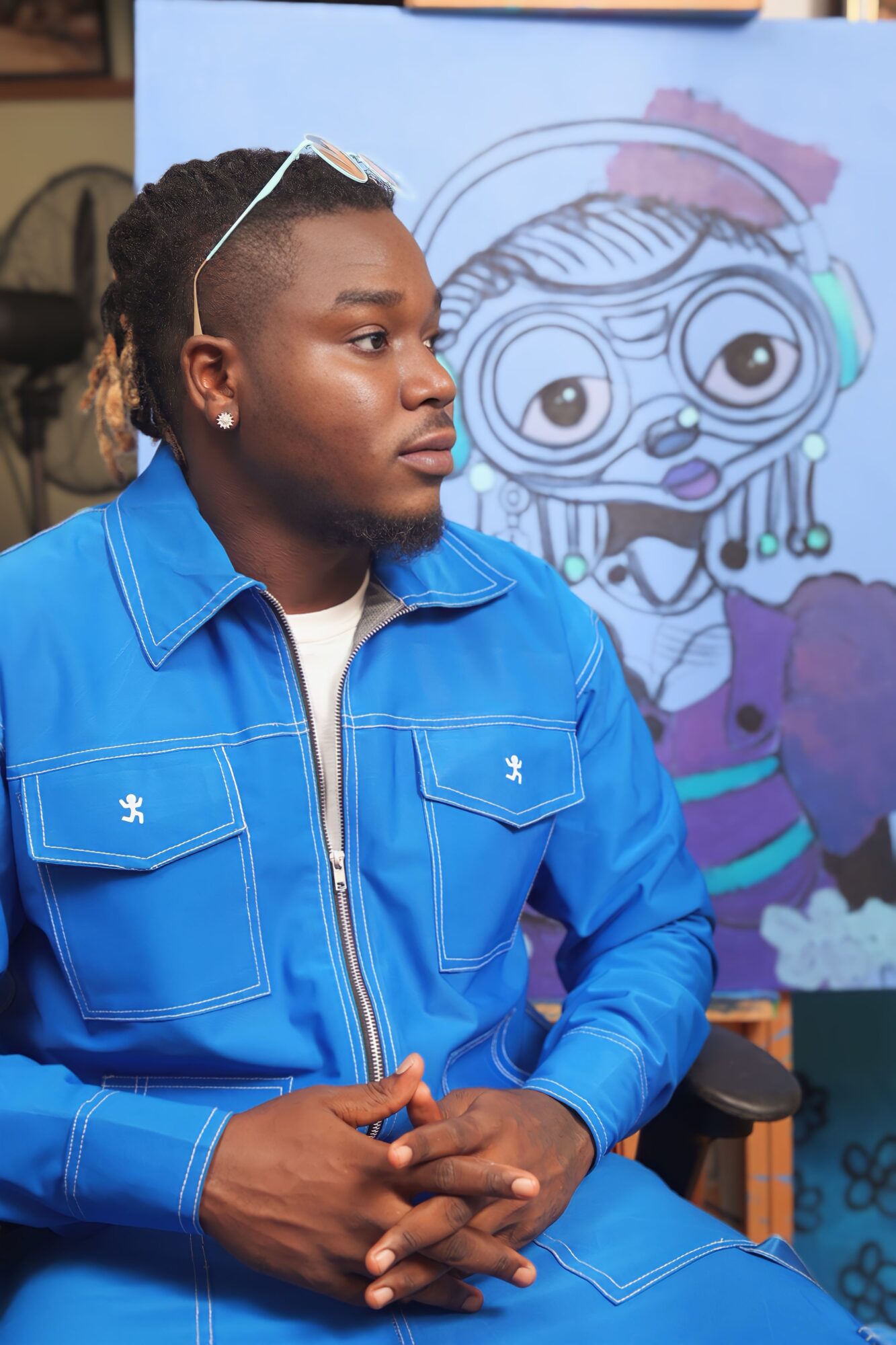
Today we’d like to introduce you to Sotonye Jumbo.
Hi Sotonye, thanks for sharing your story with us. To start, maybe you can tell our readers some of your backstory.
My Story
I often say that before I learned to speak, I had already learned to draw.
Some of my earliest memories are not of words, but of lines. I remember sitting quietly at the back of my classroom, filling the pages of my notebooks with stick figures instead of class notes. Before long, those simple drawings became portraits of my classmates, and drawing became the easiest way for me to communicate with the world around me. While other children made conversation, I made pictures.
My parents never really understood why I was always drawing. They would ask why my notebooks were full of sketches instead of notes, but I couldn’t explain it. Drawing wasn’t a hobby to me; it was instinctive. If there was an empty space on a page, I wanted to fill it. Looking back now, I realise I wasn’t choosing art . it was already choosing me.
One of the first moments that made me understand the power of what I could do happened in primary school. A teacher asked me to paint the Nigerian Coat of Arms on the classroom wall. When I finished, students from other classes came into the room just to look at it. It was the first time I experienced what it felt like for something I had created to attract people, to make them pause, to make them curious. I didn’t know it then, but that feeling would stay with me for the rest of my life.
The defining moment came years later through a simple conversation with my mother. She told me she thanked God that I had a gift, and that one day it would be able to take care of me. Those words changed the way I saw my talent. Until then, drawing had simply been something I enjoyed. After that conversation, it became something I felt responsible for developing. It stopped being a pastime and became a purpose.
I grew up in Bonny Island, Rivers State, and even today I realise how deeply that place lives inside my work.
Our house was close to the waterfront. Every morning I woke to the sound of waves striking the shoreline. I spent hours drawing in the sand, building little sand houses with my feet, watching the tide quietly come and go. I remember colourful masquerades dancing through the streets, their costumes and movements filling my imagination with mystery. I also remember the smell of crude oil drifting across the water. As a child, I thought that was simply what the sea smelled like. Only much later did I understand what that smell represented.
Those memories never left me. They continue to appear in my work not as literal representations, but as fragments of memory transformed into symbols. The environment, the culture, and the contradictions of the Niger Delta continue to shape the stories I tell.
After studying Visual Arts at Cross River University of Technology, I reached a point where I had to decide whether art would remain something I loved or become the life I wanted to build. I chose the second option.
With little more than determination and between ₦45,000 and ₦60,000 in my account, I left Port Harcourt and travelled to Lagos.
I didn’t know where I would stay.
I didn’t know who would help me.
I didn’t know what would happen next.
I only knew that I had to try.
The first few days were harder than I had imagined. Someone I trusted agreed to accommodate me, but after the very first night I returned to find the door locked. Suddenly, I was alone in a city that felt enormous, carrying my bags and wondering where I would sleep.
A friend working aboard a ship gave me somewhere to stay for a weekend. When the ship was due to leave, I found myself searching again until I eventually arrived at Universal Studios. I wrote a letter asking if I could stay there, and thankfully I was given permission.
For almost a year, that studio became my home.
During the day I worked there. At night, after everyone had left, the wooden drawing benches became my bed. There were mosquitoes, uncomfortable nights, and moments of uncertainty, but strangely, I never believed I had made the wrong decision by coming to Lagos.
People often ask if I ever considered giving up.
The truth is, I never questioned whether I was an artist.
I only questioned whether I would succeed.
Whenever money ran out, I relied on the only thing I truly trusted my hands. I tattooed. I painted faces. I accepted whatever creative work came my way. Some days I ate only once. Some days bread and water were enough. Other days I skipped meals entirely so I could make the little money I had last a little longer.
What kept me going wasn’t optimism. It was conviction. I believed that as long as I could create, I would eventually find my way.
The only time that belief was seriously tested came during the COVID-19 pandemic. Almost overnight, exhibitions stopped, tattoo appointments disappeared, collectors stayed home, and every source of income vanished. Like many artists, I found myself isolated, uncertain, and struggling simply to survive.
For the first time, I wondered whether I had made the right decision.
Instead of asking for financial help, I approached my mentor, Professor Bruce Onobrakpeya, and asked if I could work alongside him as his studio assistant. That decision became one of the greatest gifts of my career.
Working with him taught me far more than technique. It taught me discipline, patience, consistency, and the importance of building an artistic practice rather than simply making individual artworks. Looking back, what felt like one of the darkest periods of my life became one of its greatest turning points.
Not every challenge came from hardship. Early in my career, galleries rejected my work. At the time, I thought they were rejecting me. Years later, I realised they were rejecting my lack of direction. I had paintings, but I hadn’t yet developed a coherent body of work or a clear artistic voice. Those rejections pushed me back into the studio, where I learned that success isn’t built on isolated works but on consistency, research, and patience.
Today, my studio is still the centre of my life.
Every morning begins almost the same way. I wake up, say a short prayer, make a cup of coffee, and begin working. Some days I paint. Other days I sculpt, draw, carve reliefs, experiment with materials, or simply spend hours researching ideas. I don’t believe creativity is about waiting for inspiration. I believe inspiration finds you while you’re working.
What fascinates me most is transformation.
Sometimes, while painting, unexpected forms emerge on the canvas figures or symbols I never consciously intended to create. Rather than ignoring them, I pay attention. As a person of faith, I see those moments as quiet conversations between intuition, experience, and God’s guidance. They often reveal ideas I wasn’t aware I was searching for.
That same curiosity extends beyond painting. Increasingly, I’m exploring how discarded plastics and other waste materials can be transformed into sculpture. Living in Nigeria, where waste is part of everyday life, I constantly ask myself how forgotten materials can be given new purpose. Whether I transform paint, plaster, or discarded plastic, I’m interested in the same question: how can something overlooked become something meaningful?
Ultimately, that’s what my work is about.
Transformation.
Not just the transformation of materials, but the transformation of memory, struggle, identity, and hope.
If someone stands in front of one of my paintings, I don’t expect them to leave with my interpretation. In fact, some of the most meaningful conversations I’ve had are with people who discovered things in my work that I never consciously intended. I believe every viewer brings their own experiences into a painting, and those experiences complete the work in ways I never could.
More than anything, I hope people connect with my work because they genuinely love it not because of my name, where I come from, or the exhibitions I’ve participated in. I want the work to speak for itself.
If, years from now, someone stands in front of one of my paintings and feels understood, challenged, comforted, or inspired without knowing anything about me, then I will have achieved what I set out to do.
Because long before there were exhibitions, collectors, or recognition, there was simply a little boy from Bonny Island who couldn’t stop drawing.
And despite everything that has happened since, that part of me has never changed.
“I Never Questioned Whether I Was an Artist.”
Would you say it’s been a smooth road, and if not what are some of the biggest challenges you’ve faced along the way?
One of the biggest challenges I’m facing at this stage of my career is space. As my practice has evolved beyond painting into sculpture, reliefs, installations, and experiments with recycled materials, I’ve realised that my ideas are growing faster than my studio can accommodate.
Many of the materials I work with, especially discarded plastics and found objects, need to be collected, sorted, and stored before they become part of an artwork. Large scale sculptures and installations also require room to build, document, and preserve. Without adequate space, some ideas have to wait much longer than I’d like.
Beyond my own work, I also think about the next generation of artists. Over the years, I’ve found myself mentoring younger creatives who come to my studio to learn, experiment, and ask questions. I would love to build a studio that isn’t just a personal workspace, but a creative environment where artists can exchange ideas, collaborate, and grow together.
I’m already taking steps in that direction by developing a new studio, but I see it as the beginning rather than the destination. My vision is to create a space that grows alongside my practice a place where ambitious ideas can be realised and where creativity can be shared with others.
“I don’t want to build a bigger studio simply to make bigger artworks. I want to build a space where bigger ideas can happen.”
Can you tell our readers more about what you do and what you think sets you apart from others?
I am a contemporary visual artist whose practice spans painting, sculpture, relief, and installation. My work explores the relationship between humanity, technology, memory, identity, and culture through an Afrofuturist lens. Growing up in the Niger Delta, I became fascinated by how people adapt to change while holding onto their identity, and those experiences continue to shape my artistic practice.
For the past six years, I have been developing an ongoing body of work titled Radiohead. The series began with a simple question: What if the human mind was a radio? I imagine the mind as a receiver, constantly tuning into invisible frequencies of thought, emotion, memory, and imagination. This idea became the foundation of a symbolic visual language through which I explore what it means to be human in an increasingly technological world.
The Radiohead figures are hybrid beings with radio-shaped heads, oversized goggles, cassette-player noses, antennas, cables, microphones, and richly patterned African textiles. Each element carries meaning, reflecting perception, memory, cultural identity, and our evolving relationship with technology. By combining traditional African aesthetics with futuristic imagery, I imagine worlds where African identity remains central to conversations about the future.
Although painting is the foundation of my practice, I extend these ideas through relief sculpture, installation, and works made from recycled and discarded materials. Across every medium, I am interested in transformation. how people, objects, and ideas can be reshaped into something meaningful.
Ultimately, my work is about making the invisible visible. Through symbolic imagery, I invite viewers to slow down, reflect, and discover new layers of meaning within each piece. I hope they leave with a sense of wonder and the confidence to imagine beyond what they already know. For me, creating is more than a profession, it is my voice, my purpose and the way I make sense of the world.
What do you like best about our city? What do you like least?
Outside the studio, I enjoy simple things that help me slow down and reconnect with myself. Music is a constant companion while I work, and football has always been one of my favourite ways to relax. Whenever I need to clear my mind, I enjoy spending time at the beach. Growing up in Bonny Island, being close to the water has always brought me a sense of peace, so returning to the coastline still feels like returning to something familiar.
I also value solitude. Some of my best ideas come during quiet moments of reflection, away from the distractions of everyday life. Those moments allow me to think deeply about my work and often become the starting point for new projects.
One thing I value greatly is respect for people, for time, and for creative work. I appreciate honesty, professionalism, and people who genuinely support others. On the other hand, I struggle with people who take advantage of others, waste time, or fail to respect the effort and dedication that goes into building a creative career.
“Whenever I’m by the water, I feel connected to where I grew up. It reminds me of the place that first taught me how to observe the world.”
Contact Info:
- Instagram: @bigjumbo99
- Youtube: https://youtube.com/@sotonyejumbo1111?feature=shared


Popular
-
How Kaviar Sundays Is Building a Creative Career Fueled by Purpose, Community, and Staying Focused
-

Hidden Gems: Local Businesses & Creatives You Should Know
-

ATL’s Most Inspiring Stories
-

Portraits of Atlanta
-

How Kimberly D. Worthy Is Redefining Real Estate by Helping People Become Ready From the Inside Out
-
Summer McIntyre Is Building a Career at the Intersection of Sports, Media, Entertainment, and Digital Storytelling