





Today we’d like to introduce you to Camryn Triplett.
So, before we jump into specific questions about what you do, why don’t you give us some details about you and your story.
I was born and raised in Atlanta, GA, and graduated from a small private school in Atlanta. I went on to study psychology at Howard University and graduated from there, Summa Cum Laude, Phi Beta Kappa. Upon graduation, I had not secured a job, nor made a decision about graduate school, so I returned to Atlanta where rent was free. I fell into the rental car industry for a few years until I left that job to pursue my first love, marketing and branding.
My father always instilled the power of networking, so after leaving car rental, I reached out to a mentor, whom I interned with in high school. I told him I had recently left my job, and he immediately put me to work, helping on various projects and helping to produce his podcast. My relationship with James is what ultimately led to me meeting Shanti Das. Shanti Das was a guest on James Andrew’s Podcast in 2015. When James first told me about her, I was excited to hear about her glamorous life in the music industry. I was not expecting her to open up about her battle with depression, anxiety, and suicidal ideation. She said that she wanted to start a mental health movement and was going to call it Silence the Shame. I pulled her aside after the interview and told her I wanted to be involved because I had my own battles with mental illness.
What I have not mentioned in my story thus far, is my ongoing battle with mental illness. At the age of 12, I was diagnosed with Generalized Anxiety Disorder and Major Depressive Disorder. For years, it was something I dealt with privately with my family. It wasn’t until hearing Shanti open up about her own battles so publicly, and wanting to start Silence the Shame, I finally felt like space was being created for me and others to speak openly and honestly about mental illness.
We’re always bombarded by how great it is to pursue your passion, etc. – but we’ve spoken with enough people to know that it’s not always easy. Overall, would you say things have been easy for you?
Shanti often says, “You are only one traumatic event from a mental health crisis.” Those words couldn’t be more true for me. My first depressive episode happened around my parent’s divorce when I was 12. It was the first time I admitted to my mother that I was having thoughts of suicide. I was pulled out of school for about a week, was evaluated by a psychiatrist, and was put on meds that I stayed on a few years into high school.
My second depressive episode was centered around my mother’s death. She passed away 2 weeks into my senior year of high school. I really didn’t have time to grieve. I had to apply to college, and maintain my grades for the year. Upon entering Howard, I used school work, friends, and relationships, to distract me from the grief that would eventually catch up with me. Being no stranger to depression, I utilized my resources, and starting therapy through the counseling center on campus, and went back on anti-depressants. The rest of my Howard experience was incredible, in spite of my father becoming a quadriplegic due to a spinal cord injury during my sophomore year. I studied in Granada, Spain for six months, and made friends at Howard that will last a lifetime.
When the grief finally caught up with me, it hit me like a ton of bricks. I graduated at the top of my class, with honors, I found myself falling into another depression. I had been going non stop the past five years since my mother passed away, and never really took time to grieve her. All of a sudden, I had no classes occupying my mind space, distracting me from my grief. Once again I found myself back in therapy and on medication.
Although I loved being back home, and living so close to my dad, in some ways, I started to resent the fact that I was having to take care of another parent in my early twenties. My mother had been sick my entire life, so my time with friends after school growing up was constantly being cut short to tend to my mother. College gave me my first taste of freedom from responsibility to my parents, and it took me a minute to readjust.
Because of my Dad’s spinal cord injury, the last eight years of his life were spent in and out of the hospital having surgery after surgery. At the beginning of 2019, my father told his family that his body was turning septic, and chose not to undergo any more surgeries becuse is quality of life had gotten so poor. My father passed away at the end of March.
Learning from my past experience of depression and running from my grief, I told myself that I needed to take time for myself. I ended up losing my job because I did not feel that I was giving adequate bereavement given my circumstances. I also knew how much I appreciated the friends I had made since losing my mother that also had lost a parent. We understood each other in a way that people who haven’t experienced .that type of loss could. I was wracking my brain, trying to think of who I knew that had lost both of their parents.
Shanti Das came to mind. At this point, we were essentially still acquaintances. I had helped her out with a few things when I had met her a year prior, but we did not really keep in touch. I knew her father died by suicide when she was a baby, and her mother had been diagnosed with Alzheimer’s about eight years prior, so in my mind, she was the only person I knew that could kind of relate to me, and I really needed someone. I called her about a week after my dad passed away, and we made arrangements to meet up the following month. At that point, I had lost my job and had nothing but time and passion for Silence the Shame. The rest has honestly been history. When Shanti gave me access to the SIlence the Shame Instagram account we had around 600 followers. With the help of myself, Shanti, and Jasmine Chapman, Porscha Sinclair, and Free the Vision, Silence the Shame is now approaching 15k!
I said all of this because it is important ALWAYS listen to that little voice pushing you to take a chance, even if it scares you. That voice is pushing towards something great. I had a million reasons to not pick up the phone and call Shanti that day, but eventually, I told myself, Cam the worst thing she can do is say, “No, I don’t need/want your help.” and if she does, at least you tried. It’s 2019 and Silence the Shame has gone from a mental health awareness movement to a nonprofit organization in a few short years, and I am happy to be the Communications Manager.
So let’s switch gears a bit and go into Silence the Shame story. Tell us more about it.
Silence the Shame is a non-profit health, education, awareness, and advocacy organization. Through community conversations, compelling content and other programs, our goals are to normalize the conversation, peel back the layers of shame to eliminate stigma and provide support for mental health, poverty, and youth empowerment.
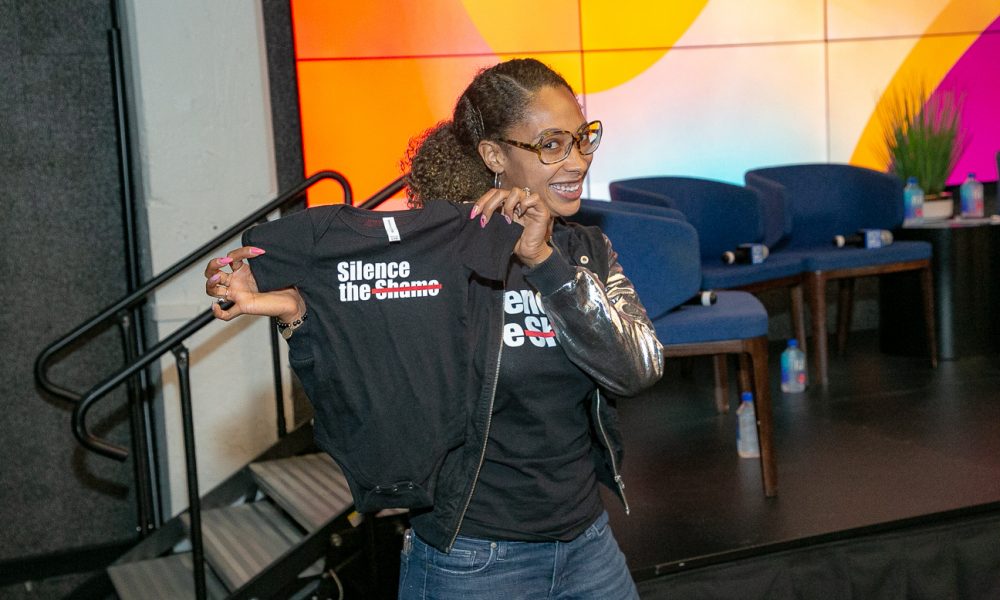
My title is Communications Manager, but my role extends beyond communications. I organize Silence the Shame Self-Care Saturdays, which are regular free events offered to the community in the name of self-care. I have created a few of our graphics on Instagram, and design some of the printed material we distribute. I manage our t-shirt orders and overall material inventory, and you can usually find me at mental health conferences around the city passing out Silence the Shame resources, and speaking about mental health. I am also a certified Mental Health First Aid Instructor. Since getting my certification, I have conducted 3 trainings, and certified about 55 Mental Health First Aiders.
I am proud of the progress we have made in such a short amount of time. Earlier this year, Silence the Shame was given an award for advancing minority mental health from the American Psychiatric Association Foundation. For me, it is important that more minorities are getting into the mental health space. Mental health does not discriminate, and minorities are seeking treatment for mental health at rates much lower than their white counterparts. Being a part of an organization that is resonating so much with my own community means the world to me.
Silence the Shame recently announced a partnership with the Atlanta Hawks for the season opener.
In addition to working for Silence the Shame, I do social media management and branding. I really have a passion for helping others visions come to life online. Working with Silence the Shame has given me multiple opportunities to enhance my skills.
What do you feel are the biggest barriers today to female leadership, in your industry or generally?
I have the privilege of working with a woman who was a leader in a male-dominated industry, now working in an industry that tends to skew female. I have created a working environment for myself where I know I am valued, and respected.
Working with Shanti, I am constantly learning how to always maintain a level of professionalism. The work that we do forces Shanti and myself to get personal very quickly with people. I have not found those normal barriers I have felt, even in corporate environments. I think working in mental health, and working with someone who commands so much respect, I am met with a level of compassion that I’ve never experienced.
Pricing:
- Social Media Strategy Session (2 hours) $500
- Social Media Content Calendar (3 posts/week) starting at $1000/mo
Contact Info:
- Website: www.silencetheshame.com
- Email: [email protected]
- Instagram: @curlycams88
- Facebook: facebook.com/SilencetheShame
- Twitter: twitter.com/SilencethShame
- Other: https://groupmatics.events/event/Silenceshame


 Image Credit:
George Butler Photography
Suggest a story: VoyageATL is built on recommendations from the community; it’s how we uncover hidden gems, so if you or someone you know deserves recognition please let us know here.
Popular
-

Hidden Gems: Local Businesses & Creatives You Should Know
-

ATL’s Most Inspiring Stories
-

Portraits of Atlanta
-

Natasha Dillard on Redefining Beauty Standards and Empowering Women Through Unapologetic Self-Expression
-

Darren Paltrowitz on Blending Investigation, Media, and Culture to Uncover the Stories Behind the Stories
-

Naeemah Jade on Redefining Networking Through Trust, Proximity, and Intentional Community