






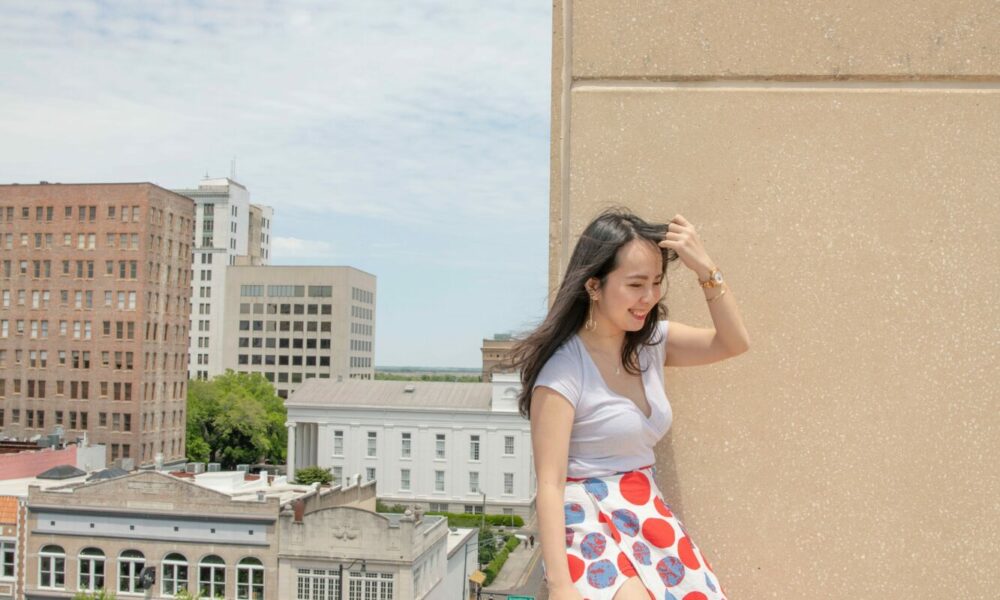
Today we’d like to introduce you to YiJun Jiang.
Hi YiJun, so excited to have you on the platform. So before we get into questions about your work-life, maybe you can bring our readers up to speed on your story and how you got to where you are today?
I am from Taiwan. Currently, I work as a designer specializing in digital marketing creative content. I have been working in the creative industry for a decade. Before coming to the United States, I was a media art teacher at a school where I worked on animation promotion projects aligned with government and educational policies. Prior to that, I served as a visual designer at a PR company, often engaging in interdisciplinary design-related tasks.
This year marks my fifth year in the United States. Five years ago, I was juggling my teaching job in Taiwan while preparing to study abroad. In my first design job, I found the design industry in Taiwan was far less friendly than I had imagined. I often rushed out numerous low-quality production works under high pressure and low pay. I lost sight of my intention as a designer to create meaningful designs. Facing confusion, I decided to change my environment and study design again. I didn’t have a plan in mind back then, but I decided to do it all without relying on my family.
The turning point in my life came when I successfully applied for a full scholarship in 2018. I remember the night after my interview for SCAD, I received an email stating that I had a chance to compete for the scholarship with other candidates. The next day, the topic was revealed: to create a design for the visually impaired. The deadline was the following day, giving me just 24 hours to complete a proposal. I stood outside the fancy hotel where the interview took place, apologizing to my employer for taking a last-minute leave. My home was far from Taipei City. I called my close friend and stayed in her apartment. I stayed up all night: imagining myself blind one day, I crafted a campaign around the Taipei metro system, created a key visual tying the topic of togetherness, and designed high-fidelity mockups combining visuals with the other four senses. For 48 hours, I worked non-stop, and in the morning, feeling exhausted, I headed to the venue, taking a taxi while rushing my presentation.
A month before the start of the semester, I received a call from the school informing me about the scholarship offer. I rescheduled my flight and arrived in Atlanta, where I had my first impression of the United States.
Two years after completing my master’s degree, in my 31st year of life in the United States, I found myself returning to where I started at 21. I gained new insights about design, although I still had to handle basic tasks and mundane chores and meet tight deadlines. I started by taking on small tasks and testing each task with dedication. By genuinely committing myself to each task, I learned that the passion for work is not something that is given. To my younger self, who was dissatisfied with the design work in my early twenties, I would say: You can choose to be a victim or become anyone you wish to be.
Can you talk to us a bit about the challenges and lessons you’ve learned along the way. Looking back would you say it’s been easy or smooth in retrospect?
During my studies, I had to maintain at least an A in one subject and a B in another to keep my scholarship. This pressure often led to feelings of depression. In my typography design class, I stayed awake until the early hours of the morning, struggling to come up with concepts with numerous attempts. My proposals were constantly rejected, and I still received criticism for being lazy.
I disagreed with this evaluation as I always approached my work with seriousness and dedication. I couldn’t even allow myself to defend my design concept when the professor critiqued it, and I ended up silently crying on the side. Over the following summer break, I spent time refining my rejected concepts into a collection as an open letter concept. I unified visuals and refined typography treatments after learning principles again from books and online lectures. My work ‘Dear Anxiety: An Open Letter’ won the International Design Awards bronze.
After graduating, I faced numerous rejections while job hunting in the United States. I sent out hundreds of resumes, went through rounds of interviews, and often received sudden emails stating that I didn’t meet the company’s hiring criteria after discussing my sponsorship requirements. It made me doubt my abilities. However, I continued to improve my portfolio, practice my pitches, and explore opportunities. Eventually, I landed a job as a junior designer and later got promoted to a designer.
Despite this success, especially with the rare H1B lottery drawing, with high registrations, the chances of selection are 10.89%. I have a lot of uncertainty about my future and where I would be. I now try not to worry about the unpredictable and focus on addressing problems as they come.
As you know, we’re big fans of you and your work. For our readers who might not be as familiar what can you tell them about what you do?
I focus on conceptualizing ideas and providing visual solutions. To me, the ability to offer solutions to design problems is crucial. These solutions can range from small adjustments in layouts to larger endeavors like campaigns or projects. My current responsibilities involve creating user interfaces for responsive websites, generating social media content, developing brand identities, crafting campaigns, and ideating concepts. I not only create design, but I also write about design and talk about design. I believe that design is about communication. Effective communication begins with connecting with people. I strive to be a skilled visual and verbal communicator.
One of my proudest achievements is formulating my thesis proposal in a month, resulting in the successful attainment of a $32,000 grant funding. The process of crafting a thesis proposal was remarkably like the design process – from brainstorming ideas through freeform writing to scrutinizing the initial chaotic drafts and contemplating which issues could have the most societal impact. I pondered how to harmonize design solutions with the project’s overarching theme and how to visually present these concepts. This endeavor led me to deeply reflect on myself, my hometown, and cultural values. In my thesis ‘Revealing Diversities in Modern Taiwan Visual Language,’ I reimagined Taiwan’s banknotes through the lens of religion and values, conceptualized passports based on social movements to express shifts in identity, and designed stamps for everyday life to convey sentiments of longing. My banknote design was even selected for the JAGDA International Student Poster Award. It was through the fund derived from my thesis paper that I navigated through two and a half years of graduate school.
In times of resource scarcity, I actively strive to become a resourceful individual.
If we knew you growing up, how would we have described you?
I have always believed that I possess a free spirit, driven by a desire for personal growth and to experience different things. At the age of 15, I independently applied to an art school, spending my teenage years immersed in paints and charcoal. My parents were often unaware of my pursuits.
During my university years, I participated in the Ministry of Education’s study abroad program, competing among the top 30 students nationwide. In the end, I only secured the thirtieth place in the animation category. After graduation, I made a decisive switch from animation to design. Even in the face of failure, after putting in the effort, the outcome is predetermined.
At the age of 25, I was working as a media art teacher, waking up at 7 a.m. each morning and dedicating my evenings to an adult English class. Over years of working, I almost forgot my aspirations to study abroad. However, one evening, after a casual conversation with a fellow classmate in an adult English class, I impulsively walked into a study abroad agency and paid the fees – thus commencing my journey.
All the experiences seem related but unrelated. I am someone who follows my instincts; if I think of something, I simply go ahead and do it!
Contact Info:
- Website: https://jyijun.com/
- Linkedin: https://www.linkedin.com/in/yijunjiang/


Popular
-

Hidden Gems: Local Businesses & Creatives You Should Know
-

ATL’s Most Inspiring Stories
-

Portraits of Atlanta
-

Natasha Dillard on Redefining Beauty Standards and Empowering Women Through Unapologetic Self-Expression
-

Darren Paltrowitz on Blending Investigation, Media, and Culture to Uncover the Stories Behind the Stories
-

Naeemah Jade on Redefining Networking Through Trust, Proximity, and Intentional Community