




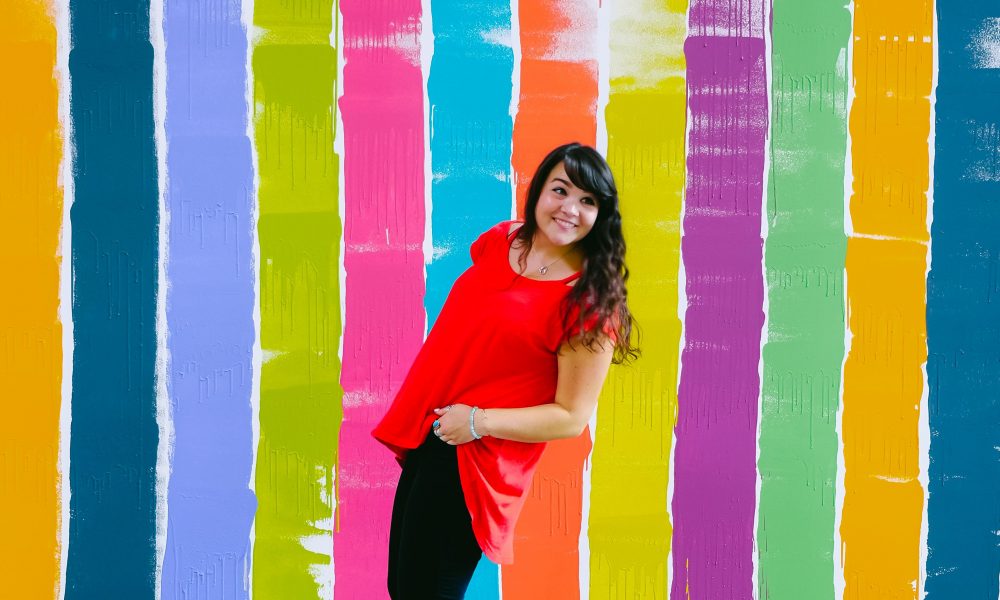
Today we’d like to introduce you to Rebecca Carmen.
Rebecca, please share your story with us. How did you get to where you are today?
I got started at a very young age designing and painting whenever I could. To this day, my mom has piles of my drawings. I graduated from Savannah College of Art and Design with a B.F.A in fashion marketing and management. While in school I sold products I designed and freelanced in trend forecasting and surface pattern design. Whenever I had an opportunity I took it and if it required a skill I wasn’t 100% at, I learned on the job. While school taught me skills, it was the on-the-job learning where I really would have to problem solve and think creatively to reach a solution.
I interned for Disney Theme Park Merchandise in product development in consumables, stationery, and souvenirs. While interning I did trend forecasting for my department as well as continued to freelance. I moved back to Atlanta after my internship and began taking on more freelance clients. Last year I came back to Disney Theme Park Merchandise in R&D. I do trend forecasting, ideation, design, and concept development. I think having skills in multiple disciplines has really opened up solutions in design challenges for clients. For instance, when I see a trend I’m able to interpret it for my client so they understand how the trend can be developed. Along with my job, I continue to develop my own products and do photography for brands like James Avery, Teva, and Universal Orlando Resort.
I got where I am today because of risk taking, constant development, and a high value for work ethic and efficiency. The way I approach a job is how I would want the task done if I was a client. I’m constantly reaching out to artists I admire for advice as well as using any opportunity I can to network.
Some of my clients include Disney, Marvel, Lucasfilm, Universal Orlando Resort, AmericasMart, and Impulse Tech.
Has it been a smooth road?
I don’t think there is ever a smooth road, and if someone is under the impression of a smooth road they are living too far in their comfort zone. While in college I took on my first licensing agreement for surface pattern designs and ended up having to write my own contract with zero experience. It was definitely a learning curve to determine how and where my products can be used. Pricing myself was difficult as well, I wanted jobs so I would undervalue myself so I could take on jobs. I learned a lot but in the end, I realized you can’t undervalue your work and yourself. I think creative people thrive the most when they’re the most uncomfortable, sure you can produce some great things in your comfort zone, but that doesn’t necessarily move you forward. I’ve found that some of my best work so far has been created from those high pressure, fast pace, and most uncomfortable assignments.
What is the most difficult part of what you do?
I think there are two things that can make my job hard. The first is second guessing or doubting myself. When working on a project each decision has to be made with tact. If I’m choosing colors and I begin to second guess one color it could lead to a tangent of re-pulling colors and lead to a result I may not have been aiming for. It is a tough line to walk at times because a lot of my work is making choices that aren’t a client’s status quo and if I doubt my choices that can show. The second is editing and curation. I want to show clients the best possible concepts for successful results. For me to do that I have to be sure I’m not overwhelming the client with options. In trends and forecasting, I may gather ten different ideas for one trend but I will only show two concepts to my client. That way I’m going deep into the narrative of those two particular concepts rather than spreading thin over multiple ideas that may have missing parts in their story. Editing can be hard, but fun. Once I get through the nitty gritty of sorting, sifting and narrowing down ideas the real creating begins.
How do you define success?
Success to me is kind of like a stair master. I think if you have endurance and an efficient work ethic successes will appear, the results may not be immediate but with consistency, they will come. Something I look out for to be successful is constantly learning more about your craft or a new skill entirely. A lot of people say that you need to choose one thing and just be good at that one thing, but to me, that notion closes your mind. Sure you may not start basket weaving after you watch a few youtube videos, but you may pick up a weaving technique or fabric application that you want to use in a new line of women’s handbags. Confidence in risk taking is huge. Most of my clients have been in the business for longer than I’ve been alive. The concepts I present are not their “norm” and I’ve been questioned many times about the choices made for a project (like obscure colors for a multi-category park program); when my clients not only see my research but my confidence, they understand that this is the sort of change they need. It’s not about reinventing the wheel, it’s about replacing the axels and steering.
So, what should we be on the lookout for, what’s next in store for you?
I’m lucky to be able to utilize different skill sets at my day job like fashion illustration, trend forecasting, and graphic design; so I hope wherever I am next that I’m able to do the same. Making the time to freelance has been great and I’m planning on expanding that this next year with photography and design. I love traveling so I’m hoping to do a bit more of that because I’ve learned so much from it.
Contact Info:
- Website: https://www.rebeccacarmen.com
- Email: rebeccacarmendesigns@gmail.com
- Instagram: https://www.instagram.com/rebeccacarmen/
- Facebook: https://www.facebook.com/RebeccaCarmenDesigns
- Other: https://twitter.com/RebeccaCarmen


Popular
-

Hidden Gems: Local Businesses & Creatives You Should Know
-

ATL’s Most Inspiring Stories
-

Portraits of Atlanta
-

Satoya Hayes on Turning Beauty 2 Extensions into a Platform for Affordable Confidence and Entrepreneurial Opportunity
-

Asha Ford on Building Krystal Klear Motion and Creating Purpose-Driven Design for Women
-

Truth in Every Verse: Jay Erve on Identity, Experience, and Creating Art That Lasts