


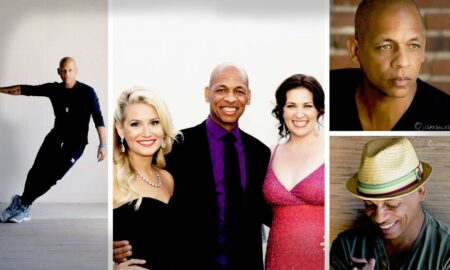




Today we’d like to introduce you to Tauheedah Baker-Jones.
Hi Tauheedah, we’d love for you to start by introducing yourself.
I was born and raised in Newark, NJ. I am a first-generation college graduate, daughter of working-class parents, a wife, and the proud mother of three amazing adults. My experiences as a student and a mother of children with intersections across race, gender identity, and learning differences have given me a unique view into how children can be adversely affected by educational inequity and marginalization. My experiences as a student have informed my “why” for doing this work, and my experiences as a mother have informed “how” I approach this work.
From Pre-K to 3rd grade, I had very positive experiences with school, and I excelled at it. From 4th through 8th grades, I had the misfortune of having a string of teachers who would have both profoundly negative, and unintendedly positive, impacts on my educational experience. What prompted this shift, is that in 3rd grade, I left my school in the more affluent section of the city, where my mom and I lived, to attend a school on the other side of town, in a less affluent section of the community, where my dad lived.
In my new school, I learned the words ill-bred, brazen, defiant, and miscreant, not by reading some high-level text, but through the words my teachers used to describe my peers and I. One day, I was called into the hallway by my 7th-grade teacher. I don’t recall what I had done, and I don’t recall exactly what he said. What I do recall, was the thunderous sound of his voice, the look of anger in his eyes, him pointing in my face, and him using the words “ill-bred miscreant” to describe me. I also remember running to the restroom in tears.
One of my friends tried to comfort me by saying that I shouldn’t be too upset because “no one understood what he was saying anyhow.” That comment angered me. Primarily because she was right. I didn’t know what he meant, but I knew it had a negative connotation and I knew it had a traumatizing effect on me.
I later went to the library and checked out a dictionary so that I could look up the words. I learned that ill-bred meant “badly brought up or rude,” and that miscreants described a person who “behaves badly or in a way that breaks the law.” I wondered why our teachers would describe us this way.
I began connecting the dots and realized that my school was down the street from one of the worst housing projects in the city, our community had the highest crime rate, all of my friends lived in some form of public or low-income housing, and most of us were the products of teenaged parents. We checked all the boxes for deficit thinking and bias. Our teachers didn’t even bother to learn much more about us beyond that.
In that moment, I became aware that violence and power are encapsulated in words. I also learned that this same violence and power exists within the funds of knowledge in our classrooms.
Equipped with a dictionary, and resolve, I became committed to learning the meaning of the words that our teachers were using to describe us. I also committed to learning new words that I could use to defend myself. I guess you can say, that was my first act of challenging the status quo.
Little did I know that a year and a half of studying the dictionary would gain me admission into the top-performing magnet high school in the district. That negative event in 7th grade, by default, put me on a different path than my peers. I graduated high school and went on to attend Howard University, and later UCLA and Harvard University.
I often reflect on how my life would be different if that event had not occurred. I think about my peers, and I know how many of their lives turned out. I wonder how many more Harvard graduates were among us, but whose latent potential wasn’t actualized because of their experiences at our school.
My experiences as a student are what prompted me to go into K-12 education. First, as a high school History teacher committed to teaching students how to use the power of words and storytelling to empower and uplift. Later as an administrator, committed to redesigning systems and structures that create barriers for children.
All of my work has been rooted in a belief that students should not have to be in a certain classroom, attend school on the other side of town, or live in a certain zip code, to be seen, valued and highly educated. Every child deserves a learning environment where they can thrive, not by accident, but by design.
As a result, I have committed the past 19 years to ensuring that demography is not destiny for children. In all of my roles, I have worked to design systems, using a social justice lens, so that learning for all students improves and opportunity gaps are closed.
I’m sure you wouldn’t say it’s been obstacle free, but so far would you say the journey have been a fairly smooth road?
Throughout my career, there have been many ups and downs. My experiences growing up in Newark, NJ, during the height of the crack epidemic, bred in me a ‘Ride or Die’ spirit. The term ‘Ride or Die’ is often referenced in hip-hop and means someone would rather die than not support their friend. As I shared, this ‘ride or die’ spirit fueled my ‘why’ for becoming an educator.
I stepped into the education profession as a Rida’—ready to ‘Ride or Die’ for the communities and children that I served. These communities typically looked like me, or had similar socio-economic upbringings, or shared a common struggle of marginalization and oppression.
Reflecting on past leadership failures, I came to realize that possessing a “Ride or Die’ mentality, at least as I interpreted it, oftentimes caused me to get in my own way when leading this work. “Going hard” on issues of perceived inequity, having zero tolerance for bias, and canceling people who exhibit cultural ignorance, was an ill-informed approach. It dehumanizes the work. This work is human-centered and human beings are not disposable.
I have come to appreciate the power of grace in leading this work. Giving myself grace and extending grace to others. I credit this realization to the lessons I learned as a mom of my son, Sayer.
When Sayer came out to my husband and I as transgender, he told us that he would understand if we wanted him to leave our home. This broke my heart. I couldn’t believe that my child would think that this was an option for us. I wondered what would lead him to this conclusion. Then, I thought back to all the times during his childhood when I tried to force him to fit nicely into the gender normative box that I had internalized.
This was over 22 years ago, and even with all of the “social justice” training I had received; I didn’t know what to do with my child who was gender non-conforming. Back then, best practices in supporting LGBTQ+ students appeared as a blip in my teacher training curriculum, and there was no mention at all about Transgender or Non-Binary youth, and it’s sad to see that very little has changed.
My son’s coming out has positively impacted my life and my approach to this work. On that day, I was given grace to grow, and Sayer extended the patience I needed to make mistakes as I learned how to show up as my best self in this new space. Sayer also taught me that I am not the sum total of my worse mistake, and that grace comes in having another day to know better and do better. Another day to live as a better human being.
Because of this, I try to meet people where they are, not where I want them to be. I also try to hold space for the humanity in myself, with all its imperfections, so that I can recognize the humanity in others. We all have internalized the biases, conscious or unconscious, that come with these systems we were born into. Even once we realize our biases, it’s a daily practice to remain conscious of how they play out in our lives. We will undoubtedly make mistakes and experience setbacks because as human beings we are perfectly, imperfect.
I now approach this work by going softer on people and harder on systems because this work is not about baiting, guilting, shaming, or canceling. It is about grappling with the complexity of the world we live in, striving to ensure that our actions align with our values, acknowledging and reconciling with our past, and working to expand the promise of democracy for all. This work is about leaving our children with a better world and history to inherit.
Thanks for sharing that. So, maybe next you can tell us a bit more about your business?
My office, the Center for Equity and Social Justice (CESJ) is Atlanta Public School’s first office devoted solely to advancing equity in education.
We work to accelerate closing achievement and opportunity gaps. We do this by partnering with district staff to ensure that equity is a primary consideration in the district’s problem-solving, decision-making, and implementation processes. We also develop tools, share data, facilitate training, and provide the resources necessary for district staff to build their capacity, professional stamina, and the equity lens necessary to address equity issues within their scopes of work. The end goal is to create more inclusive, equitable, and just conditions for all APS students and staff.
One thing I am proud of is that the APS CESJ has taken the lead in cultivating cross-sector collective impact work. Historically, APS and City Hall has not had a collaborative relationship. However, our new Superintendent, Dr. Lisa Herring, has worked to mend the bridge between our offices. She is a natural collaborator, and she understands that the district cannot do this work alone. Under her leadership, the door has been opened for us to do some meaningful collective impact work.
I am also proud of the collective impact work and solid partnership that our office has developed with the Mayor’s Office of Equity, Diversity, and Inclusion. The collaborative work that we’ve been able to do, in such a short amount of time, is building a legacy for future generations.
As a result, Qaadirah Abdur-Rahim, the City’s Chief Equity Officer, and I have worked deliberately to break silos and leverage our collective resources to remove undue barriers to opportunity within our city.
In partnership with Operation Hope and CitiBank, we supported the launch of a Child Savings Account (CSA) Program. Child Savings Accounts are designed to help children build savings for the future. As part of the program, close to 3,000 kindergartners in Atlanta Public Schools will be provided with $50 savings account. These accounts grow in deposits each year upon meeting programmatic milestones and can be used to pursue post-secondary education or vocational programming after completing high school.
We also launched a Youth Entrepreneurship Program that target young people who were on our corners selling water. This program provided these students with $200 cash gift cards each month upon maintaining satisfactory academic progress and meeting programmatic benchmarks. The data collected from this pilot program revealed that most of the youth spent their earnings on clothing and food, which demonstrates a genuine need for programs like this in our community
The CSA and Youth Entrepreneurship programs are game-changers for our city. According to a recent study, about 35% of Atlanta’s children are living in poverty. Research also shows that a child born in poverty in the city of Atlanta has only a 4.5% chance of upward mobility.
Participation in a Child Savings Account Program, for example, has been shown to improve students’ educational outcomes, increase their success in college, and enhance their relationships with financial institutions. Atlanta is now 1 of 4 cities across the nation with a program of this nature.
Now, APS is leading the way and working to create a cross-sector data-dashboard that will support agencies across the city in identifying the resources and barriers within our neighborhoods that support, or hinder, a child from being ready for college, career, and life. With this dashboard district, city, non-profit, philanthropic, and other agencies will be able to measure our collective efforts to advance equity and improve the quality of life within our communities.
Achieving equity in our city will require cross-sector collaboration and mobilization of resources. This can only be done by design, and I am proud of the collaborative work we have done with cross-sector partners to advance equity within our communities.
I think this is what sets me apart from others leading DEI work within public organizations. I understand that the system is producing the results that we see and that it is doing exactly what it was designed to do. As I shared previously, my approach to this work is to go harder on systems and softer on people.
As equity leaders, we sometimes focus heavily on people — helping them examine their implicit biases, develop their cultural competency, etc. While this work is vitally important, if we want to accelerate our equity impact, we must be able to see the system that we are functioning in, understand how it works, and determine how it is reproducing inequitable outcomes. Disrupting inequity means dismantling oppressive systems and redesigning them to produce the equitable outcomes we wish to see. I am working to achieve equity by design.
Alright, so to wrap up, is there anything else you’d like to share with us?
No one person or organization can do this work alone. Achieving equity across the city, and within our district, requires attention from every member of our community- educators, families, civic leaders, business leaders, etc. It’s a herculean task but it is doable. To accomplish it, it will take:
Introspective Reflection: We must continuously always ask ourselves, “how can we do better?” in the pursuit of equity for all.
Relentless Optimism: Only those who see the invisible, can do the impossible. This work requires us to see the invisible. We must see the world as it can be so that we can do the impossible to get there.
Perseverance: We must keep at it. It’s hard work. It’s uncomfortable work. It’s necessary to work. We owe it to our kids, and each other, to work as hard as we can to achieve our shared goal and realize our vision for the future.
Teamwork: We are in this together. The success of our district, and our city, is a collective responsibility. Although we inherited this collective history and these current systems, we must do our part to ensure that we leave our community better than we found it. We owe it to the civil rights leaders who came before us. They have passed the torch to us. Now, it’s up to us to carry it forward.
Contact Info:
- Twitter: @TauheedahBaker
- LinkedIn: https://www.
linkedin.com/in/ tauheedahbaker/

Popular
-

Darren Paltrowitz on Blending Investigation, Media, and Culture to Uncover the Stories Behind the Stories
-

Naeemah Jade on Redefining Networking Through Trust, Proximity, and Intentional Community
-
Dr. Cortnie Baity on Expanding Beyond Therapy to Build Scalable Tools for Intentional Living and Relationships
-

Dr. Shameka Campbell on Embracing a New Identity and Guiding Others Toward Purpose and Spiritual Breakthrough
-

ATL’s Most Inspiring Stories
-

Kareem “Reemo Meerak” Tyson on Building The C.U.T.S. Podcast and Creating a Space Where Culture Lives and Breathes