



Today we’d like to introduce you to Kymberly Day.
Every artist has a unique story. Can you briefly walk us through yours?
My family moved often while I was young, from McKinney, TX, across Georgia and the Carolinas. Amidst this constant uprooting, artistic expression became the anchor in my life, as I grew up painting alongside my mother and comparing myself to her artistically. Inevitably I enrolled in the South Carolina Governor’s School for the Arts & Humanities, an arts boarding high school in Greenville, SC, while my family made another move across the state.
The Governor’s School gave me an amazing foundation of knowledge in many art mediums. I decided to move to Baltimore, MD, to attend the Maryland Institute College of Art (MICA), where I wouldn’t be forced to spend my freshman year simply repeating the foundations I received in high school, as would have been the case in most universities. Although I received a B.F.A. in painting at MICA, this was where I tried my hand at several alternative mediums in three dimensions during my senior year. For most of my time there, I had questioned what was important enough for me to paint, and I felt a greater satisfaction after completing a sculpture than I did from completing a painting.
After graduating from MICA in 2013, I worked in a local pet store in Baltimore, lazily freelanced in costume fabrication, and occasionally took buses up to New York City, contemplating graduate school. Soon after, I quit my job to spend a month couch surfing and visiting graduate programs in Los Angeles.
Ultimately, I returned to Greenville, SC, where my family had settled, and I rented a studio with my mother while I worked on graduate school applications. During this time, I developed a niche costume airbrushing business online and continued to explore obscure sculpture materials like foam, faux fur, and thermoplastics. This led me to accept an offer into the M.F.A. program at Clemson University in 2015. At first, this felt like I was settling because it wasn’t in a major city, but the affordability and slower pace of life in upstate SC proved to foster my motivation and ability to work large scale. I developed a series of large scale, mixed media figure sculptures.
Immediately after graduating from Clemson in 2017, I completed a residency at The Bascom: A Center for the Visual Arts in Highlands, NC, and began teaching at Lander University. Most recently, I’ve traveled to Atlanta for some prop and costume fabrication projects and exhibited my newest sculpture work at Young Harris College in northern Georgia. Today, I still teach at Lander, as well as at Clemson University, and continue to work in my studio in the Village of West Greenville, where I am returning my focus to painting for the time being.
Please tell us about your art.
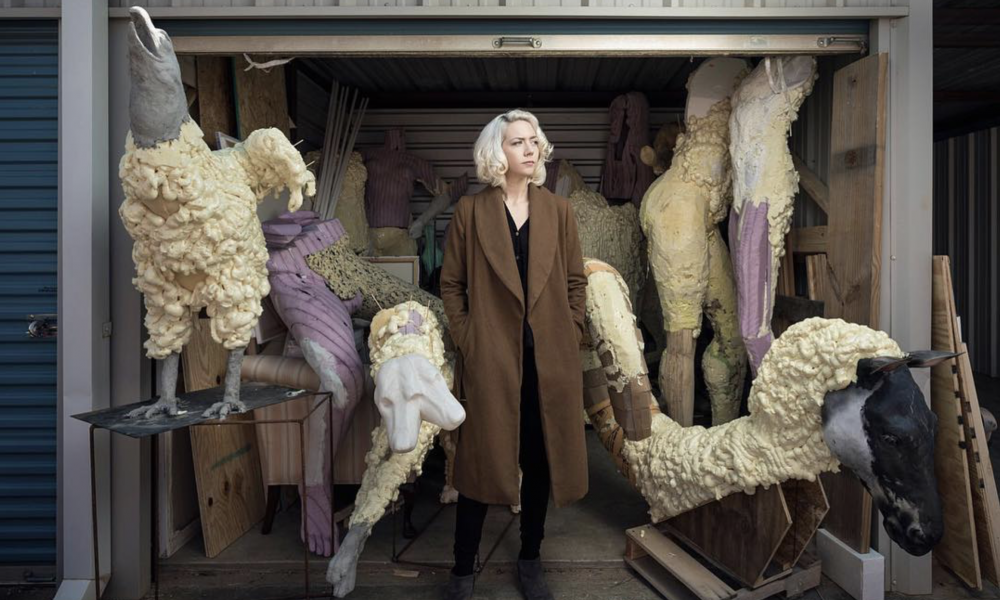
I paint in oils and sculpt in foam. It’s hard to reckon between the two sometimes, as they don’t relate much to each other apart from the prevalence of the figure. I use my paintings to explore tensions within the human mind, using the animal as an extension of or proxy for the human. Some of my new paintings explore the lost connection I have to my birthplace of Texas by staging pseudo-Western figural arrangements. Light surrealism results from scale discrepancies and disparate elements in the digital collages I make for each composition. I like to preserve a note of disbelief within an otherwise believable painted world. I compare this to the way that technology skews perceptions of history and memory. This becomes an investigation into the nature of reality and an attempt to organize perceptions.
My sculptural work is built from many layers of pink Foamular insulation foam laminated together and afterward carved by hand. I use a Japanese pull saw and a snap utility blade. The forms of the sculptures are based largely on remnants of Ancient Greek Classical, as well as Renaissance, figure sculpture. I participate in the practice of copying that is prevalent throughout art history, in which the Classical functions as the unwavering foundation for representational work in Western art. My renditions of the figures, however, present a fractured body that dances along the blurred lines of incompletion, destruction, and restoration, much like the artifacts of ancient or damaged works we see in museums. This state of incompletion, coupled with the exposed construction foam material, suggests that to be human is to be a perpetual work in progress, subject to bouts of restoration or healing, and never complete, a lot like history. The animal motif becomes an extension of the human as well.
Do you have any advice for other artists? Any lessons you wished you learned earlier?
Put your phone away often. Don’t let trends dictate your next steps. Trying to make your art fit into a certain category or theme will waste otherwise good studio time. Make what you’re passionate about, and if you don’t know what that is yet, then you’re not making enough to start with! I wish I had understood earlier just how imperative it is that artists make their own opportunities. Don’t wait for a “lucky break” to find you.
How or where can people see your work? How can people support your work?
My Instagram, @kymberlyday is the best place to see what’s going on in my studio, view progress shots, and process videos of my painting or carving techniques. My website, http://kymberlyday.com displays most of my figure sculptures and completed paintings.
Contact Info:
- Website: kymberlyday.com
- Email: kymberlydayart@gmail,com
- Instagram: @kymberlyday
- Twitter: @kymberlyday


 Image Credit:
Eli Warren
Getting in touch: VoyageATL is built on recommendations from the community; it’s how we uncover hidden gems, so if you know someone who deserves recognition please let us know here.
Popular
-
Darren Paltrowitz on Blending Investigation, Media, and Culture to Uncover the Stories Behind the Stories
-

Naeemah Jade on Redefining Networking Through Trust, Proximity, and Intentional Community
-

Dr. Cortnie Baity on Expanding Beyond Therapy to Build Scalable Tools for Intentional Living and Relationships
-

Dr. Shameka Campbell on Embracing a New Identity and Guiding Others Toward Purpose and Spiritual Breakthrough
-

ATL’s Most Inspiring Stories
-

Kareem “Reemo Meerak” Tyson on Building The C.U.T.S. Podcast and Creating a Space Where Culture Lives and Breathes