


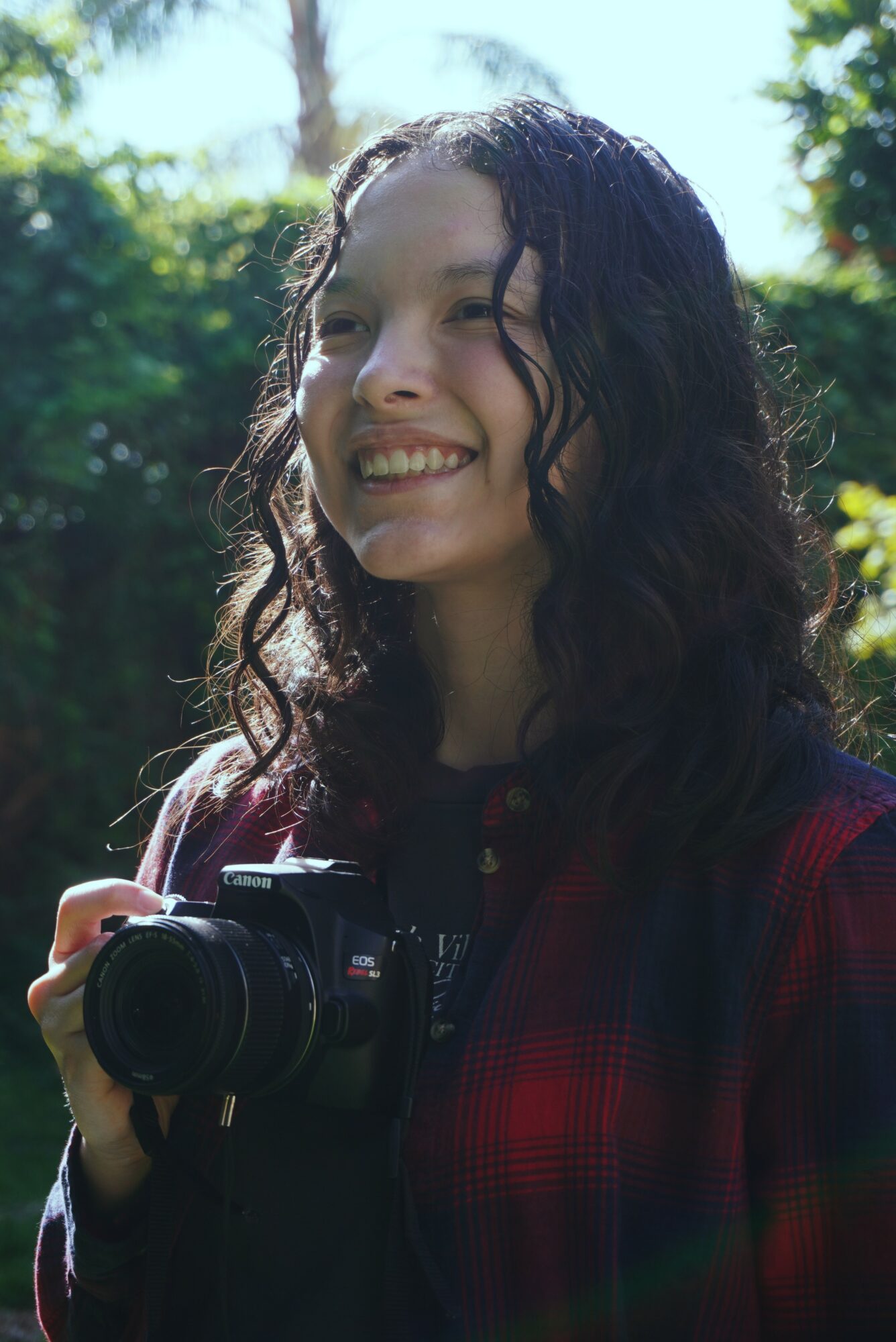
Today we’d like to introduce you to Adriana Chong.
Hi Adriana, so excited to have you with us today. What can you tell us about your story?
I’ve always been fascinated by lighting, cameras, studios, CGI, VFX, and visual storytelling. As a child, I simply didn’t have the words to describe it.
When my family moved to Mexico, I began photographing tourist spots wherever we went. Friends started complimenting my shots, which gave me the confidence to take photography more seriously. Around the same time, I began going to the movies more often. As we left the theater, I’d find myself wondering how every scene was captured. I understood image compositing and creating still montages, but video felt like an entirely new world. 24 photos per second, all in motion.
A turning point came during a hotel stay on the 5th floor. Looking down at the traffic below, I remembered long-exposure photos of light trails from car headlights. I researched how to create one with my phone, took the shot, and loved the result. That moment ignited my desire to pursue photography consistently.
I soon realized my phone’s manual controls and processing had limits. When I asked my parents for a proper camera, they challenged me to explain the fundamentals of photography and how a camera actually works. Even though I’d been experimenting on my phone, I struggled to articulate the concepts clearly. They suggested I take classes first. I agreed.
I started following photographers like Peter McKinnon and Hayden Pedersen, took the classes, and eventually received my first camera. I began carrying it everywhere. Before long, I was shooting for my high school volleyball team.
By then, I assumed I would study photography in college. While browsing program pamphlets, I discovered a BFA in Film, a major I didn’t even know existed. Already confident in photography, I decided to enroll in the Film program at SCAD.
On sets, I met some of my closest friends. The following summer, I completed an internship at a local TV station in Guadalajara, Jalisco. Eventually feeling stuck creatively in photography, I added it as a minor, which helped me break through my block. One professor’s class, experimenting with film, different lenses, filters, and color, made me fall in love with analog photography.
My growing passion for cameras and lighting led me to declare a second minor in cinematography.
A year before graduation, my family ran out of funds despite the scholarships I’ve been so fortunate to receive. Though returning to Mexico signaled a difficult financial struggle, it became a valuable opportunity for me to update my portfolio and social media with my SCAD work. My parents encouraged me to continue brushing up on topics I wasn’t 100% confident in and to start posting more actively.
On the side, I’ve collaborated with my sister on her projects. She’s an entrepreneur who occasionally bakes, makes cosmetics, and creates makeup content for social media. I photograph her products and help shoot her videos.
Once I moved back to Mexico, I started posting more seriously. My goal with social media is to make filmmaking feel accessible. Many people believe they need expensive lighting, cameras, props, or locations to create films. While good gear certainly helps, seasoned cinematographers will tell you that the story matters most. I want to prove that, and help others do the same. After just a year and a half, I’m proud that my content is already making an impact. The comments and messages I receive from people who are not only enjoying the videos but actually applying what they’ve learned mean everything to me.
Looking ahead, I want to keep building that impact through social media (I may even start vlogging), graduate, launch my own production company, and work as a Director of Photography on sets. Ultimately, I hope to put Honduran filmmaking on the map and show the world the talent and stories from where I’m from.
I’m sure it wasn’t obstacle-free, but would you say the journey has been fairly smooth so far?
If by “smooth” road you mean graduating on time and following my plans exactly as I had envisioned them, then no, it hasn’t been. But if I approach setbacks with a pessimistic attitude, I know I’ll never get anywhere.
Easier said than done, of course. There are moments when I do feel frustrated and stuck, when nothing seems to be working out. Still, I’ve learned that every struggle, just like every success, carries the potential for something new.
I’ve always loved new experiences, learning, and exploring different hobbies. So when things don’t go according to plan, I allow myself to feel the frustration for a moment, then consciously redirect that energy into something productive.
It also helps knowing that God has everything laid out for me. I believe He listens to my needs and desires, and as the ultimate Parent, He knows exactly what’s best for me and when I need it. That trust brings me peace amid uncertainty. (And if you’re not religious, the same logic applies to your own worldview, everything is going to be fine; it just might not be easy.)
The future is already there. How it unfolds depends largely on how we choose to approach it.
Can you tell our readers more about what you do and what you think sets you apart from others?
My work on set is primarily focused on cinematography. I’m especially drawn to projects that give me the freedom to be creative and experimental with both camera work and lighting. Some of my biggest references include Avatar, Interstellar, Euphoria, Sinners, Ugly Stepsister, and Nosferatu, among others. Other than narrative projects, I’d also love to work on music videos.
Off set, my current focus is creating social media content. As I mentioned earlier, I break down technical filmmaking concepts in an accessible way. I’m planning to expand this soon by incorporating more creative and experimental work as well.
I’m proud of several milestones in my journey. One of the most memorable experiences was working on the thesis film A Bowerbird, directed by Mylo Victor. We shot roughly 90 scenes over three intense days, working full 12-hour shifts. What made it special wasn’t just that many of our close friends were on the crew, but how smoothly everything ran through constant communication and teamwork. While one group built a set, another was tearing a different one down, and yet another was actively shooting. It was inspiring to watch the entire production flow like a well-orchestrated machine.
I’m also proud of the impact I’m making through social media. Knowing I’ve helped even one person improve their craft makes all the effort worthwhile.
On the creative side, I take pride in my photography. I often draw inspiration from my peers, classmates, and online sources, then reinterpret those ideas into my own work, and I’ve been really satisfied with the results.
Finally, I’m proud of the short films I’ve directed and shot. The more I create, the more I appreciate what my team and I can accomplish together. My latest short, Portrait of a Dog, is now available on YouTube. For this project, I balanced directing and shooting the film itself, producing a behind-the-scenes video, and completing the actual dog portrait that inspired the story.
What sets me apart is my intricate, detail-oriented way of thinking. I constantly ask “why” and “how” until I have a clear vision of how every element should work. When approaching a project, I think through the entire lifecycle of the film, from pre-production to post. As a DP, that means when I imagine a shot, I’m already considering the camera, settings, file format, codec, crew needed, how the editor and colorist will handle it, how sound design can elevate the scene, and how I can collaborate with the art department for more meaningful visuals. I also focus on creating smooth communication across departments.
I’ve noticed that producers and directors sometimes overlook parts of this bigger picture. Bringing this holistic mindset into the workflow consistently leads to stronger, more successful productions. That’s why, in my role as Director of Photography, I make a point to consider pre-production, production, and post-production holistically, looking for ways I can contribute, directly or indirectly, to ensure everything runs as smoothly as possible.
We’d love to hear about how you think about risk taking?
Taking my worldview into account, I don’t have much fear of taking risks. As I’ve mentioned, I believe God has everything laid out for me, I just have to live it. Beyond that, I’m always open to the interesting experiences, stories, and lessons that come with stepping outside my comfort zone.
That said, I don’t take risks blindly. I carefully evaluate the pros and cons of each decision. Once my analysis is done and I’ve committed to a path, the risks no longer hold me back.
One of the biggest risks I’ve taken was moving to Mexico. It completely changed our lives, and the outcome could have gone either way. Yet that move played a pivotal role in my development. It helped me discover my deep interest in visual art. Without it, I might never have pursued this path.
Studying film is also a significant risk in the Latin American context. While we represent a huge audience, Latin American filmmaking still isn’t widely consumed on a global scale. That’s exactly why part of my mission is to help build bridges, to seek out, create, and strengthen opportunities that expand the reach and recognition of Latin American cinema.
Contact Info:
- Website: https://sites.google.com/view/adrianamchongg/adriana-melissa-chong-garc
- Instagram: https://www.instagram.com/shotby.adri
- Youtube: https://www.youtube.com/@adrianachong
- TikTok: https://www.tiktok.com/@shotbyadrim


Image Credits
On-set photos taken by Jack Easterhaus
Popular
-

Hidden Gems: Local Businesses & Creatives You Should Know
-

ATL’s Most Inspiring Stories
-

How Cameron Zabko Is Helping Families Build Financial Confidence Through Trust, Planning, and Meaningful Conversations
-

Portraits of Atlanta
-
Nury Crawford is Helping Writers Discover That Their Voice Already Matters
-

Why Tiyonna Griffin Believes Confidence Is the Most Beautiful Thing You Can Create