

Today we’d like to introduce you to Ashley Rader.
Ashley, we appreciate you taking the time to share your story with us today. Where does your story begin?
I’ve always been creative, but I definitely didn’t have some perfectly mapped-out plan to become a full-time artist. My background is actually in marketing, branding and design, and for a while I worked around interior design and architecture as well. Looking back, I think all of those things ended up shaping the way I approach art now, especially the way I think about scale, composition and how a piece actually lives in a space.
Painting was something I kept coming back to, and eventually it became the thing I couldn’t ignore. I started Rader Art Studios and really just began putting my work out there, saying yes to opportunities and figuring out the business side as I went. One opportunity would lead to another, and over time what started fairly organically turned into an actual career.
A huge turning point for me was having my solo exhibition, Emergence, at the Booth Western Art Museum in 2022. The museum also acquired one of my paintings, Magisterial, for its permanent collection, which was pretty surreal. Since then, my work has gone into private collections, licensing, auctions and different commercial projects, and I’ve had opportunities to work with my art in ways I never would have thought about when I first started.
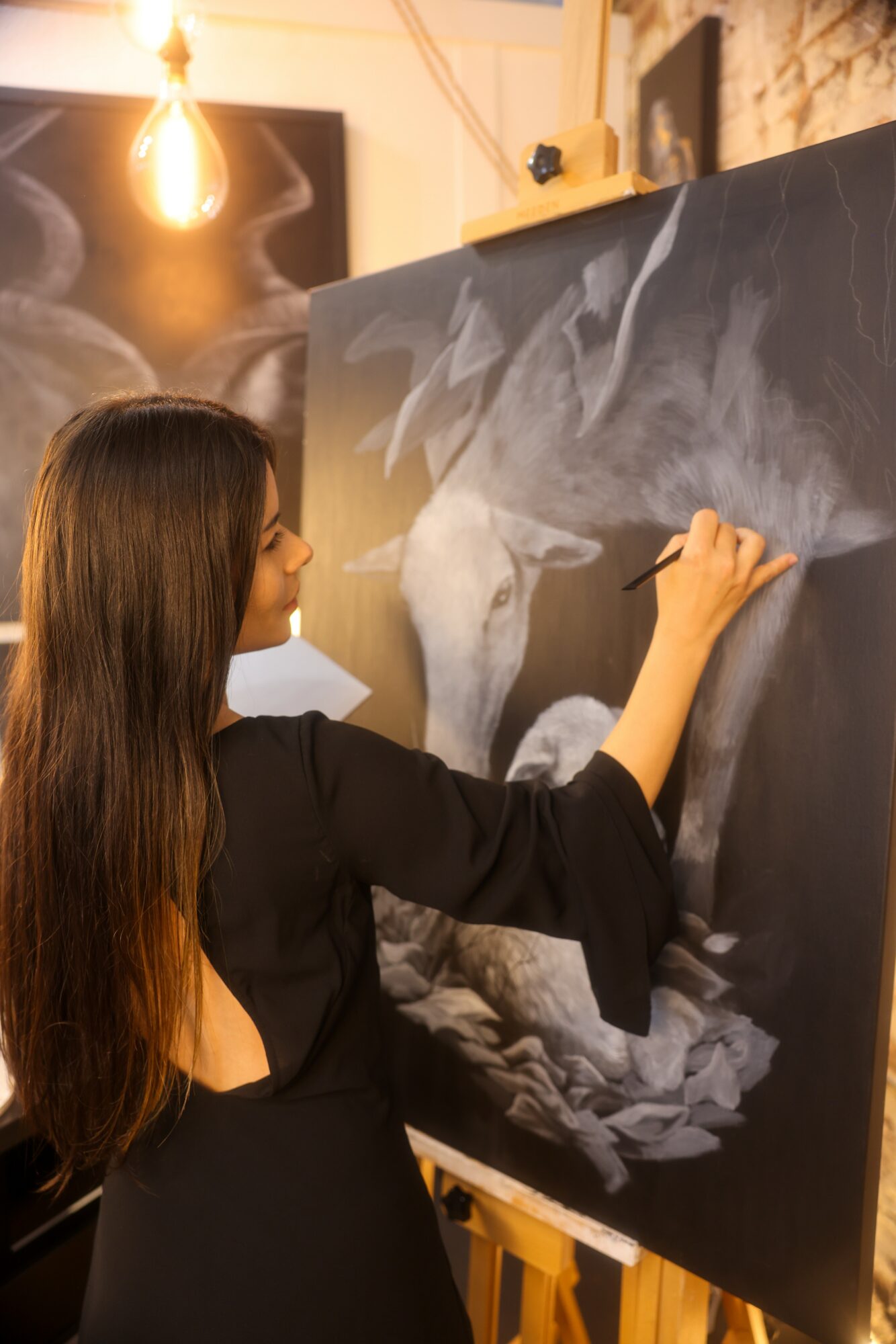
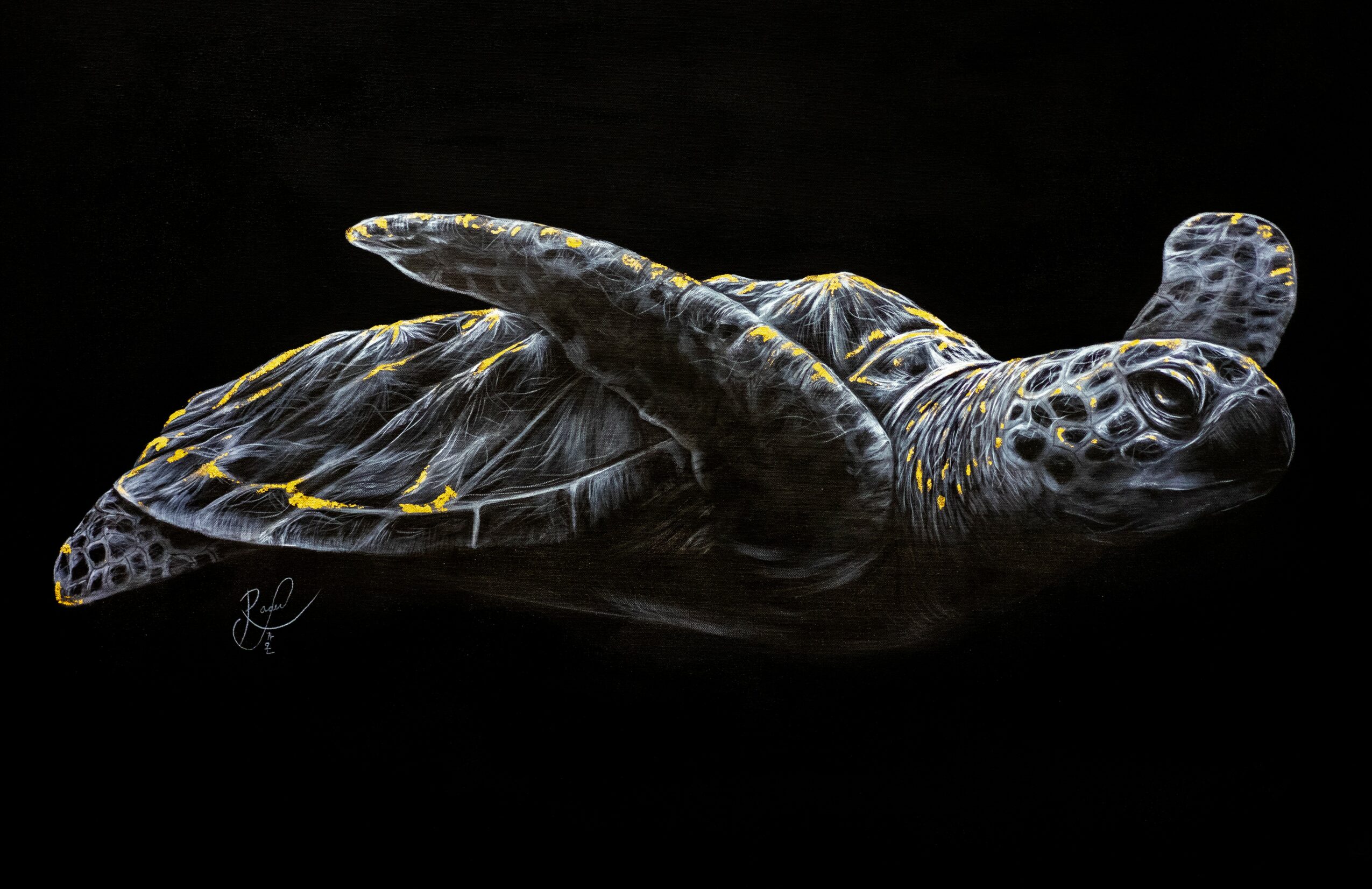
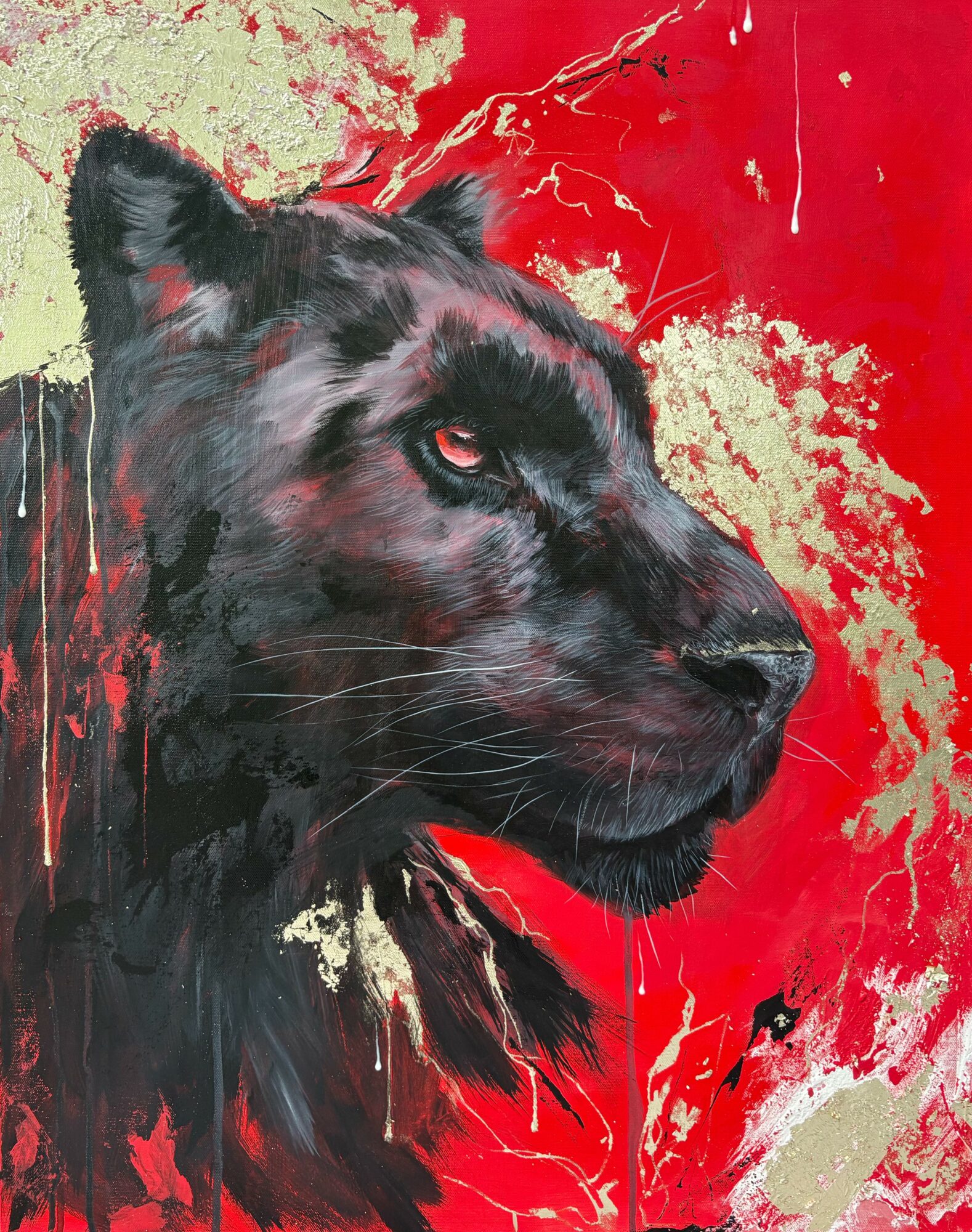
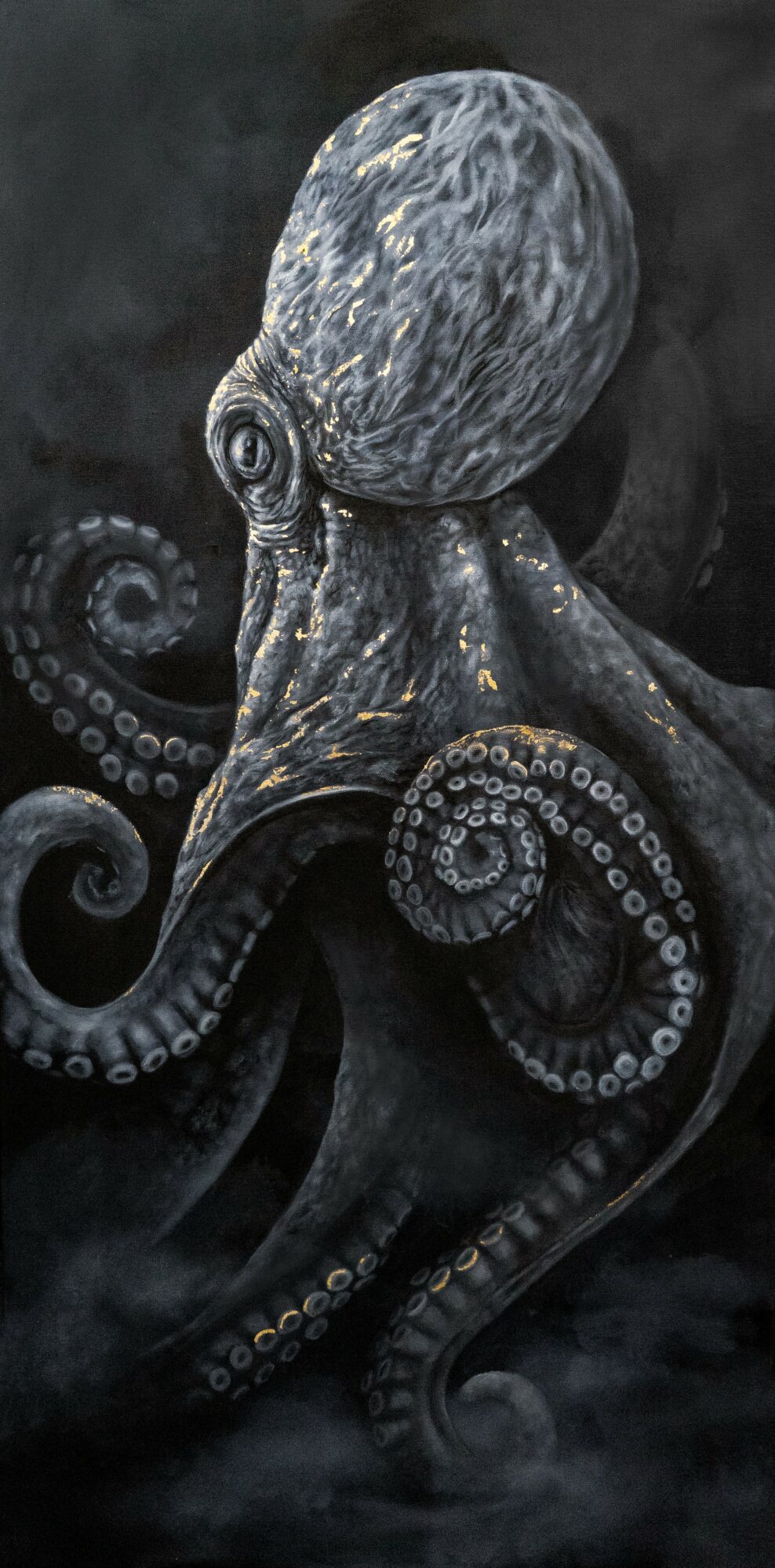
My work has evolved a lot too. Wildlife has always been at the center of it, but I’m constantly trying to push beyond simply painting an animal realistically. I love combining really detailed realism with abstraction, gold leaf, loose marks and unexpected materials. Lately I’ve been experimenting more with dimensional and sculptural elements and thinking about art through a design lens again, which feels a little like coming full circle.
I think where I am today came from being willing to evolve. I get bored doing the same thing over and over, so I’m always asking myself, “Okay, what can I do with this next?” Sometimes that probably makes my life harder than it needs to be, but I think it’s also what has kept me excited about making art.
We all face challenges, but looking back would you describe it as a relatively smooth road?
Definitely not. I think one of the biggest misconceptions about being a full-time artist is that once your work starts getting recognition, everything just sort of falls into place. It really doesn’t. You can have an incredible year, land an opportunity you’ve dreamed about, and still find yourself wondering what the next year is going to look like.
One of my biggest challenges has been learning how to be both the artist and the person running the business. Those are two very different jobs. I love creating. I could happily disappear into my studio and paint all day. The emails, marketing, pricing, contracts, shipping, social media and constantly figuring out where the next opportunity is coming from are a completely different story. I’ve had to learn a lot of that as I go.
There’s also a strange pressure that comes once people begin recognizing you for a certain style of work. Wildlife has opened so many doors for me, and I genuinely love painting it, but I never want to feel like I’m just reproducing a version of something I’ve already done because I know it will sell. I think some of my biggest creative struggles have actually come from pushing myself out of what is comfortable and allowing my work to change, even when I don’t necessarily know how people are going to respond to it.
And then there’s just life. I have a family, responsibilities and a life outside of my studio. I’m not in a season where I can disappear for three months and live somewhere for the sake of my art. I’ve had to figure out what being ambitious as an artist looks like while also being present for the people I love. My definition of success has changed because of that.
I think I’ve learned not to expect a smooth road anymore. There are really exciting highs and some very humbling stretches in between. I’m still figuring things out all the time. The difference now is that I trust myself a lot more. If something isn’t working, I know I can pivot, make something new, or find another way forward.
Thanks for sharing that. So, maybe next you can tell us a bit more about your work?
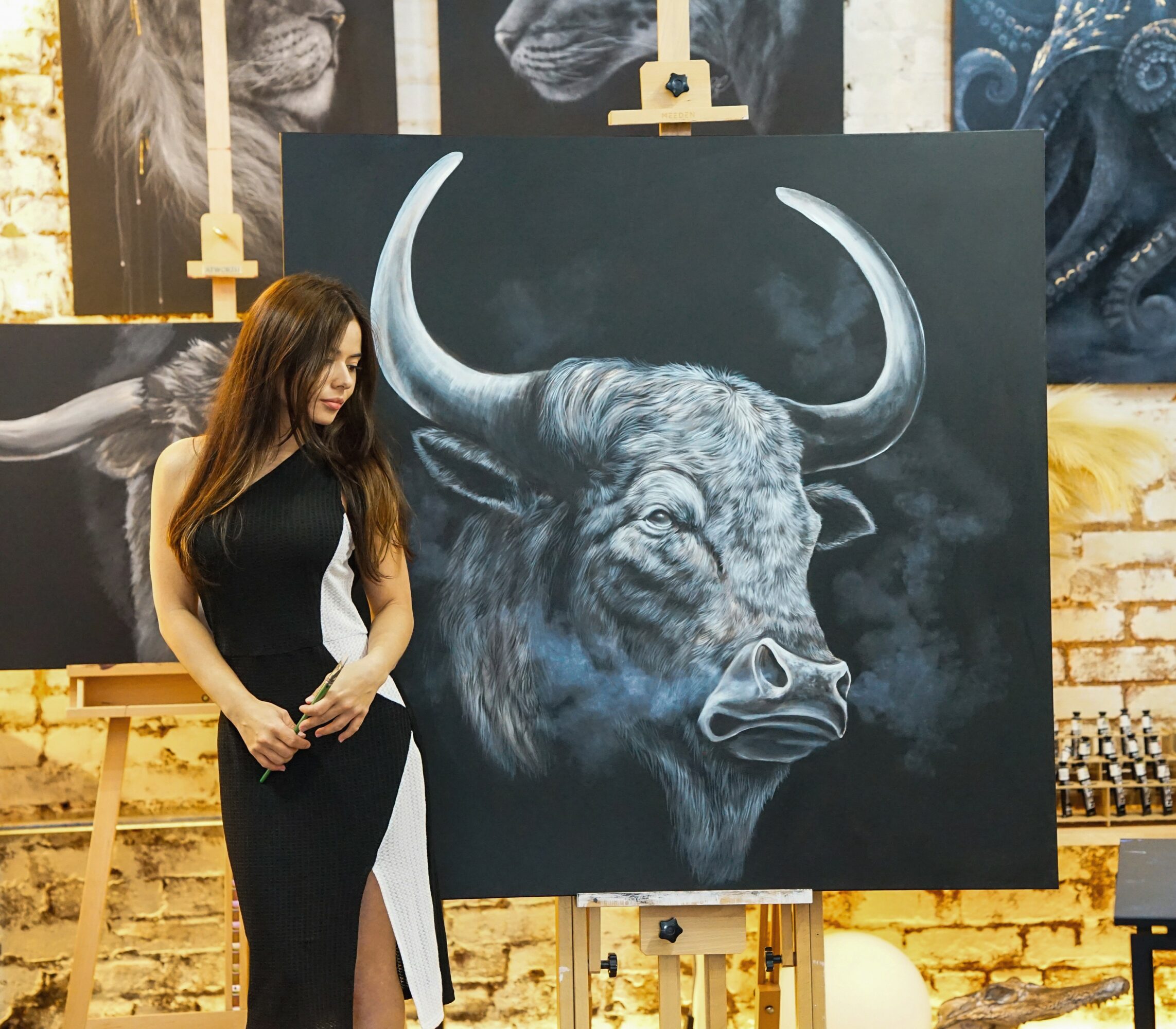
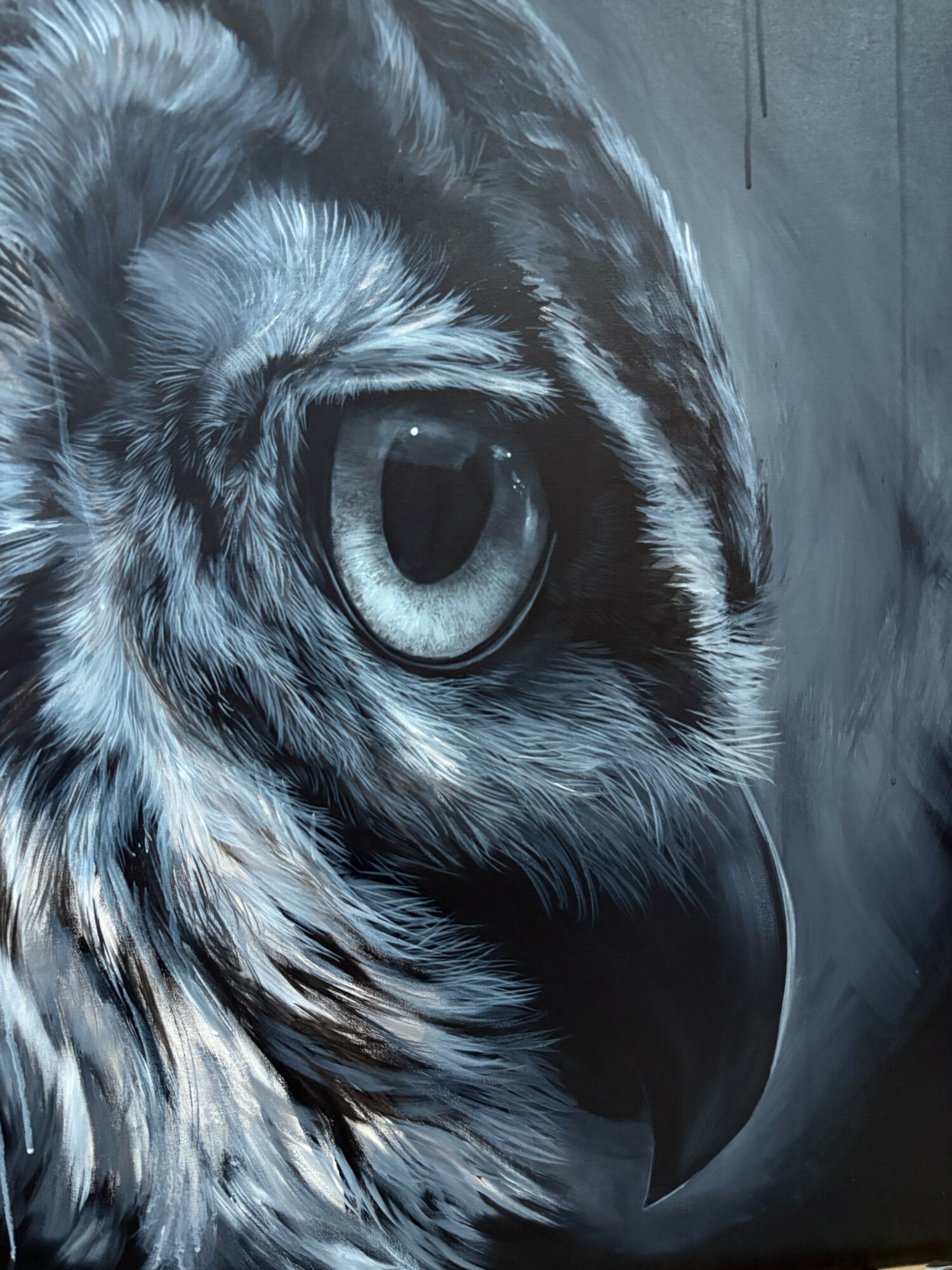
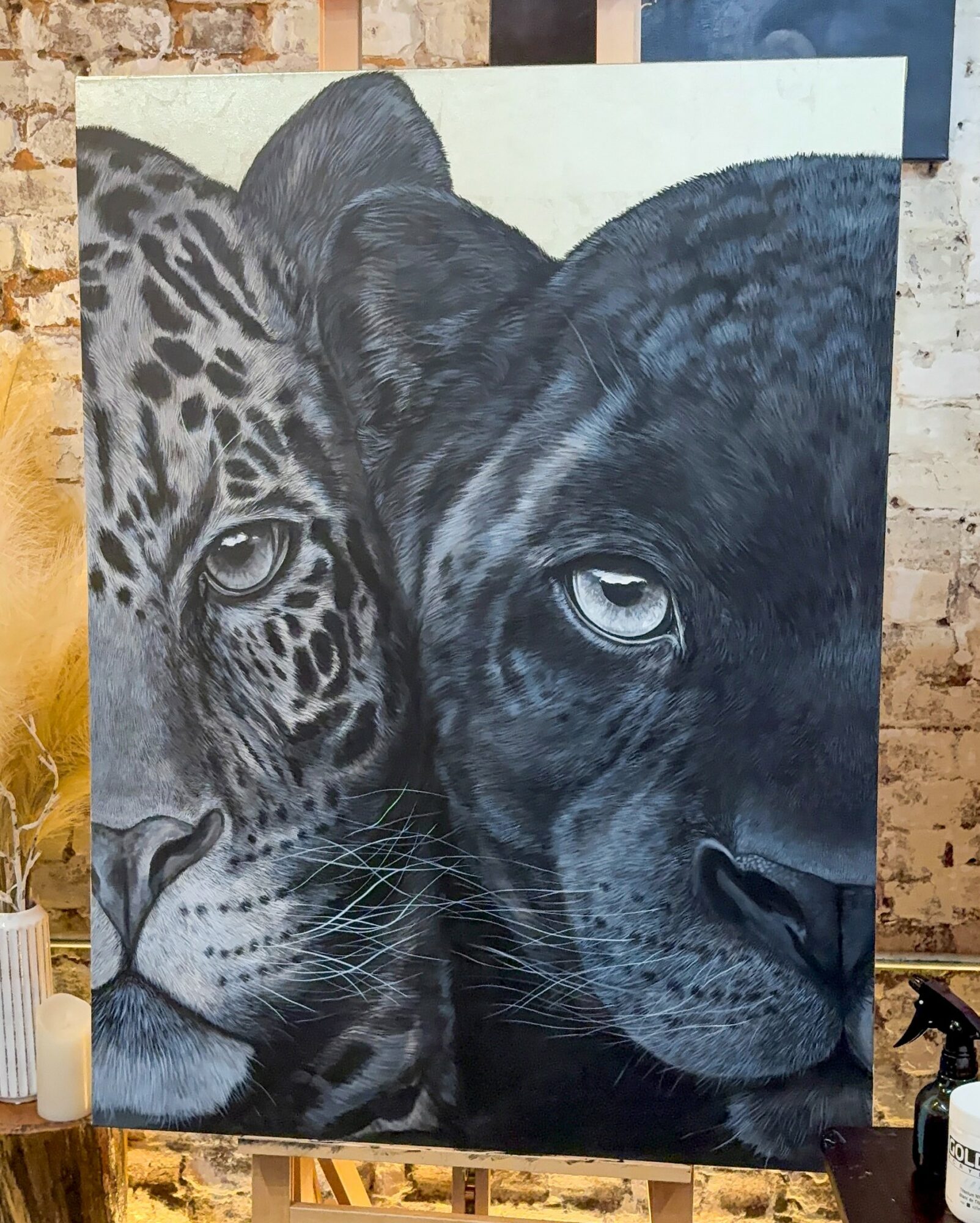
I’m a contemporary wildlife artist, and my work really lives somewhere between realism and abstraction. I’m probably best known for highly detailed wildlife paintings with a lot of contrast, expressive marks and gold leaf. I love creating an animal that feels almost photographic in certain areas and then letting other parts completely break apart into drips, texture, loose brushwork or abstraction.
Wildlife has always been the subject I’m most drawn to, but I’m less interested in simply painting a beautiful animal than I am in capturing its presence. I want you to feel something when you’re standing in front of it. A lot of my work is oversized for that reason. There’s something completely different about standing in front of a six-foot animal looking back at you.
I also think my design background sets me apart in the way I approach a painting. I’m constantly thinking about negative space, scale, color and how the work is going to interact with the room around it. I don’t really separate art and design in my head. Sometimes I’ll literally look at a blank canvas and think about what I would want to see on that wall if I were designing the entire space.
I’m probably most proud that I’ve built a body of work that people can recognize as mine. That means more to me than I realized it would. Having a solo exhibition at the Booth Western Art Museum and having Magisterial become part of their permanent collection will always be incredibly special to me, but I’m equally proud that I haven’t let those accomplishments make me afraid to change.
Right now I’m experimenting a lot. I’m bringing more texture and dimensional elements into the work, playing with sculptural relief, different materials and ways of letting pieces extend beyond what you expect from a traditional painting. I’m also really interested in the relationship between art, interiors and hospitality. I think there’s a much bigger world there that I’m just starting to explore.
If there’s something that sets my work apart, I hope it’s that combination of discipline and unpredictability. I can spend an absurd amount of time rendering an eye or a tiny section of fur perfectly, and then turn around and throw paint across it. I think I’ve gotten to a point where I’d rather enjoy the process and experiment than feel restrained by a certain style or by what I think I’m supposed to be making. I get bored when things become too predictable, so giving myself that freedom is a big part of what keeps me excited about my work.
What quality or characteristic do you feel is most important to your success?
I think my ability to adapt has probably been the most important. I’m pretty comfortable figuring things out as I go, and I’m not afraid to change direction when something isn’t working. Being an artist requires a surprising amount of problem solving, both creatively and professionally, and I’ve learned not to get too attached to one version of what my career is supposed to look like.
I’m also naturally curious. If I see a material, technique or even an entirely different industry that interests me, I want to understand how it works and figure out whether I can bring some part of it into what I’m doing. I think that’s why my background in marketing and design still shows up in my work today, and why I’m constantly experimenting in the studio.
I’ve definitely had moments where things didn’t go the way I expected, but I’m pretty good at asking, “Okay, so what can I do with this instead?” I think that mindset has helped me more than trying to follow some perfect plan ever could.
At the end of the day, I don’t think success in a creative career comes from having everything figured out. For me, it’s been about being resourceful, staying open to new ideas and being willing to keep moving when the direction changes.
Contact Info:
- Website: https://www.raderartstudios.com
- Instagram: https://www.instagram.com/raderartstudios.com
- Facebook: https://www.facebook.com/raderartstudios.com
Popular
-

Hidden Gems: Local Businesses & Creatives You Should Know
-

ATL’s Most Inspiring Stories
-

Portraits of Atlanta
-
Dr. Hildiah Martin-Suggs Is Building Second Chances for Youth Who Were Almost Lost in the System
-
From Showing Up to Seeing His Face on a Billboard: Anthony Green Is Just Getting Started
-
Wayne Smith Jr on Survival, Psychological Thrillers, and the Cost of Staying Alive