





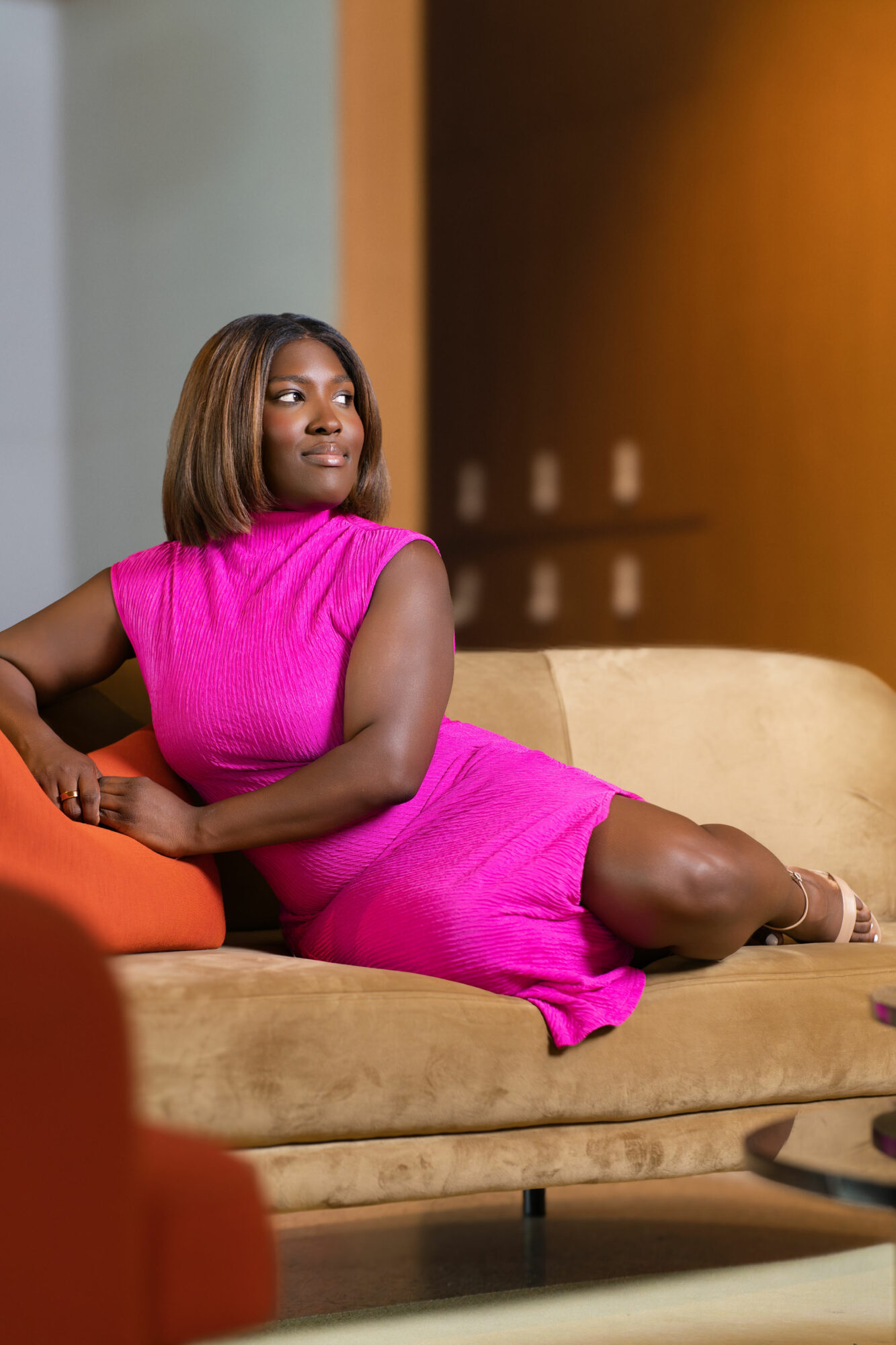
Today we’d like to introduce you to Najaah Reid.
Najaah, we appreciate you taking the time to share your story with us today. Where does your story begin?
Come on over and pull up a chair. I don’t have drinks, but I do have a story!
I’m shamelessly born and raised in Brooklyn and unapologetically New York: Think Flatbush Ave, Empire Roller Skating Rink, Labor Day on the Parkway. Knicks in five. You get it.
I’ve always been wildly ambitious and twice as audacious. If you let my middle school friends tell it, I was walking around in eighth grade carrying a college business textbook because I had already decided I needed (and would) be successful no matter what I did. Did I understand everything in that book? Absolutely not. But the vision was there. I had the plan; I just needed the platform.
Fast-forward to college: still spunky, still audacious, but with absolutely no idea how to navigate the professional world. I joined my first community organization, Women in Business, where I met my longtime best friend, Jovi. She taught me one of my earliest adult lessons: access to experience and exposure will get you much further than trying to guess your way through everything alone. Being able to watch the experiences of my peers through things as small as how they networked to as large as interview and study prep for internships flattened that learning curve in little to no time. I didn’t have many people around me with that skill already in place, so being close to the action was the start of a very humbling, but necessary adventure in my personal development.
I stepped it up a couple of notches thanks to that first community, and got just enough seasoning on me to produce a pretty solid background. A few years later, at my next telecom company, I met one of the best people and colleagues ever, Fred. Fred taught me lesson number two: if you’re going to talk about it, be about it. I kept saying I wanted to work in operations, and his response was essentially, “Then stop waiting for somebody to give you an operations job. Go create one.” I didn’t have a thing to lose, besides, to his point who was REALLY going to stop me?
At 22, I built a national territory-mapping system out of Google Maps that organized our company’s real estate acquisition sites across North America. It was something no one had asked me to build and, at the time, wasn’t really a defined function. It became one of my proudest early-career accomplishments and helped me prove I could do the work I kept saying I wanted to do. The amount of fanfare and accolades I received from something that was just an annoying problem I wanted to solve to make my job easier was…incredibly validating .Apparently, Fred was onto something.
That “who was really going to stop me?” mentality became the blueprint from there. I built a career spanning operations, project management and strategy, and eventually turned that same energy toward entrepreneurship. Real estate, property management, construction, consulting—and even a little healthcare investing along the way—I kept finding new ways to build, solve problems and create my own lane. One thing about me: I’m going to find something to do.
And in my continued audacity to do something bigger, Houston started calling. Naturally, I answered and made the big move down there to expand my business and Houston taught me lesson number three.
I’d spent most of my life being the person in the room saying, “We can do this. We can make it bigger.” Houston put me around entrepreneurs, mentors, friends and eventual business partners who looked back at me and said, “We can do bigger than THAT.” That challenged me to raise my own ceiling, to stop asking only what’s possible? and start asking, how big am I actually willing to bet on myself?
Eventually, my adventures brought me to Atlanta. Over the last three years, I’ve found my way into several of Atlanta’s ecosystems, doing what I naturally do: connecting dots, moving ideas forward, putting the right people in the right rooms and making a meaningful splash in the corners of this city I’ve been fortunate enough to call mine.
And somehow, all of this madness makes perfect sense in hindsight. I’ve had a plan at every stage, but I’ve never been afraid to change the route. Every chapter expanded my idea of what was possible, and every version of me has always been willing to bet on the next one. I’ve been practicing the art of the pivot long before I ever gave it a name.
Can you talk to us a bit about the challenges and lessons you’ve learned along the way. Looking back would you say it’s been easy or smooth in retrospect?
Absolutely not. Not a chance! Life was definitely set on hard mode with a few buttons missing from the controller.
There was plenty of character development courtesy of financial and housing instability growing up. By the time I got to college, I was toggling back and forth between trying to survive and chasing that long-term ambition. I worked full-time to keep a roof over my head while going to school full-time at one point juggling two full-time jobs while being a full-time student.
My back was definitely against the wall in adulthood, too. I’ve had to rebuild financially, personally and professionally more than once. I’ve had moments where I was exhausted, moments where the life I knew I was capable (and deserving) of building felt deeply far away, and moments where I genuinely wondered if I was ever going to get out of whatever season I was in. I thought my lucky girl syndrome had finally hit the end of the road.
But here’s the weird thing: I don’t think I ever struggled to believe I would become something. I’ve always had an almost unreasonable belief in myself. My struggle was figuring out how to get from where I was to where I knew I could be. The best analogy I have is Who Wants to Be a Millionaire?
Imagine you’re at $900,000. The million-dollar question comes up, you have absolutely no idea what the answer is, and you’re down to your last lifeline: Phone a friend. I’ve spent different chapters of my life staring at my own million-dollar questions. And somehow, when I’ve been down to my last lifeline, I’ve always had someone I could call.
A friend who reminded me who I was. Someone who knew something I didn’t. Someone who opened a door. Someone who gave me perspective when mine was shot. Someone who said, “Bet on yourself,” and then did something even more meaningful: They bet on me too.
I’ve done a lot of difficult things to build the life I have today, and I’m incredibly proud of myself for that. But I would never tell my story as though I did it alone. I didn’t. There’s something incredibly powerful about having people around you who don’t just cheer when you win, but sit beside you while you’re still trying to figure out the answer.
I’ve been fortunate enough to have people like that throughout my life. And every time I’ve had to phone a friend, somebody picked up.
Alright, so let’s switch gears a bit and talk business. What should we know?
Allow me to introduce you to The Pivot.
If you haven’t figured it out by now, I’ve spent most of my life reinventing myself six ways to Sunday. And somewhere between my own pivots and years spent developing and participating in professional communities, I realized something: we celebrate people after the pivot, but we rarely create spaces for people while they’re making it.
The Pivot is a career-mobility community for mid-career professionals figuring out what’s next. Maybe you’re changing industries, moving into leadership, exploring entrepreneurship or heading back into corporate. We’re not here to convince you to make a move. We’re here to give you enough access and experience to make an informed decision for yourself.
We do that through curated, interactive workgroups designed around different career paths. And I’m a lifelong project manager, so when I say workgroup, I actually really mean a workgroup. Think laptops, sticky notes, whiteboards, real scenarios and actual professionals—not 87 PowerPoint slides and a networking happy hour. We want you to touch the work.
Depending on the career you’re exploring, in a workgroup with others you might respond to a mock negotiation email, navigate a technical platform, write a few lines of code, solve a real-world problem or simply watch someone experienced do what they do and ask every question that comes to mind. You can participate or spectate. The point isn’t to become an expert. It’s to get close enough to the work to decide whether you actually want it.
Maybe the answer is yes. Maybe it’s not yet. Maybe it’s absolutely not and thank God I figured that out before I blew up my life. All three are wins. What sets The Pivot apart is a belief I’ve carried throughout my own career: access to experience is currency. Information is everywhere. You can Google it, buy a course or ask AI. What is harder to find is trusted access to the people, tools, conversations and lived experiences behind that information.
I’m most proud that The Pivot doesn’t require you to have yourself figured out before you walk through the door. We’re not waiting at the finish line to applaud your pivot. We’re building the room where you figure it out.
Risk taking is a topic that people have widely differing views on – we’d love to hear your thoughts.
Throughout my life, my mentality has pretty consistently been go big or go home. I’ve always been a bit of a gambling girl because I genuinely believe growth sits on the other side of discomfort, and getting there almost always requires some level of risk. I think when people delay a big decision, they’re usually waiting for one of two things: more time or more information. I’m 1000% an information girl. Give me enough information to understand what I’m getting myself into, let me calculate the downsides, and quickly I’ll reach a point where I know enough. And once I get there, then it’s “fuck it, we ball”. We’re doing it and we’ll figure out whatever comes next.
That mentality has led me to make some pretty significant bets on myself. I’ve packed my life into my car and moved across the country. I’ve walked away from a life I’d known for years because I knew I needed something different. I’ve invested a substantial amount of my own money into ventures I had no choice but to trust and repeatedly chosen paths where the outcome wasn’t guaranteed. Some have paid off tremendously. Some have come with VERY expensive character development. But I don’t regret being willing to make the bet.
I think risk is a necessary evil, not because risk itself is inherently bad, but because uncertainty makes people uncomfortable. Sometimes though, the bigger risk is complacency. We spend so much time calculating what could happen if we change direction that we rarely calculate the risk of doing absolutely nothing. But eventually, you have to accept that you can know enough to make a decision without knowing exactly how the story ends. And personally, I’d rather take the risk of finding out than spend my life wondering what would’ve happened if I did.
Contact Info:
- Website: https://meetthepivot.com
- Instagram: https://instagram.com/najaahsade


Popular
-

Hidden Gems: Local Businesses & Creatives You Should Know
-

ATL’s Most Inspiring Stories
-

Portraits of Atlanta
-

Dr. Hildiah Martin-Suggs Is Building Second Chances for Youth Who Were Almost Lost in the System
-

From Showing Up to Seeing His Face on a Billboard: Anthony Green Is Just Getting Started
-

Wayne Smith Jr on Survival, Psychological Thrillers, and the Cost of Staying Alive