


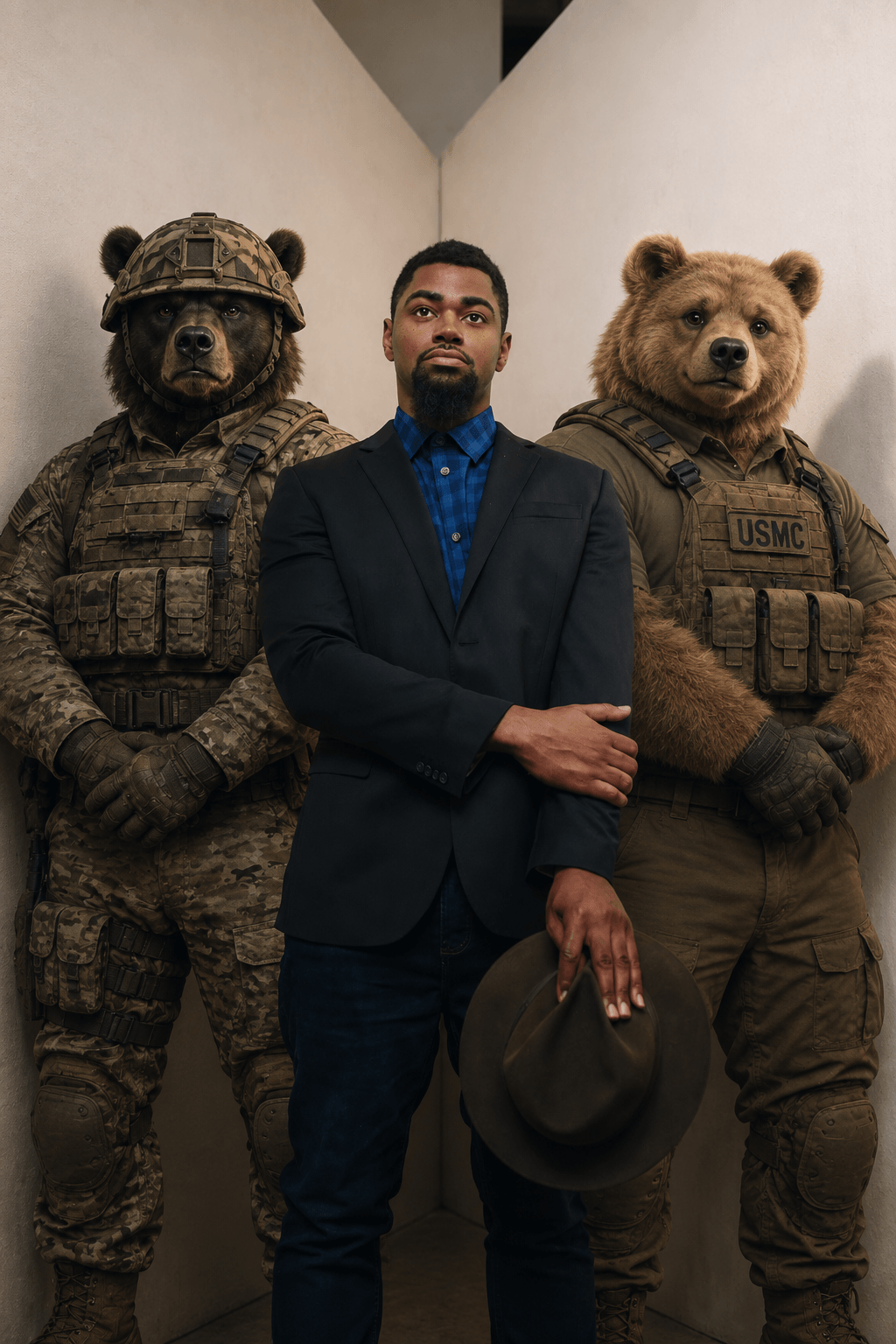
Today we’d like to introduce you to Cedrick Wiley.
Hi Cedrick, so excited to have you on the platform. So before we get into questions about your work-life, maybe you can bring our readers up to speed on your story and how you got to where you are today?
I learned very early that life is precious and not guaranteed. I lost my father to gun violence when I was four years old, but I was fortunate to be raised by a strong mother and surrounded by a village of men and women who helped shape me into the man I am today. The men in my life taught me the importance of protection, responsibility, providing for others, and being accountable for the people who depend on you. The women in my life taught me strength in a different form—empathy, intuition, nurture, resilience, and the value of what I’ve come to understand as the divine feminine. Together, those influences gave me a more complete understanding of strength, character, and balance.
As a young adult, I joined the United States Marine Corps, serving in infantry and communications roles and spending time in a combat environment. The Marine Corps cemented Honor, Courage, and Commitment as more than words for me—they became principles that I try to carry into how I live, work, and treat other people. Combat also deepened my appreciation for life and gave me a very different understanding of time. When you experience how quickly circumstances can change, you become much more intentional about how you use the time you have.
One of the ways I’ve processed and preserved those experiences has been through a graphic novel project centered on my time in combat, the realities of returning home, and PTSD awareness. It started as a way for me to make sense of my own experiences, but over the years I realized it could also help families understand what combat veterans sometimes carry home with them. I’ve been developing the project for more than 15 years, and as storytelling tools and technology have advanced, I’ve been able to rethink what it can become. What started as a graphic novel is now evolving into a broader series that uses visual storytelling to explore combat, memory, trauma, resilience, and the experiences veterans and their families often struggle to put into words.
After the military, I began developing another part of myself that had always been there: creativity. I earned my BFA in Illustration and later pursued graduate studies in Industrial Design, expanding into product development, CNC machining, digital fabrication, and 3D design. Throughout that journey, I also developed a deep passion for anthropology and the study of culture—how people live, communicate, build identity, create meaning, and influence one another. That interest naturally overlaps with both my art and design work, because I’m constantly thinking about the human experience behind what we create.
Professionally, my path has taken me through manufacturing and work with recognized technology companies, giving me the opportunity to combine technical problem-solving with creativity, adaptability, and the discipline I developed earlier in life. I’ve learned that I’m most fulfilled when I’m building something—whether that means a physical product, a visual story, a technological idea, or a new way of looking at a familiar problem.
That mindset has also pushed me toward creating my own platforms, brands, and technology-driven projects. I’m increasingly interested in work that sits at the intersection of design, technology, psychology, culture, and storytelling.
My journey hasn’t been linear, but the thread running through it has remained consistent. My mother and the village around me gave me my foundation, the Marines strengthened my character, combat changed my relationship with life and time, and art and design gave me a language for turning experience into something tangible. Today, I place a high value on meaningful relationships, creativity, curiosity, service, and using the time I have intentionally.
Alright, so let’s dig a little deeper into the story – has it been an easy path overall and if not, what were the challenges you’ve had to overcome?
It definitely hasn’t been a smooth road. Some of the biggest challenges in my life have involved loss, combat, transition, and learning how to rebuild different parts of myself.
Losing my father at a young age introduced me to loss before I really had the language to understand it. Years later, serving in combat brought a different relationship with mortality, responsibility, and trauma. Returning home also meant learning that leaving a combat environment doesn’t necessarily mean every part of that experience stays behind. Living with PTSD became part of that transition and forced me to better understand how combat can continue affecting the mind, body, relationships, and sense of identity long after the deployment ends.
One of the more difficult transitions was figuring out who I was outside of the Marine Corps. The structure, mission, and sense of identity that come with military service are very different from civilian life. I had to learn how to take the discipline, Honor, Courage, and Commitment that had become part of me and apply those values to a completely different environment.
Art became one of the ways I worked through that transition. My long-running graphic novel project began as a way for me to make sense of my own combat experiences and PTSD, but over time I realized it could also help families understand what combat veterans sometimes carry home with them. That project has stayed with me for more than 15 years and has continued evolving as both I and the available storytelling technology have evolved.
I’ve also had to navigate changing careers and identities—from Marine, to artist, to engineer, to working within major technology environments while continuing to build my own creative projects. Starting over in a new field can be humbling, especially when you know you’re capable but still have to become a student again.
Those challenges have taught me that resilience isn’t simply enduring difficult experiences. For me, it has meant being willing to examine them, learn from them, adapt, seek growth, and continue creating. I don’t look at PTSD, combat, or the difficult parts of my life as the entirety of my story, but they have given me a much deeper appreciation for time, relationships, purpose, and the opportunity to keep growing.
Alright, so let’s switch gears a bit and talk business. What should we know about your work?
My work sits at the intersection of art, design, technology, storytelling, psychology, and culture. I began as an illustrator, and after graduation I was selected by the Society of Illustrators, which was an important early recognition of my creative work. Over time, my practice expanded into industrial design, digital fabrication, 3D design, product development, and technology-driven storytelling.
Today, I work as an AI engineer for a major technology company, with a focus on behavioral anthropology—understanding how people interact with systems, environments, technology, and one another. That has become one of my main areas of specialization because it brings together several things I’ve always been drawn to: human behavior, culture, psychology, design, and technology.
My personal creative brand reflects that same range of interests. I explore fitness, design, anthropology, philosophy, PTSD awareness, and storytelling, often looking at the connections between physical discipline, identity, culture, trauma, resilience, and personal development. I’m interested in how people become who they are, what shapes their behavior, and how art and technology can help communicate those ideas in ways that feel meaningful and accessible.
One of the projects I’m most proud of is my long-running graphic novel and evolving series Gunny.Moto based on my experiences as a combat Marine and the realities of PTSD. I’ve been developing it for more than 15 years. It started as a way for me to make sense of my own experiences, but over the years I realized it could also help families understand what combat veterans sometimes carry home with them. As storytelling technology has advanced, the project has grown beyond the original graphic novel format and into something I now see as a larger storytelling universe.
What sets me apart is the range of experiences I bring into the creative process. I don’t approach problems only as an artist, designer, engineer, or veteran. I bring all of those perspectives together, along with a strong interest in anthropology and human behavior. That allows me to move between creative thinking, technical problem-solving, and understanding the people ultimately affected by what is being designed or communicated.
I’m most proud that my work continues to evolve without losing its core purpose. Whether I’m working with technology, visual storytelling, design, fitness, or PTSD awareness, I’m ultimately interested in understanding people more deeply and creating work that encourages reflection, connection, and a different way of seeing the world.
What do you like and dislike about the city?
I grew up in Georgia and, for a long time, Atlanta was the city I imagined myself living in. What I’ve always appreciated most is the history, culture, creativity, and influence the city has had—not just on Georgia, but nationally. As a native Georgian, there’s also a sense of familiarity and pride in seeing Atlanta continue to grow and evolve.
What I like least is something I’ve noticed as the city has changed. At times, Atlanta can feel more transactional than it did when I was younger, where people may first consider what someone does, who they know, or what value a connection can provide. I personally value character, authenticity, and getting to know people for who they are before thinking about what they may be able to offer.
That said, I still see Atlanta as a city with a lot of depth, history, creativity, and opportunity. I think the challenge is preserving the sense of community and genuine connection that helped make the city special in the first place.
Contact Info:
- Website: https://Stereotyp.ai
- Instagram: Wileystyle
- Facebook: Wileystyle
- LinkedIn: https://www.linkedin.com/in/cedrick-wiley-68b75971?utm_source=share_via&utm_content=profile&utm_medium=member_ios
- Twitter: Stereotyp_AI
- Youtube: WileystyleID




Popular
-

Hidden Gems: Local Businesses & Creatives You Should Know
-

ATL’s Most Inspiring Stories
-

Portraits of Atlanta
-
Peyten Williams Is Helping Parents Trade the Pressure of Perfect Parenting for Better Judgment
-

Dr. Hildiah Martin-Suggs Is Building Second Chances for Youth Who Were Almost Lost in the System
-
From Showing Up to Seeing His Face on a Billboard: Anthony Green Is Just Getting Started