
Today we’d like to introduce you to Leah Dalton.
Hi Leah, it’s an honor to have you on the platform. Thanks for taking the time to share your story with us – to start maybe you can share some of your backstory with our readers?
My path to The 109 Gallery grew out of my own work as an artist, curator, and organizer, and from a belief that meaningful contemporary art conversations don’t have to happen only in major cities.
While completing my MFA at the School of the Art Institute of Chicago, I was living and working in the Southeast, moving between very different cultural landscapes. That experience shaped how I began thinking about exchange, access, and what might be possible in a small Appalachian community.
I eventually founded The 109 Gallery in historic downtown Chickamauga, Georgia, as a contemporary art space rooted in place but connected outward. We bring together exhibitions, artist talks, poetry, performance, workshops, and community gatherings, creating opportunities for local and regional artists to be in dialogue with artists and ideas from across the country and internationally.
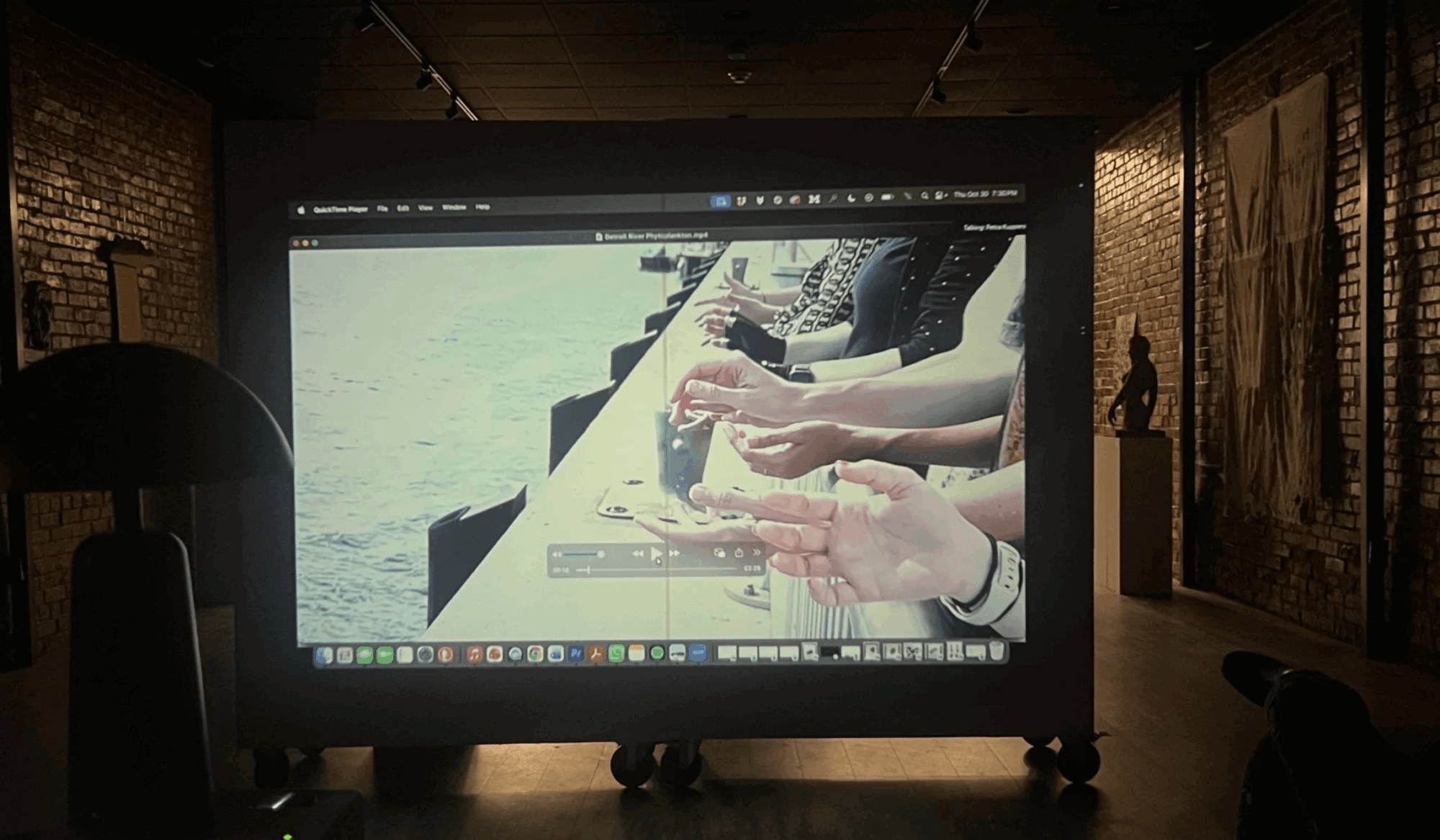
That same thinking led to the Chickamauga Art & Folk Festival, which brings contemporary practices into conversation with Appalachian traditions, artists, makers, music, and the life of the town. My curatorial work with Women Eco Artists Dialog (WEAD) has expanded those connections even further, particularly around ecology, the body, land, water, and how artists respond to the places and systems we inhabit.
It is also a tremendous amount of work. Building something like this in a rural community means wearing a lot of hats, learning constantly, and sometimes literally doing the physical work yourself. But I’ve also learned that community makes it possible. Artists, neighbors, collaborators, volunteers, and people who simply keep showing up have helped The 109 become something much larger than I could have built alone. There is a sense of family that is being created along the way,
I’m interested in what can happen when we stop thinking of rural places as being outside of contemporary cultural dialogue. The exchange moves both ways. The 109 is still evolving, and I think that openness, between local and global, tradition and experimentation, individual practice and community, is really at the heart of what I’m building.
I’m sure it wasn’t obstacle-free, but would you say the journey has been fairly smooth so far?
I don’t know that anything worth building is ever completely smooth. For me it has felt more like one of those bumpy dirt roads I grew up around, sometimes beautiful, sometimes muddy, and sometimes you genuinely can’t see very far ahead. You just keep going.
It is hard work. Really hard work. And sometimes the sheer range of it is wild. I can be sitting in an artist’s studio talking deeply about their work and what an exhibition might become, then writing a curatorial statement, meeting with a collector, working on a grant, building a newsletter, or making the flyer because, well, somebody has to make the flyer. There are board meetings, budgets, permits, partnerships, exhibitions being planned years out, and now the very real work of opening a café and wine bar.
Actually, as I’m writing this, an artist is downstairs installing a show and may call at any moment because they need my eye, another set of hands, or, apparently today, a fork. I’m hunting down funder logos with my collaborators at WEAD for a 2027 exhibition. The City has asked me to help think through the rehabilitation and public art possibilities for our historic water tower. I need to get across town to work on auction pieces for the Sculpture Fields gala, and there is an interview about data centers, land, water, and our region that I need to get to. I’ve also needed to pee for an unreasonable amount of time. Somewhere inside all of this, I am a mother raising a teenager and an artist trying to protect the quiet necessary to make my own work.
The work moves between full rooms of people and very long hours alone. It can move from conversations about art, ecology, land, and what we want our communities to become, to me being on my knees scraping stubborn paint droplets off the gallery floor. Sometimes I catch myself down there with a bucket and just start laughing. What on earth am I doing?
There is easily enough work here to keep four to six people busy, and one of the harder lessons has been realizing that the answer cannot always be for me to work harder. I’m learning about capacity, when to ask for help, when something needs a better system instead of another hour of my time, and how important it is to build a network of people who carry things together.
That may actually be the biggest challenge and the biggest gift of it. You start out thinking you are building a gallery, and then realize you are building relationships, infrastructure, trust, and community at the same time. None of that happens quickly.
So the road is definitely bumpy. It can be exhausting, exciting, messy, funny, and occasionally held together with whatever happens to be within reach. You have to laugh. And you have to have people beside you.
Can you tell our readers more about what you do and what you think sets you apart from others?
I think of my work as an artist first, but it has expanded into curating, organizing, writing, and building spaces for other artists and communities to encounter one another. Increasingly, I’m interested in the places where those roles overlap rather than trying to separate them.
My own studio practice is interdisciplinary and rooted in the body, ecology, care, intimacy, land and water and plastic, and the ways we encounter one another and the more-than-human world. I work across installation, performance, sculpture, writing, and research, often collaboratively. That way of thinking carries directly into my curatorial work. I’m less interested in simply putting objects in a room than in what happens around them, what conversations they create, who enters the space, and what relationships might continue afterward.
The 109 Gallery has become one of the places where all of those interests can meet. We are in historic downtown Chickamauga, Georgia, within the greater Appalachian region, and I care deeply about being rooted here while creating genuine exchange beyond it. I want regional artists to have serious contemporary platforms without feeling that they have to leave where they come from to participate in larger conversations. At the same time, it has been pretty remarkable to have artists from New York, Boston, Los Angeles, Italy, and elsewhere wanting to show work in this small Georgia town.
One of the projects I’m particularly proud of is my curatorial work with Women Eco Artists Dialog (WEAD). Our recent collaboration connected women artists from 38 cities, 17 states and provinces, and four countries. Some were able to physically exhibit here, while others participated through the online exhibition. To me, that is exactly the kind of exchange I want to keep building, not a one-way idea of bringing contemporary art into a rural place, but a network where artists and ideas from here move outward while artists and ideas from elsewhere move in.
I’m also proud of the Chickamauga Art & Folk Festival because it approaches that exchange from another direction. Folk practices, contemporary artists, makers, music, local businesses, families, and visitors can occupy the same space. I don’t see Appalachian heritage and contemporary practice as opposites. There is enormous knowledge, experimentation, storytelling, material intelligence, humor, and invention already embedded in this region.
That thinking increasingly moves beyond the walls of the gallery too. I serve on arts boards and committees, work collaboratively around public sculpture and environmental art, and am becoming more involved in civic conversations around how our communities develop and care for the places we inhabit. Sometimes that means an exhibition, sometimes a festival, sometimes a conversation around land and water, and sometimes helping a small city imagine what an old water tower might become.
I’m probably most proud of the connections forming between all of it. An artist meets another artist. Someone who has never entered a contemporary gallery walks through the door. A local teenager encounters a kind of work they didn’t know existed. An artist hundreds or thousands of miles away wants to participate in something happening in Chickamauga. A conversation begun through an exhibition becomes a collaboration somewhere else.
I’m not particularly interested in building a little version of a big-city art world here. I’m interested in what can happen specifically here, from this landscape, history, and community, while remaining porous enough to be in dialogue with the rest of the world.
For me, the work is ultimately about encounter and connection, between bodies, disciplines, communities, landscapes, and ideas. Whether I’m making my own work, curating an exhibition, organizing a festival, or helping build a cultural space, that throughline remains pretty constant: create the conditions for something meaningful to meet something else, and see what becomes possible.
Any advice for finding a mentor or networking in general?
I think finding a mentor starts with understanding what conversation you are trying to join. Art is so much about conversation, not only historically, but in how we participate in and move those conversations forward now. Find someone within that dialogue, but ideally someone who approaches it differently than you do.
One of the most important mentors in my practice has been Julie Tolentino. As I began moving more deeply into the language and dialogues where I saw my work, it was critical to have someone who understood that territory from another angle. At one point Julie asked me, “Leah, have you ever thought about wrapping your sculptures as a performance?” Such a simple question, but it changed everything. Suddenly the act, the body, duration, and encounter could all be part of the work. It opened an entirely different way of understanding my practice.
We didn’t live in the same place, either. A mentor doesn’t need to be down the street or have the exact career you want. Sometimes they simply need to see your work clearly enough to ask the question you haven’t thought to ask.
I think about networking similarly. It isn’t collecting contacts, it is participating in conversations. Show up, visit studios, share opportunities, make introductions, be genuinely interested in what other people are building. Relationships grow from there.
Ask yourself what you are looking for, sure, but maybe more importantly: What do I think I know, and where are the gaps in what I don’t know? Find people who help you see into those gaps. Sometimes one really good question can change everything.
Contact Info:
- Website: https://www.the109gallery.com/
- Instagram: https://www.instagram.com/the109gallery/
- Facebook: https://www.facebook.com/people/The-109-Gallery/61573997223648/


Popular
-

Hidden Gems: Local Businesses & Creatives You Should Know
-
ATL’s Most Inspiring Stories
-

Portraits of Atlanta
-
Peyten Williams Is Helping Parents Trade the Pressure of Perfect Parenting for Better Judgment
-
Dr. Hildiah Martin-Suggs Is Building Second Chances for Youth Who Were Almost Lost in the System
-
From Showing Up to Seeing His Face on a Billboard: Anthony Green Is Just Getting Started